

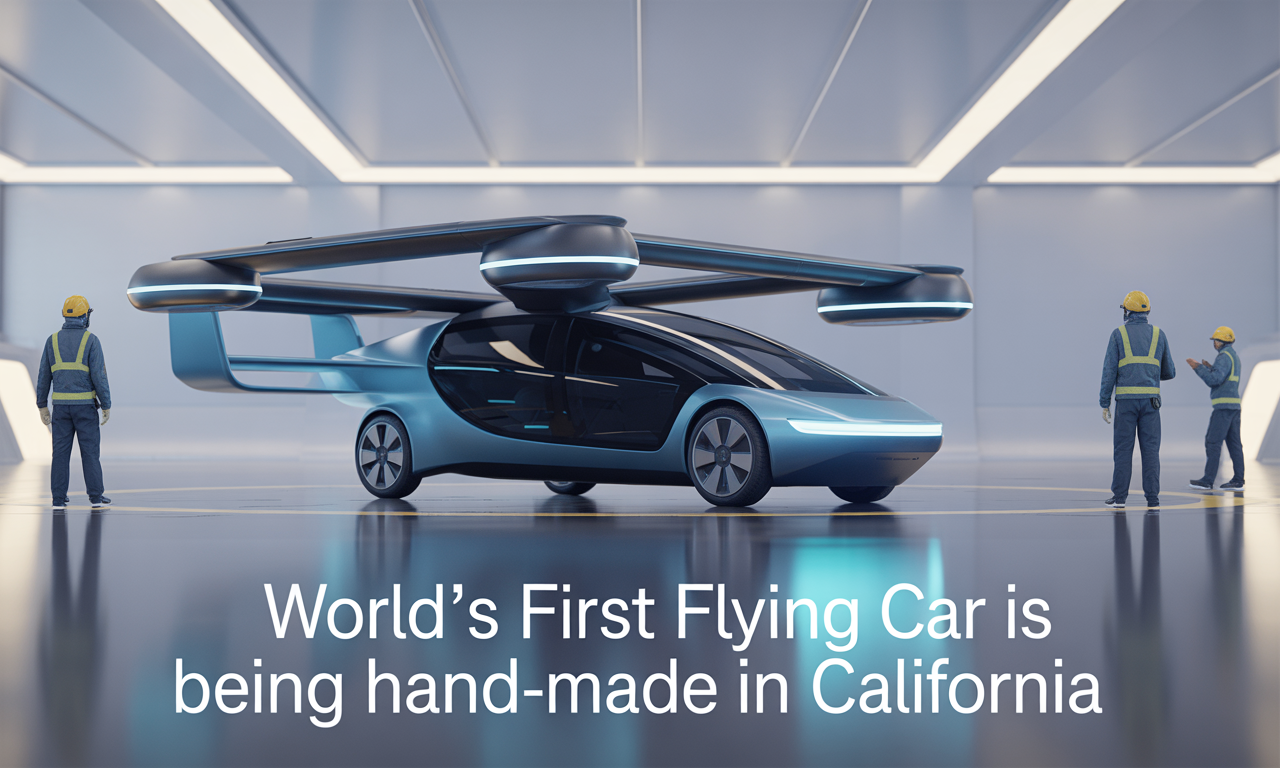
World’s First Flying Car Is Being Hand-Made in California
Intermediate | December 20, 2025
✨ 혼자서 기사를 소리 내어 읽거나 튜터를 따라 각 단락을 반복해서 읽으세요. 레벨...
Electric Flying Car California: Hand-Built Production Begins
From Sci‑Fi to a Real Factory Floor
For years, “flying cars” have sounded like a fun joke—something you’d see in The Jetsons, not on a production schedule. But in December 2025, California startup Alef Aeronautics said it has started building its first customer-bound vehicles at a facility in Silicon Valley. The early models are being hand-made and delivered to a small group of early customers for controlled real-world testing, according to reporting from Electrek.
What They’re Actually Building
Alef’s first vehicle is called the Model A, and the company says it’s fully electric and designed to work as both a road vehicle and a vertical takeoff aircraft. Electrek reports Alef claims the Model A can drive about 220 miles and fly about 110 miles on a charge—numbers that are impressive on paper, but still need to be proven consistently in real conditions (Electrek).
Why “Hand-Made” Matters
Early Builds Are Slow—On Purpose
If you hear “hand-made,” you might think luxury watches. In this case, it’s more about safety and learning. Industry site Revolution.aero reports Alef expects the first builds to take months, because early production involves rigorous testing of parts and many test flights. The company says it wants to optimize its process before moving toward more automated, mass production.
The Real Challenge: Regulations and Training
Even if the technology works, flying car operations depend on rules. In earlier coverage, Electrek noted that Alef’s vehicle received a Special Airworthiness Certification from the U.S. FAA for testing—an important step, but not the same as “anyone can fly this anywhere” approval (Electrek). Alef also says it plans to train and support early adopters, using feedback to improve the product and the safety process.
The Business Angle: Demand, Pricing, and Hype
Big Interest—Big Price Tag
Electrek reports Alef says it has collected 3,500 pre-orders—and claims that represents about $1 billion in demand. The expected starting price is around $299,999, with reservation options that include a smaller deposit and a more expensive “priority queue” spot (Electrek).
So… Is This the Future or a Very Expensive Beta Test?
Right now, this looks like a classic tech story: bold vision, limited early rollout, and a lot of learning in the real world. For businesses, the electric flying car California project is a signal that advanced mobility is moving from prototypes to early manufacturing. But it also reminds us that new industries don’t scale overnight—especially when safety, regulations, and public trust are involved.
Vocabulary
- Prototype (noun) – an early test version of a product.
Example: “The company showed investors a prototype before starting production.” - Milestone (noun) – an important achievement or stage.
Example: “Starting production is a major milestone for the startup.” - Manufacturing (noun) – making products in a factory.
Example: “Manufacturing began at the company’s facility in Silicon Valley.” - Hand-made (adjective) – built by people rather than automated machines.
Example: “The first vehicles are hand-made to support careful testing.” - Facility (noun) – a place designed for a specific purpose (like a factory).
Example: “The facility is located in Silicon Valley, California.” - Certification (noun) – official approval that something meets a standard.
Example: “The company received certification for certain testing flights.” - Rigorous (adjective) – very careful, strict, and thorough.
Example: “The company says it will do rigorous testing of parts.” - Pre-order (noun) – an order placed before a product is available.
Example: “Thousands of customers have placed a pre-order.” - Rollout (noun) – the release of a product or plan.
Example: “The rollout will start with only a few early customers.” - Scale (verb) – to grow from small to large production.
Example: “It will take time to scale production safely.”
Discussion Questions (About the Article)
- What does Alef say it has started doing in California?
- Why is the company building the first vehicles by hand?
- What are the claimed driving and flight ranges of the Model A?
- Why do regulations matter so much for flying cars?
- Do you think this is a realistic commuting product—or mainly a test phase?
Discussion Questions (About the Topic)
- What would need to change before flying cars become common?
- Should governments create special rules for new transport technology faster? Why or why not?
- How should companies balance innovation with safety?
- Would you personally trust an electric flying car? What would you need to feel confident?
- How might flying cars change cities, traffic, and real estate?
Related Idiom
“The proof of the pudding is in the eating” – you can’t judge something until you see real results.
Example: “Alef’s model looks exciting, but the proof of the pudding is in the eating once real customers start using it.”
Note: Many native speakers shorten this idiom to “the proof is in the pudding” in everyday conversation.
📢 Want more news-based English practice like this? 👉 Sign up for the All About English Mastery Newsletter!
https://allaboutenglishmastery.com/newsletter
Want to finally master English but don’t have the time? Mastering English for Busy Professionals is the course for you! Check it out now!
Follow our YouTube Channel @All_About_English for more great insights and tips.
This article was inspired by: Electrek and Revolution.aero.


 한국어
한국어  English