

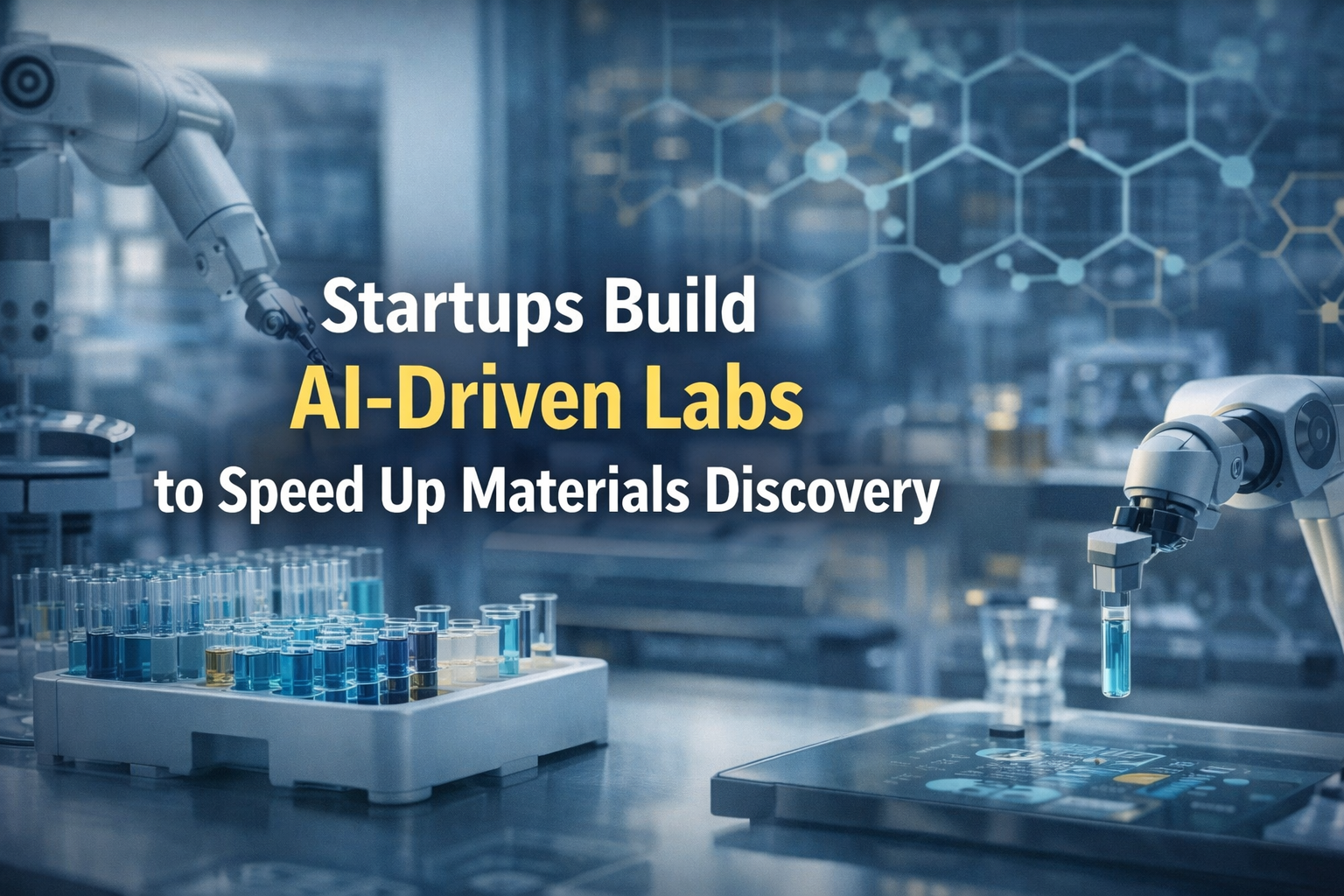
Startups Build AI-Driven Labs to Speed Up Materials Discovery
Intermediate | January 25, 2026
✨ 혼자서 기사를 소리 내어 읽거나 튜터를 따라 각 단락을 반복해서 읽으세요. 레벨...
Why AI-driven labs matter
New materials power almost everything we care about—better batteries, faster chips, lighter cars, stronger medical devices. The problem is that discovering and testing a new material can take years (or even decades) because lab work is slow, expensive, and full of trial-and-error.
That’s why AI-driven labs are getting so much attention. The idea is simple: let robots run experiments, let AI decide what to try next, and keep the lab moving 24/7. MIT’s materials community has highlighted this trend as startups push “AI-driven labs” into the real world. (MIT DMSE)
The startup bet: Turn labs into “science factories”
One example is Lila Sciences, which says it’s building “AI Science Factories”—automated facilities where robotic lab instruments run experiments continuously while AI systems plan and analyze the work. Reuters reported that Lila raised $115 million in extension funding, reaching a valuation of more than $1.3 billion. (Reuters)
From a business perspective, that funding is a big signal: investors believe faster discovery could become a real competitive advantage—especially in areas like energy and semiconductors. (Reuters)
What “automated” looks like in a real lab
This isn’t just a PowerPoint dream. At Lawrence Berkeley National Laboratory, the A-Lab is a fully automated lab that uses robots guided by AI to speed up materials science discoveries. It has worked with the Materials Project to help synthesize new materials with promising future applications. (Berkeley Lab News Center)
This is the practical side of AI-driven labs: machines handle repetitive steps, while AI helps choose the next best experiment—so scientists can focus on direction, strategy, and interpretation.
A proof point: 17 days, 57 targets, 36 successful compounds
A major research example appeared in Nature, describing an autonomous “A-Lab” that combines robotics, machine learning, and active learning to plan and interpret experiments for inorganic materials. Over 17 days of continuous operation, it successfully realized 36 compounds out of 57 targets. (Nature)
The paper explains how the lab proposes synthesis recipes using models trained on the scientific literature and then uses robotics to run and measure results—closing the loop by improving recipes when attempts fail. (Nature)
The big takeaway: Speed is rising, but reality still matters
The hype is real, but so are the challenges. A robot lab still has to deal with physical constraints—messy powders, equipment limits, and unexpected results that don’t match the computer’s predictions. That’s why the “real-world lab” part is the bottleneck many teams are trying to fix.
Still, the trend is clear: if automated labs can shorten discovery timelines—from decades down to a few years—companies that master this pipeline could “move faster” than competitors in batteries, electronics, and other high-stakes industries. (MIT DMSE)
Vocabulary
- Automated (adjective) – done by machines with minimal human effort.
Example: “An automated lab can run experiments overnight without staff.” - Autonomous (adjective) – able to operate and make decisions with little human control.
Example: “An autonomous system can choose the next experiment based on results.” - Synthesize (verb) – to create or produce a material or chemical.
Example: “Researchers synthesized a new compound for testing.” - Instrument (noun) – a tool or device used for scientific measurement.
Example: “Robotic instruments can measure samples quickly and consistently.” - Pipeline (noun) – a step-by-step process that moves work from start to finish.
Example: “A faster pipeline can reduce the time from discovery to product.” - Throughput (noun) – how much work can be processed in a given time.
Example: “Automation increases throughput by running more experiments per day.” - Bottleneck (noun) – the slowest step that limits overall progress.
Example: “Lab testing is often the bottleneck in materials discovery.” - Iterate (verb) – to repeat a process, improving each time.
Example: “The AI can iterate on recipes until it gets better results.” - Validate (verb) – to confirm something is correct or real.
Example: “The lab must validate predictions with physical experiments.” - Valuation (noun) – an estimate of what a company is worth.
Example: “The startup’s valuation rose after new funding was announced.”
Discussion Questions (About the Article)
- Why is discovering new materials often slow and expensive?
- What is the basic idea behind AI-assisted automated labs for materials discovery?
- Why might investors care about faster discovery in energy or semiconductors?
- What do the A-Lab results in Nature suggest about the potential of autonomous labs?
- What real-world challenges might keep “self-driving labs” from being fully hands-off?
Discussion Questions (About the Topic)
- Which industry do you think would benefit most from faster materials discovery (batteries, chips, medicine, construction, etc.)? Why?
- If automation makes labs faster, do you think it will reduce costs for consumers? Why or why not?
- Should governments fund automated labs, or should private companies lead? Explain.
- What skills do you think future scientists will need if AI runs more experiments?
- If you ran a startup, what problem would you try to solve with AI + robotics?
Related Idiom
“The rubber meets the road” – the moment when an idea faces real-world testing.
Example: “AI can predict great materials on a computer, but the rubber meets the road when the lab has to make them.”
📢 Want more English practice like this? 👉 Sign up for the All About English Mastery Newsletter! Click here to join us!
Want to finally Master English but don’t have the time? Mastering English for Busy Professionals is the course for you! Check it out now!
Follow our YouTube Channel @All_About_English for more great insights and tips.
This article was inspired by: MIT DMSE (via MIT Technology Review mention), Reuters, Berkeley Lab News Center, and Nature.


 한국어
한국어  English