

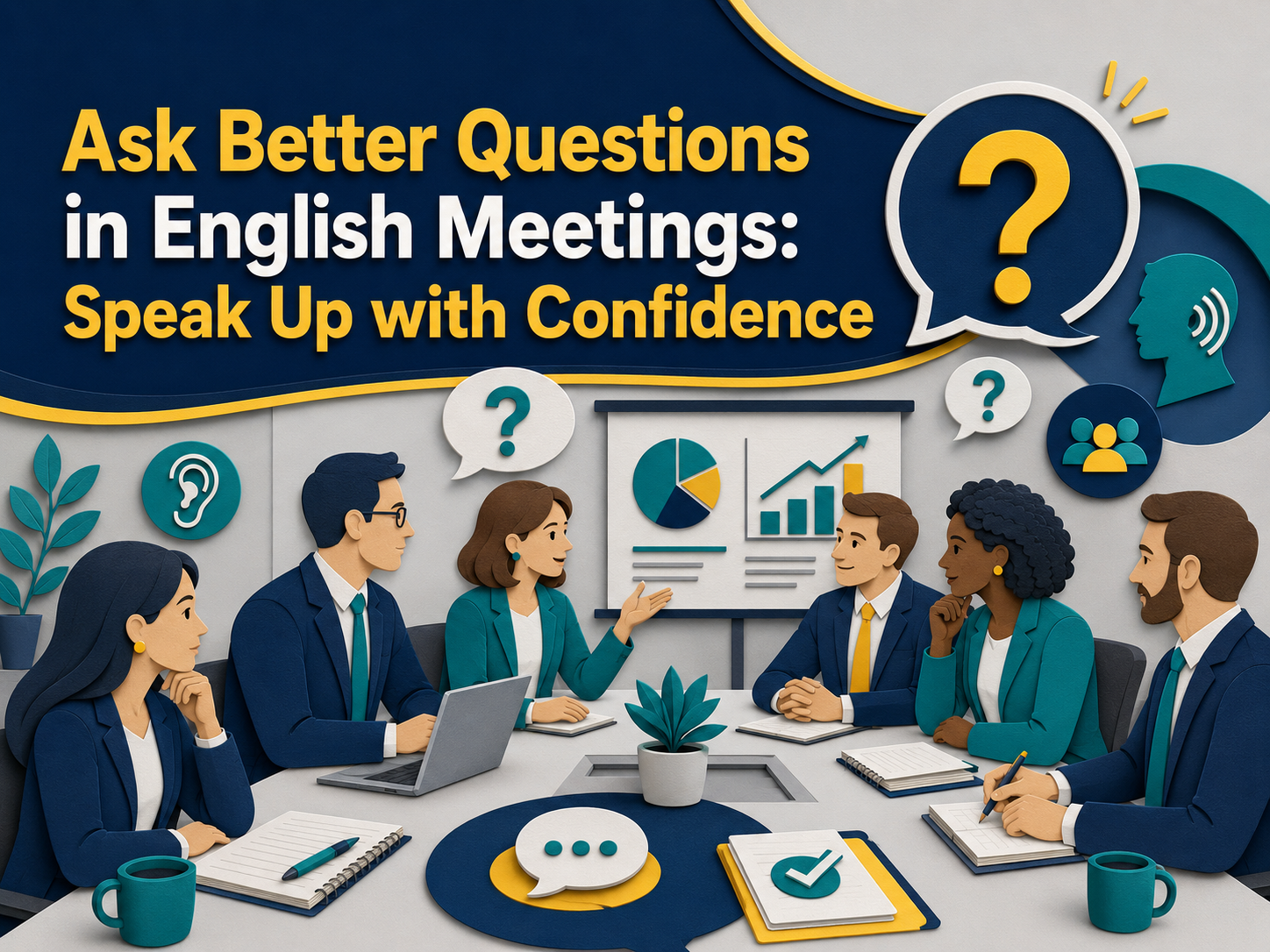
Ask Better Questions in English Meetings: Speak Up with Confidence 💬
Advanced Level | June 13, 2026
혼자서 기사를 소리 내어 읽거나 튜터를 따라 각 단락을 반복해서 읽으세요. 레벨...
In many English meetings, the smartest person in the room is not always the person who talks the most. Often, it is the person who knows how to ask the right question at the right time. If you want to ask better questions in English meetings, you do not need to sound complicated. You need to sound clear, curious, and professional.
Today, let’s look at how busy professionals can ask better questions in English meetings and create stronger conversations at work.
Why Better Questions Matter in Meetings
Good questions show that you are listening. They also help you understand problems, clarify goals, and invite other people to share useful ideas. In business, questions are not just for getting information. They are tools for leadership. When you ask a thoughtful question, you show that you are engaged, prepared, and thinking beyond the surface.
Start with Open-Ended Questions
One of the best ways to improve your meeting English is to use open-ended questions. These questions usually begin with what, how, or why. Instead of asking, “Do you agree?” you can ask, “What are your thoughts on this approach?” That small change creates more space for discussion. It also helps you avoid the painful business meeting disease known as “everyone silently staring at the screen.”
Use Questions to Clarify
Sometimes you may understand the general idea, but not the details. In that case, ask a clarification question. You might say, “Could you clarify what you mean by the next phase?” or “When you say urgent, what timeline are we talking about?” These questions are professional because they prevent confusion before it turns into a bigger problem. In other words, they save everyone from the classic workplace adventure: fixing a mistake that could have been avoided in five seconds.
Ask Follow-Up Questions
A good meeting question often leads to another question. If someone gives a short answer, you can keep the conversation moving with a follow-up. For example, if your manager says, “The client wants changes,” you could ask, “What kind of changes are they most concerned about?” Follow-up questions show that you are not just hearing words—you are thinking about the meaning behind them.
Use Questions to Show Leadership
Leaders ask questions that help the team move forward. Try asking, “What is the next step?” “Who needs to be involved?” or “What could slow this project down?” These questions are simple, but they help everyone focus on action. You do not need a long speech to sound professional. Sometimes one strong question can guide the whole discussion.
Be Careful with “Why” Questions
“Why” questions can be useful, but they can also sound aggressive if your tone is too direct. For example, “Why did you choose this plan?” might sound like criticism. A softer version is, “What led us to choose this plan?” or “Could you walk me through the thinking behind this decision?” This sounds more respectful and gives the other person room to explain without feeling attacked.
Prepare Two Questions Before the Meeting
If you often feel nervous speaking in English meetings, prepare two questions before the meeting starts. Look at the agenda and think about what you need to understand better. You could prepare one question about the goal and one question about the next step. This gives you a safety net, so you are not trying to invent perfect English while your brain is quietly jumping overboard.
Practice the Question Formula
Here is a simple formula you can use: Context + Question. First, give a short reason. Then ask your question. For example: “I want to make sure I understand the deadline clearly. What needs to be finished by Friday?” This sounds more natural and professional than asking a sudden question with no setup. It also helps people understand why you are asking.
Final Thought: Ask Better Questions in English Meetings
Learning to ask better questions in English meetings is one of the fastest ways to become more active at work. You do not have to dominate the conversation. You just need to participate with purpose. Ask clearly. Listen carefully. Follow up naturally. Over time, better questions will help you sound more confident, build stronger relationships, and contribute more value in every meeting.
Vocabulary List
- Clarify (verb) — To make something easier to understand.
Example: Could you clarify the deadline for this task? - Engaged (adjective) — Interested and actively involved.
Example: She stayed engaged during the entire meeting. - Surface (noun/adjective) — The basic or obvious level of something.
Example: We need to go beyond the surface and understand the real issue. - Follow-up (noun/adjective) — Something that continues or responds to an earlier point.
Example: He asked a follow-up question after the presentation. - Approach (noun) — A way of doing something.
Example: What are your thoughts on this approach? - Concerned (adjective) — Worried or focused on a possible problem.
Example: The client is concerned about the timeline. - Aggressive (adjective) — Too forceful or direct in a way that may feel unfriendly.
Example: His question sounded aggressive, even though he did not mean it that way. - Agenda (noun) — A list of topics for a meeting.
Example: Please review the agenda before the meeting starts. - Safety net (noun) — Something that protects you or gives you support.
Example: Preparing two questions gives you a safety net in meetings. - Contribute (verb) — To give ideas, effort, or help.
Example: Everyone should contribute during the discussion.
5 Questions About the Article
- Why do better questions matter in English meetings?
- What is the difference between a closed question and an open-ended question?
- Why are clarification questions useful at work?
- How can “why” questions sometimes sound aggressive?
- What is the “Context + Question” formula?
5 Open-Ended Discussion Questions
- What kind of questions do you usually ask in meetings?
- How do you feel when you need to ask a question in English?
- What is one meeting situation where a better question could help you?
- How can asking questions make someone sound more professional?
- What two questions could you prepare before your next meeting?
📢 Want more tips like this? 👉 Sign up for the All About English Mastery Newsletter! Click here to join us!
Want to finally Master English but don’t have the time? Mastering English for Busy Professionals is the course for you! Check it out now!
Follow our YouTube Channel @All_About_English for more great insights and tips.

 한국어
한국어  English