

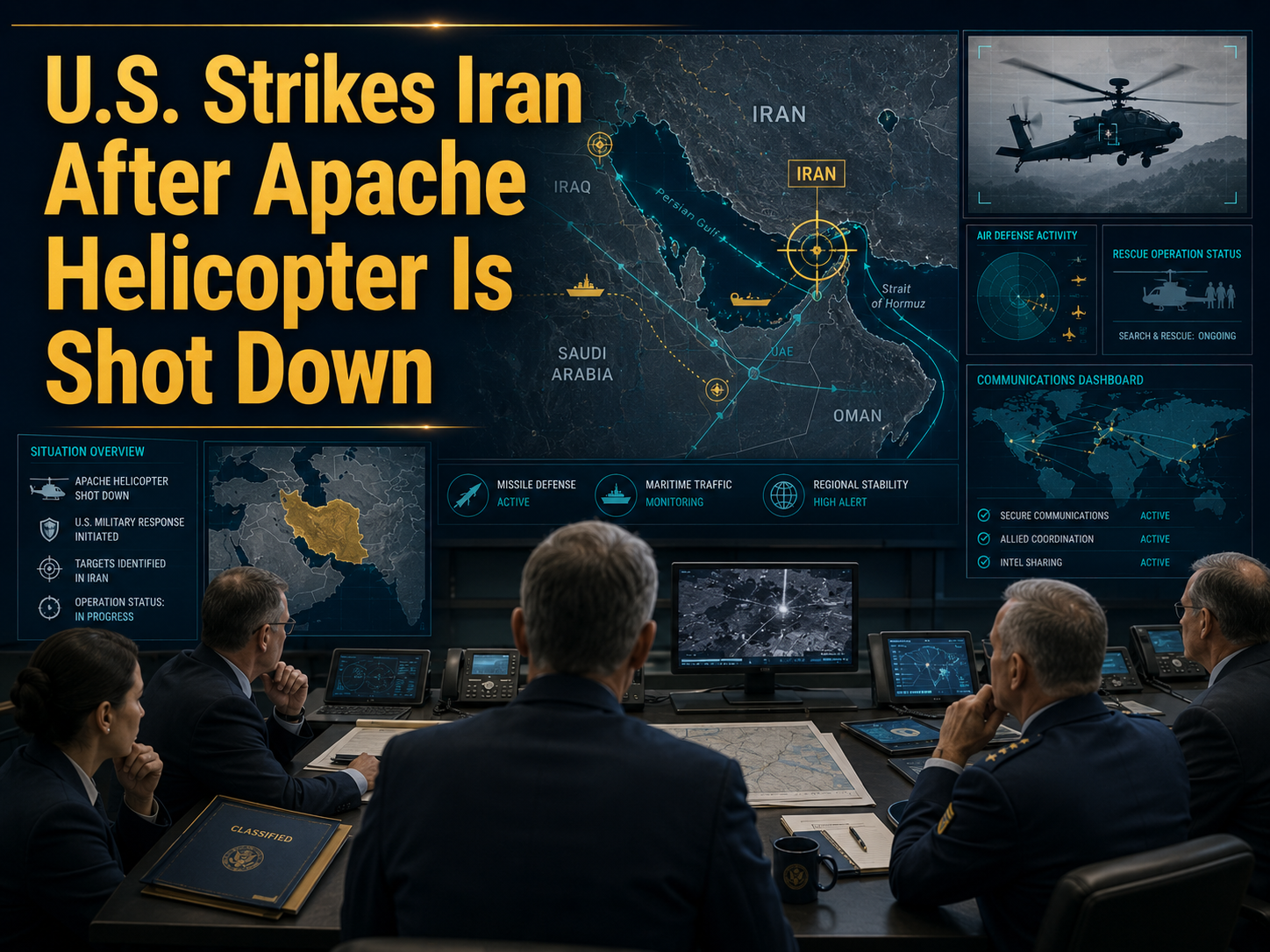
U.S. Strikes Iran After Apache Helicopter Is Shot Down
Advanced | June 13, 2026
✨ 혼자서 기사를 소리 내어 읽거나 튜터를 따라 각 단락을 반복해서 읽으세요. 레벨...
U.S. Strikes Iran After Apache Shoot-Down
On June 10, 2026, Fox News reported that the United States carried out airstrikes on Iranian targets after Tehran shot down a U.S. Army Apache helicopter. According to Fox, both U.S. pilots were rescued and remained safe, but the incident threatened to derail peace talks between Washington and Tehran. President Donald Trump defended the attacks as a necessary and “powerful” response to Iran’s actions.
Why the U.S. Strikes Iran Story Matters
The U.S. strikes Iran story matters because it shows how quickly a military incident can raise the pressure in an already dangerous conflict. The Apache helicopter was reportedly operating near the Strait of Hormuz, one of the world’s most important shipping routes. When a military aircraft is shot down, leaders often feel pressure to respond. But every response also creates risk. In plain business English, this is the kind of situation where one bad move can turn a difficult negotiation into a full-blown crisis.
CENTCOM Says the Strikes Were Self-Defense
U.S. Central Command, or CENTCOM, said American forces struck Iranian targets that threatened U.S. forces and international commercial ships moving through regional waters. Fox News reported that the targets included military surveillance capabilities, communications systems, and air defense sites. Air & Space Forces Magazine reported that the operation began around 5 p.m. Eastern Time on June 9 and involved U.S. Air Force and Navy aircraft using precision munitions near the Strait of Hormuz. CENTCOM described the operation as a proportional response. Translation: “We hit back, but we say we kept it limited.”
The Pilots Survived the Incident
One major detail is that both pilots survived. Air & Space Forces Magazine reported that the Apache went down near the Strait of Hormuz and that the two pilots were rescued by an unmanned U.S. Navy boat. The report also said Air Force and Navy aircraft, including MQ-9 Reapers and fighter jets, helped protect the area during the rescue. Trump said the pilots were safe and uninjured, and he described their survival as a “miracle.” In a tense military story, that detail matters. It changes the emotional temperature of the news.
Iran and the U.S. Disagree About What Happened
The situation is complicated because Iran did not fully accept the U.S. version of events. Air & Space Forces Magazine reported that Iran did not claim responsibility for shooting down the helicopter and suggested the Apache may have crashed because of an accident, human error, or crossfire. U.S. officials, however, said an Iranian drone may have hit the helicopter. This is a useful reminder for English learners: in international news, words like “said,” “claimed,” “reported,” and “suggested” matter. They show what is confirmed, what is disputed, and what is still under investigation.
Peace Talks Continue Under Heavy Pressure
The strikes happened while the U.S. and Iran were still discussing a possible peace deal. Reuters reported that Trump later said a deal could be signed soon, but Iran said no final decision had been made. Reuters also reported that after the Apache was downed, Trump ordered new strikes around the Strait of Hormuz over two days, while Iran launched missile and drone attacks on U.S. bases in the region. So, the two sides are talking and fighting at the same time — which is basically diplomacy with a migraine.
What Happens Next?
The next question is whether the U.S. strikes Iran story becomes a short military response or part of a larger escalation. If both sides return to negotiations, the strikes may be remembered as pressure before a deal. If more attacks follow, the region could face a deeper crisis affecting oil markets, military bases, commercial shipping, and global confidence. For English learners, this story is useful because it includes powerful real-world vocabulary: retaliation, self-defense, air defense, surveillance, escalation, and ceasefire. It also teaches a practical lesson: in global affairs, timing is everything.
Vocabulary
- Retaliation (noun) – action taken in response to an attack.
Example: “The U.S. strikes were described as retaliation for the Apache shoot-down.” - Apache helicopter (noun) – a U.S. military attack helicopter.
Example: “The Apache helicopter was reportedly shot down near the Strait of Hormuz.” - Airstrike (noun) – an attack by aircraft.
Example: “CENTCOM said the airstrikes targeted Iranian military sites.” - Self-defense (noun) – action taken to protect yourself or your forces.
Example: “The U.S. described the strikes as self-defense.” - Precision munition (noun) – a weapon designed to hit a specific target accurately.
Example: “U.S. aircraft used precision munitions in the operation.” - Surveillance (noun) – careful watching or monitoring.
Example: “Some strikes targeted Iranian surveillance systems.” - Air defense (noun) – systems used to detect or shoot down aircraft or missiles.
Example: “Iranian air defense sites were among the targets.” - Derail (verb) – to stop something from continuing as planned.
Example: “The helicopter incident could derail peace talks.” - Escalation (noun) – a situation becoming more serious or dangerous.
Example: “Many leaders worry about further escalation.” - Under investigation (phrase) – still being examined to find the truth.
Example: “The exact cause of the helicopter crash remains under investigation.”
Discussion Questions (About the Article)
- What happened to the U.S. Apache helicopter?
- How did the U.S. respond after the incident?
- What kinds of Iranian targets did CENTCOM say it struck?
- Why is the Strait of Hormuz important in this story?
- What details about the helicopter incident are still disputed?
Discussion Questions (About the Topic)
- When is military retaliation justified?
- How can countries respond to attacks without making a crisis worse?
- Why do military incidents often affect peace talks?
- What role does public language play during a conflict?
- How should news readers handle stories where two sides disagree about the facts?
Related Idiom
“Walking a tightrope” – trying to manage a difficult situation where one mistake could cause serious trouble.
Example: “The U.S. and Iran are walking a tightrope as they continue peace talks while also trading military strikes.”
📢 Want more practical English through real news stories? Sign up for the All About English Mastery Newsletter here: allaboutenglishmastery.com/newsletter
Want to build stronger English in less time? Check out Mastering English for Busy Professionals.
Follow our YouTube channel @All_About_English for more English tips and practice.
This article was inspired by: Fox News, Air & Space Forces Magazine, Reuters, and Al Jazeera


 한국어
한국어  English