

How Stock Pay Is Helping Keep the U.S. Economy Moving
Intermediate | June 14, 2026
✨ 혼자서 기사를 소리 내어 읽거나 튜터를 따라 각 단락을 반복해서 읽으세요. 레벨...
A New Kind of Paycheck: The Stock Pay Boom
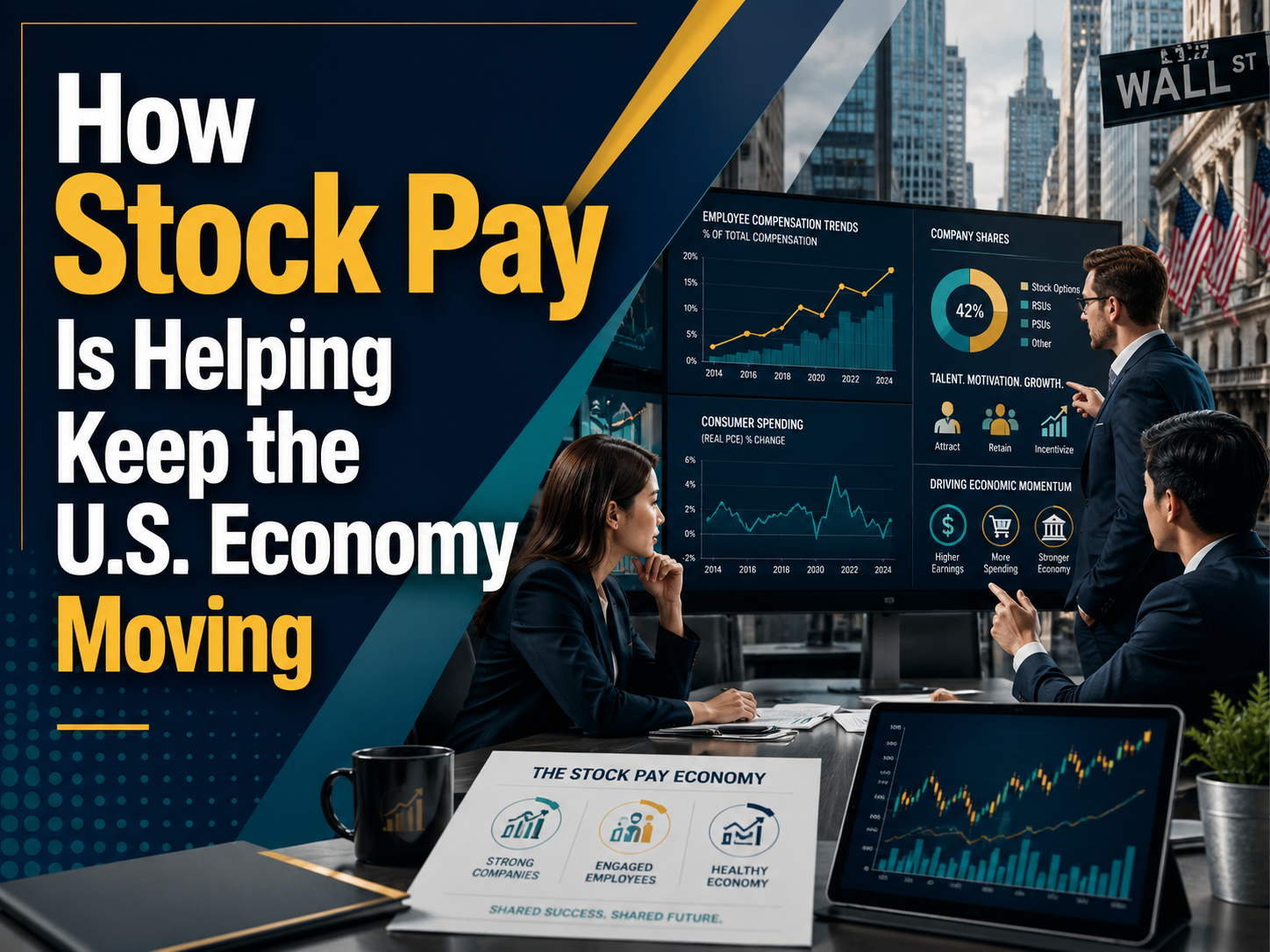
Many people think the stock market is separate from the “real economy.” But a new Reuters analysis suggests the connection may be getting stronger. On June 10, 2026, Reuters columnist Mike Dolan reported that more American workers are receiving part of their pay through stock-based compensation, or SBC. This means employees may receive company shares, stock options, or similar rewards as part of their overall pay package. When stock prices rise, those rewards can become more valuable. (Reuters)
Why the Stock Pay Boom Matters
According to the Reuters report, stock-based compensation rose 9% annually and reached about one-third of a trillion dollars through last year. That is not pocket change — unless your pockets are apparently the size of Texas. The biggest users of this pay system are technology companies, but Reuters said almost every sector increased its use of SBC over the year. This shows that stock pay is no longer just a Silicon Valley perk for a few lucky engineers. It is becoming a bigger part of how some companies reward workers. (Reuters)
Tech Workers Are Leading the Trend
The technology and communications sectors remain at the center of the story. Reuters reported that stock-based compensation in those sectors rose 25% last year, reaching more than $170 billion in expenses. That was equal to about 3.9% of combined sector revenue. In simple English: tech companies are spending a lot of money paying workers with stock. When the stock market is strong, workers who receive this kind of pay may feel wealthier and may spend more. That spending can help support the wider economy. (Reuters)
The Consumer Spending Connection
This story matters because consumer spending is a huge part of the U.S. economy. Reuters noted that the top 20% of U.S. income earners account for nearly two-thirds of consumer spending, while consumer spending makes up almost 70% of GDP. So, if higher-income workers receive more valuable stock pay, they may continue spending on homes, travel, services, restaurants, and investments. That may help explain why the U.S. economy has stayed stronger than many people expected despite inflation, high interest rates, trade uncertainty, and political drama — because apparently the economy enjoys juggling knives while riding a bicycle. (Reuters)
The Problem: Not Everyone Benefits
However, there is a downside. Stock pay is often concentrated among higher-income workers, especially in tech. Reuters’ related May analysis said more than 60% of U.S. households own stocks directly or indirectly, but the gains are not evenly spread. The richest 10% own about 90% of U.S. equity wealth, and the richest 1% own about half of the country’s stock market wealth. This means the stock pay boom may help support the economy, but it can also widen the gap between workers who benefit from rising markets and workers who do not. (Reuters)
A New Phrase: “Human Capitalists”
A 2021 paper from the National Bureau of Economic Research used an interesting phrase: “human capitalists.” The researchers argued that some high-skilled workers are no longer paid only like normal employees. Because they receive equity-based compensation, they also benefit like partial owners when company stock rises. The paper found that equity-based compensation represented about 36% of total compensation for high-skilled workers in U.S. manufacturing in recent years. This helps explain why stock pay is more than a company accounting detail. It may be changing how we understand wages, wealth, and the modern economy. (NBER)
The Big Picture
The stock pay boom shows how Wall Street and Main Street may be more connected than they used to be. Strong stock prices can lift the value of worker compensation, especially for tech employees and other high earners. That can support spending and help keep the economy moving. But there is a risk: if the stock market falls, those same workers may feel less wealthy and spend less. In other words, stock pay can be a tailwind when markets rise — but a headache when markets reverse.
Vocabulary
- Stock-Based Compensation (noun) – pay given to workers in the form of company shares, stock options, or similar rewards.
Example: “Many tech workers receive stock-based compensation as part of their pay.” - Share (noun) – one unit of ownership in a company.
Example: “She received company shares after working there for three years.” - Pay Package (noun) – the total amount and type of pay an employee receives.
Example: “His pay package includes salary, bonuses, and stock.” - Sector (noun) – a part of the economy, such as technology, finance, or manufacturing.
Example: “The technology sector uses a lot of stock-based compensation.” - Revenue (noun) – the money a company earns from selling goods or services.
Example: “The company’s revenue increased after strong product sales.” - Consumer Spending (noun) – money people spend on goods and services.
Example: “Consumer spending is an important part of the U.S. economy.” - GDP (noun) – the total value of goods and services produced in a country.
Example: “Consumer spending makes up a large part of GDP.” - Income Gap (noun) – the difference between high earners and low earners.
Example: “Some critics worry that stock pay can widen the income gap.” - Equity (noun) – ownership value in a company, often through shares.
Example: “Employees with equity can benefit when the company grows.” - Tailwind (noun) – something that helps progress or growth.
Example: “A strong stock market can be a tailwind for consumer spending.”
Discussion Questions About the Article
- What is stock-based compensation, and why is it important?
- Which sectors are leading the stock pay boom?
- How can rising stock prices affect worker behavior?
- Why does consumer spending matter for the U.S. economy?
- What is the risk if stock prices fall?
Discussion Questions About the Topic
- Should companies use stock pay to reward employees? Why or why not?
- Is stock-based compensation better than a higher salary?
- How could stock pay affect employee motivation?
- What happens when only high-income workers benefit from rising stock prices?
- Should workers learn more about investing if they receive stock pay?
Related Idiom
“Don’t put all your eggs in one basket” – don’t depend too much on one thing.
Example: “Stock-based compensation can be valuable, but workers should remember not to put all their eggs in one basket because stock prices can fall.”
📢 Want more practical English through real news stories? Sign up for the All About English Mastery Newsletter here: allaboutenglishmastery.com/newsletter
Want to build stronger English in less time? Check out Mastering English for Busy Professionals.
Follow our YouTube channel @All_About_English for more English tips and practice.
This article was inspired by: Reuters, Reuters Open Interest, and NBER


 한국어
한국어  English