

Google and Samsung May Team Up on a Next-Generation AI Chip
Intermediate | June 20, 2026
✨ 혼자서 기사를 소리 내어 읽거나 튜터를 따라 각 단락을 반복해서 읽으세요. 레벨...
A Possible New Partnership in AI Chips
Google is reportedly in talks with Samsung Electronics to help manufacture part of its next-generation artificial intelligence chip. According to Reuters, the report originally came from The Information, which cited two people familiar with the matter.
The chip is reportedly codenamed “Icefish.” It is part of Google’s line of Tensor Processing Units, or TPUs. These are custom chips designed to handle AI work more efficiently. In simple terms, TPUs help Google run advanced AI tools, large language models, cloud services, and other heavy computing tasks. So, the Google Samsung AI chip deal could become an important part of the future AI supply chain.
Why the Google Samsung AI Chip Deal Matters
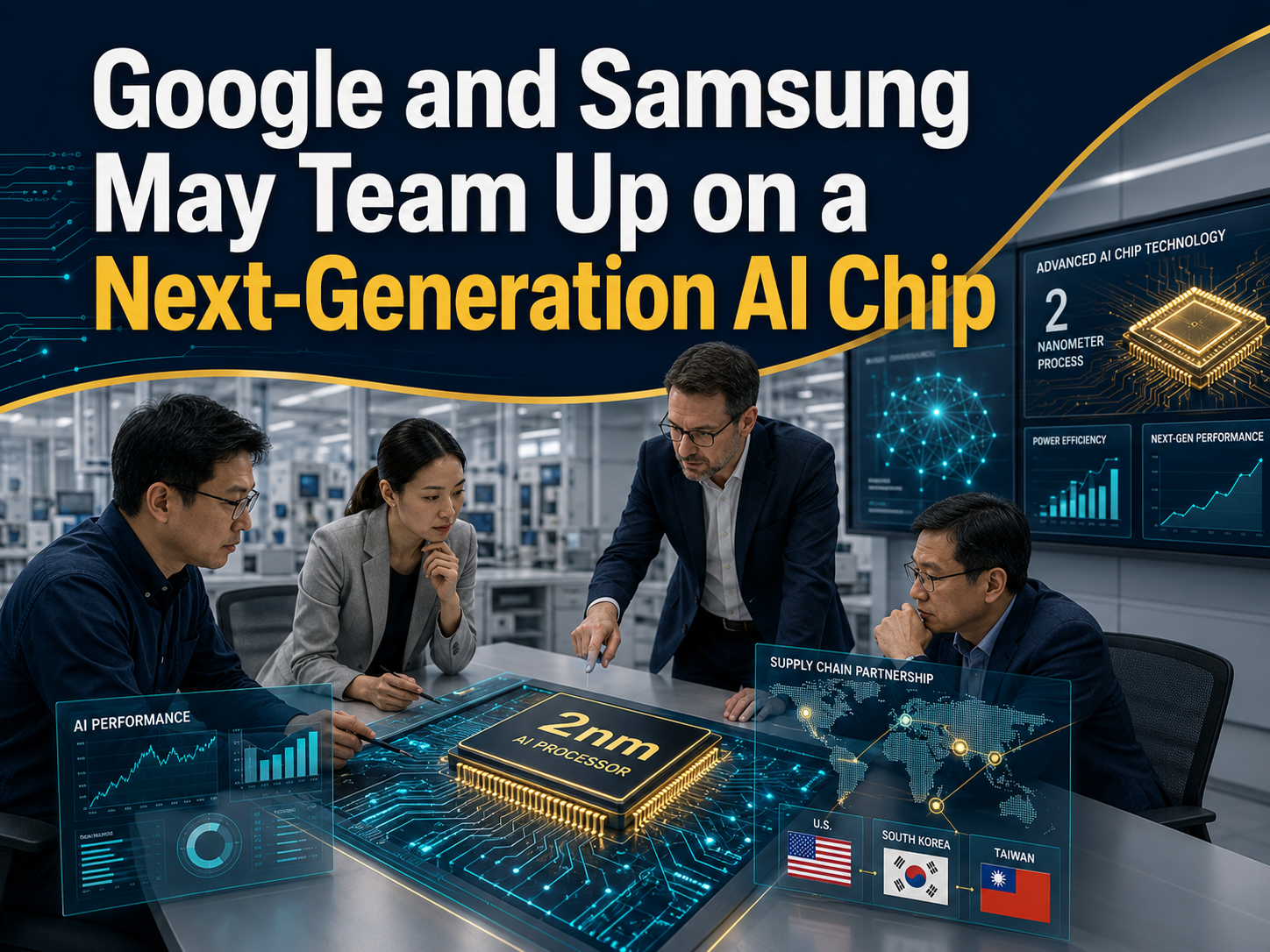
The reported plan is not for Samsung to make the whole chip. Instead, Google reportedly plans for Taiwan’s TSMC to make the main computing part of the chip, while Samsung may produce a separate component that helps connect the chip to memory. That memory connection is important because AI chips need to move large amounts of data very quickly.
Samsung may use its 2-nanometer production technology for this component. In the chip world, smaller production technology can often mean better speed and better power efficiency. Samsung says its SF2 technology is part of its 2nm roadmap and is designed to improve performance-per-watt. Translation: do more work while using power more efficiently. That is basically the chip industry’s version of “work smarter, not harder.”
Google Wants More Control Over AI Infrastructure
Google has been developing its own AI chips for years. Its TPUs are built for machine learning tasks such as large language models, code generation, media generation, recommendation systems, and other AI workloads. According to Google Cloud, TPUs help power Gemini and Google AI applications such as Search, Photos, and Maps, serving more than 1 billion users.
This matters because AI companies do not want to rely only on one kind of chip or one supplier. Nvidia still dominates the AI chip market with its GPUs, but Google’s TPUs give the company another option for powering its own AI services and cloud customers. If the Google Samsung AI chip deal moves forward, it could help Google spread out production and reduce pressure on one supplier.
Samsung Could Get a Big Foundry Win
For Samsung, this possible deal could be a major win. Samsung is already famous for memory chips and smartphones, but it also wants to grow its foundry business. A foundry makes chips designed by other companies. In this case, Google would design the chip system, while Samsung could help manufacture one important part of it.
Reuters reported that landing this contract would support Samsung’s push to grow its contract chip-manufacturing business. The timing is important. Samsung has been trying to attract more major customers for its advanced manufacturing technology. In 2025, Samsung also secured a reported $16.5 billion deal with Tesla to make next-generation AI chips, according to Reuters.
The Chip Is Still in Development
There is one important detail: this deal is not final. Reuters said Samsung declined to comment, while Alphabet, Google’s parent company, did not immediately respond to a request for comment. Reuters also said it could not independently verify The Information’s report.
The chip itself is still in development. Google is reportedly working with MediaTek on the design, and mass production may begin as early as 2028. That means this story is more about long-term strategy than immediate production. In other words, nobody is pulling this chip off a shelf tomorrow morning and saying, “Here it is, fresh from the oven.”
A Bigger Race for AI Power
The bigger story is the global race for AI computing power. As AI tools become more popular, companies need more advanced chips, more factory capacity, and more reliable supply chains. TSMC remains a giant in chip manufacturing, but demand is so high that companies like Google are looking for more options.
The Google Samsung AI chip deal shows how serious the AI infrastructure race has become. AI is not just about software anymore. It is also about factories, supply chains, advanced manufacturing, and strategic partnerships. For business English learners, this is a useful story because it connects technology, global business, negotiation, and long-term planning.
Vocabulary
- Artificial intelligence (noun) – technology that allows computers to perform tasks that usually need human thinking.
Example: “Artificial intelligence is creating new demand for advanced chips.” - Processor (noun) – the part of a computer or device that handles calculations and instructions.
Example: “Google is developing a next-generation AI processor.” - Tensor Processing Unit (noun) – a custom Google chip designed for AI and machine learning tasks.
Example: “TPUs help Google run AI services more efficiently.” - Manufacture (verb) – to make products, especially in a factory.
Example: “Samsung may manufacture part of Google’s new chip.” - Component (noun) – one part of a larger machine or system.
Example: “Samsung may produce a component that connects the chip to memory.” - Memory (noun) – the part of a computer system that stores data for quick use.
Example: “AI chips need fast access to memory.” - Foundry (noun) – a company or factory that makes chips designed by other companies.
Example: “Samsung wants to grow its foundry business.” - Supplier (noun) – a company that provides goods or services to another company.
Example: “Google may want to reduce dependence on one supplier.” - Supply chain (noun) – the network of companies and steps needed to make and deliver a product.
Example: “AI companies need reliable chip supply chains.” - Power efficiency (noun) – the ability to do more work while using less energy.
Example: “Smaller chip technology can improve power efficiency.”
Discussion Questions About the Article
- What is Google reportedly discussing with Samsung?
- What is the codename of Google’s next-generation chip?
- Which company is expected to make the main computing part of the chip?
- Why could this possible deal be important for Samsung?
- Why did Reuters say readers should be cautious about the report?
Discussion Questions About the Topic
- Why are AI chips becoming so important for large technology companies?
- Should companies depend on one supplier for critical technology? Why or why not?
- How could stronger AI chips change cloud computing?
- What risks come with developing chips that may not be produced until 2028?
- How might chip partnerships affect competition between the U.S., Korea, and Taiwan?
Related Idiom
“Don’t put all your eggs in one basket” – do not depend on only one option, because it can be risky.
Example: “Google may be trying not to put all its eggs in one basket by working with more than one chip manufacturer.”
This idiom fits the story because Google appears to be exploring different manufacturing partners instead of relying only on one supplier.
📢 Want more practical English through real news stories? Sign up for the All About English Mastery Newsletter here: allaboutenglishmastery.com/newsletter
Want to build stronger English in less time? Check out Mastering English for Busy Professionals.
Follow our YouTube channel @All_About_English for more English tips and practice.
This article was inspired by: Reuters, Google Cloud, Samsung Semiconductor, and Reuters reporting on Samsung’s Tesla chip deal


 한국어
한국어  English