

MIT AI Wristband Helps Robots Learn Human Hand Gestures
Intermediate | June 20, 2026
✨ 혼자서 기사를 소리 내어 읽거나 튜터를 따라 각 단락을 반복해서 읽으세요. 레벨...
A New Way to Teach Robots
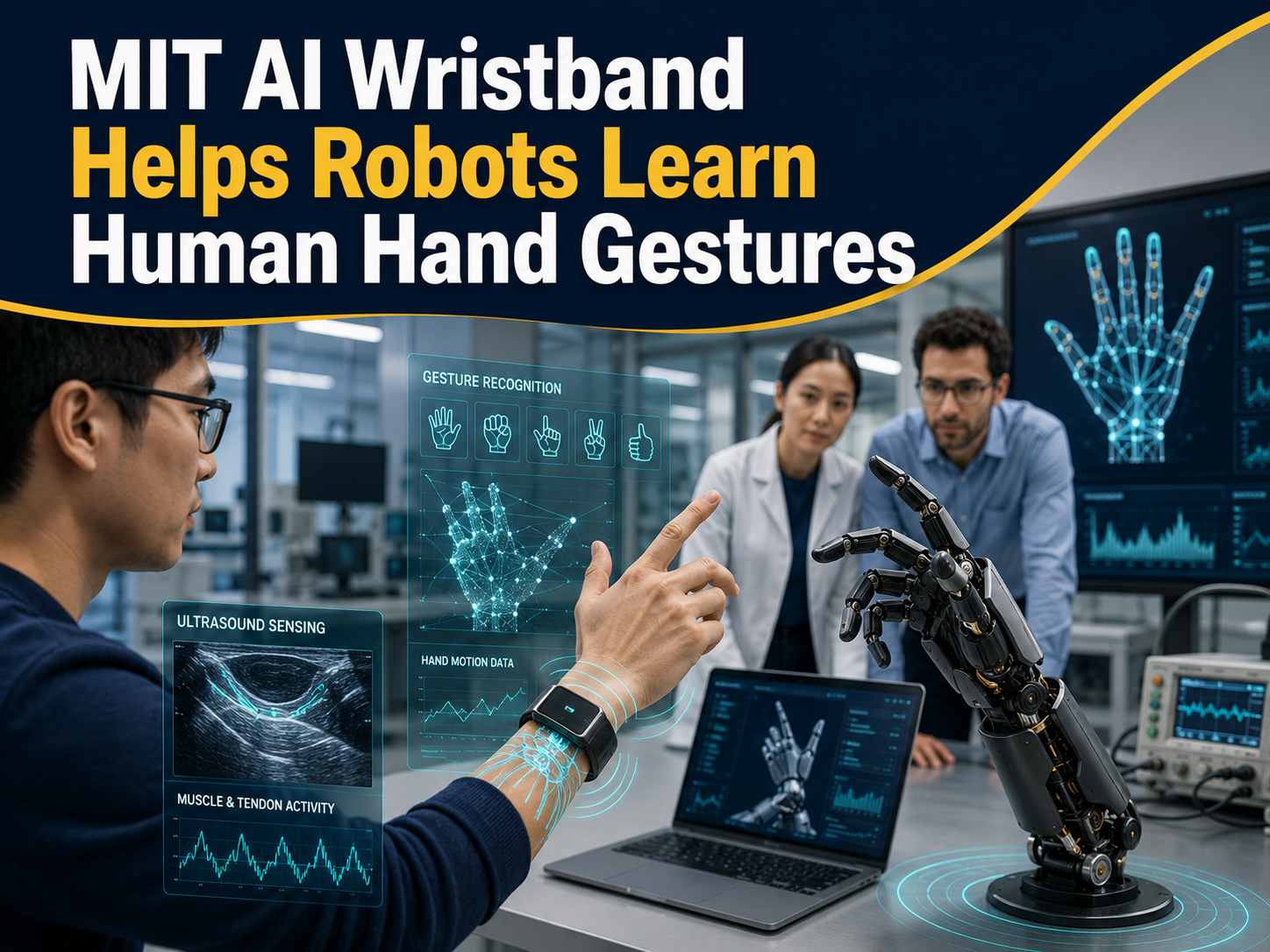
Researchers at the Massachusetts Institute of Technology, better known as MIT, have developed a wristband that could help robots learn how to move their hands more like humans. According to Associated Press, the device uses ultrasound and artificial intelligence to track what is happening under a person’s skin.
The MIT AI wristband does not just watch the outside of the hand. It captures the movement of muscles, tendons, and ligaments inside the wrist. Then, an AI system translates that information into hand movements that a robotic hand can copy. That may sound like science fiction, but this is very real research — no magic wand required, just a lot of engineering.
Why the MIT AI Wristband Matters
Robots are getting better at many tasks, but human hands are still difficult to copy. Think about simple actions like picking up a cup, tying a knot, turning a key, or buttoning a shirt. These tasks look easy to us because we use our hands all day. For robots, however, these small movements are extremely complicated.
The human hand has many moving parts. AP reported that engineers describe hand movements using degrees of freedom, which are specific ways a joint can bend or rotate. The human hand has 22 of them. Earlier systems struggled to track even part of that movement. The MIT AI wristband gives researchers a new way to collect detailed hand-motion data.
How the Wristband Works
The wristband uses high-frequency sound waves to “see” through the wearer’s skin. In simple English, it works a little like medical ultrasound. It creates images of the moving muscles and tendons in the wrist. Those images are sent to a computer, where AI analyzes them and predicts what the hand is doing.
MIT News explained that the wristband is paired with an AI algorithm that continuously translates ultrasound images into the positions of the fingers and palm. In demonstrations, a person wearing the wristband could wirelessly control a robotic hand. As the person moved, the robot copied the motion in real time.
From Sign Language to Robotic Hands
In laboratory demonstrations with eight volunteers, researchers showed that the wristband could mirror hand gestures very quickly. AP reported that it could recognize and copy all 26 letters in American Sign Language within 120 milliseconds. That is fast enough to feel almost immediate.
MIT News also said the robotic hand could copy gestures to play a simple tune on a piano and shoot a small basketball into a desktop hoop. The same wristband could also control virtual objects on a computer screen, such as pinching fingers together to enlarge or shrink an object.
Robots Could Learn From Human Motion
The long-term goal is bigger than remote control. Researchers hope the wristband can help build huge datasets of human hand movements. Those datasets could eventually train humanoid robots to perform difficult tasks with more natural hand motion.
MIT professor Xuanhe Zhao told AP that data from the system could help train robots to do housework with human-like dexterity. He also said the technology could be useful for tasks that require careful finger and hand movement, such as surgery. That does not mean robot surgeons are taking over tomorrow morning. But it does show where researchers think the technology could go.
A Useful Story for Business and Tech English
This story is useful for English learners because it connects technology, AI, robotics, healthcare, and future work. It also gives us practical vocabulary for business and engineering conversations: data, algorithm, prototype, wireless, dexterity, and automation.
The MIT AI wristband is a good reminder that AI is not only about chatbots and computer screens. Sometimes, AI is about helping machines understand the physical world. For companies, researchers, and workers, that could open the door to new products, new jobs, and new questions about how humans and robots will work together.
Vocabulary
- Wristband (noun) – a device worn around the wrist.
Example: “The wristband tracks movement under the skin.” - Ultrasound (noun) – sound waves used to create images inside the body.
Example: “The device uses ultrasound to see muscles and tendons.” - Artificial intelligence (noun) – technology that allows computers to learn or make decisions.
Example: “Artificial intelligence helps translate wrist images into hand movements.” - Gesture (noun) – a movement of the hand, arm, or body that communicates something.
Example: “The robotic hand copied the person’s gestures.” - Tendon (noun) – tissue that connects muscle to bone.
Example: “The wristband tracks tendon movement.” - Ligament (noun) – tissue that connects bones to other bones.
Example: “The device captures movement in muscles, tendons, and ligaments.” - Dexterity (noun) – skill in using the hands or body smoothly and accurately.
Example: “Robots need better dexterity to handle small objects.” - Algorithm (noun) – a set of computer instructions used to solve a problem.
Example: “The AI algorithm reads the ultrasound images.” - Wireless (adjective) – working without physical cables.
Example: “The wristband can control a robotic hand wirelessly.” - Dataset (noun) – a large collection of information used for research or training AI.
Example: “Researchers want to build a dataset of human hand movements.”
Discussion Questions About the Article
- What did MIT researchers develop?
- How does the wristband collect information from the wearer’s hand?
- Why are human hand movements difficult for robots to copy?
- What did the wristband do in lab demonstrations with eight volunteers?
- What future uses did researchers mention for this technology?
Discussion Questions About the Topic
- How could robots with better hand movement help people at home or work?
- What jobs might benefit from better robotic dexterity?
- Would you feel comfortable using a robot trained by human motion data? Why or why not?
- How could this technology be useful in healthcare or surgery?
- What risks should companies consider before using robots for delicate tasks?
Related Idiom
“Get a handle on something” – to understand or control something better.
Example: “MIT researchers are trying to get a handle on robotic dexterity by studying human hand movements.”
This idiom fits the story because the wristband may help robots better understand and copy how human hands move.
📢 Want more practical English through real news stories? Sign up for the All About English Mastery Newsletter here: allaboutenglishmastery.com/newsletter
Want to build stronger English in less time? Check out Mastering English for Busy Professionals.
Follow our YouTube channel @All_About_English for more English tips and practice.
This article was inspired by: Associated Press, MIT News, and MIT’s related research paper in Nature Electronics


 한국어
한국어  English