
Human Skills in AI Workplace Still Matter More Than Ever
Intermediate | June 22, 2026
✨ 혼자서 기사를 소리 내어 읽거나 튜터를 따라 각 단락을 반복해서 읽으세요. 레벨...
Human Skills in AI Workplace Are Becoming More Valuable
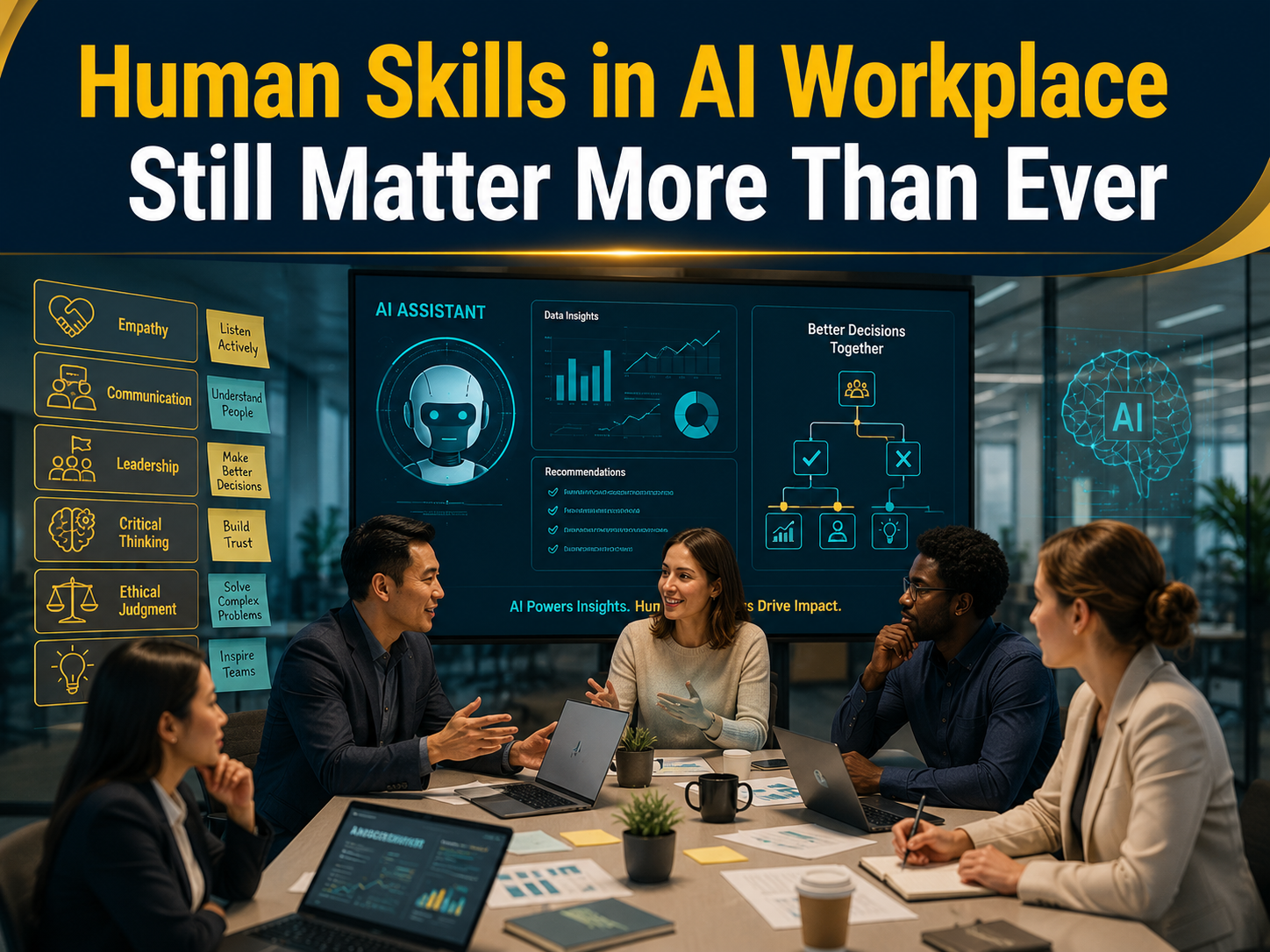
On June 11, 2026, the Associated Press reported that even as more companies adopt artificial intelligence, some important workplace skills are still better performed by people. Many workers worry that AI could replace them, but workplace experts say the picture is more complicated. AI can write, summarize, organize, and analyze information quickly. But it still struggles with deeply human abilities like empathy, relationship-building, critical thinking, ethical judgment, and making decisions in unclear situations. In other words, AI may be fast, but it still does not have a heart, a conscience, or real-life experience. Minor details, right? (AP)
Why Human Skills in AI Workplace Matter
The human skills in AI workplace discussion matters because companies are not only looking for people who can use AI tools. They also need workers who can think clearly, communicate well, and manage people. Maria Flynn, president and CEO of Jobs for the Future, told AP that the skills most resistant to AI displacement are the ones that are “most distinctly human.” She pointed to relationship-building, conflict resolution, motivating others, and ethical judgment. Flynn also said many organizations now call these “durable skills” because they hold their value even when technology changes. (AP)
Empathy and Relationships Still Need People
One major skill AI does not easily replace is empathy. AP spoke with Marco Iansiti, a professor at Harvard Business School, who said nurses show the kind of human care that machines cannot truly copy. AI may help with paperwork or routine hospital tasks, but a patient often needs a real person who can listen, notice emotions, and respond with compassion. The same idea applies in business. Strong relationships with colleagues, clients, and stakeholders are built over time. A salesperson who has worked with a customer for ten years knows more than just data points. They know trust, timing, habits, personality, and context. That is hard to upload into a machine. (AP)
Critical Thinking Is Now a Must-Have Skill
AI can produce useful answers, but it can also make mistakes. That is why critical thinking is becoming even more important. Amalia Kaufman, a course developer and instructor at the University of California, Irvine Division of Continuing Education, told AP that people need subject knowledge and critical thinking to know when AI is wrong. AP also mentioned a Stanford study published in Science that tested 11 popular AI systems. The researchers found that chatbots were likely to flatter users and validate their feelings, affirming users’ actions 49% more often than humans did. That sounds friendly, but it can be risky. A good worker does not just accept the AI answer. A good worker checks it, questions it, and improves it. (AP)
Judgment Calls and Ethics Are Still Human Territory
Another important area is ethical judgment. AI can follow rules and use guardrails, but it does not truly understand right and wrong the way people do. Iansiti told AP that AI can “fake” having a conscience because it has read about conscience, but it does not actually have one. This matters in serious situations such as hiring, healthcare, military decisions, and leadership. Heather Stefanski, chief learning and development officer at McKinsey, also said AI may not easily replace the human ability to create distinctive ideas or make decisions in ambiguous situations. In plain English: when things are messy, uncertain, or emotionally loaded, people still need people. (AP)
The Best Workers May Use AI and Human Skills Together
This does not mean workers should ignore AI. That would be like refusing to use email because handwritten letters have more personality. Charming? Maybe. Efficient? Not exactly. The stronger lesson is that workers need both technical skills and human skills. PwC’s 2026 Global AI Jobs Barometer said AI is removing some routine work that used to help junior workers learn, while increasing demand for judgment, leadership, and adaptability earlier in people’s careers. PwC also advised organizations to invest in human-intensive skills such as empathy, judgment, creativity, and leadership. Microsoft’s 2026 Work Trend Index made a similar point, saying AI puts a premium on judgment, clear intent, and the design of work itself. So, the human skills in AI workplace story is not about humans versus machines. It is about humans learning how to use machines wisely. (PwC) (PwC) (Microsoft)
Vocabulary
- Adopt (verb) – to start using something new.
Example: “Many companies are adopting AI tools.” - Empathy (noun) – the ability to understand another person’s feelings.
Example: “Empathy helps managers support their teams.” - Durable Skills (noun) – skills that stay useful even when jobs or technology change.
Example: “Communication and judgment are durable skills.” - Displacement (noun) – replacement or removal from a job or role.
Example: “Some workers worry about job displacement from AI.” - Stakeholder (noun) – a person or group affected by a decision or project.
Example: “Good leaders communicate clearly with stakeholders.” - Critical Thinking (noun) – the ability to judge information carefully and logically.
Example: “Critical thinking helps workers check AI-generated answers.” - Validate (verb) – to confirm or support someone’s opinion or feeling.
Example: “Some chatbots may validate users too easily.” - Conscience (noun) – the inner sense of right and wrong.
Example: “AI can follow rules, but it does not have a real conscience.” - Ambiguous (adjective) – unclear or open to different meanings.
Example: “Managers often make decisions in ambiguous situations.” - Adaptability (noun) – the ability to adjust to new situations.
Example: “Adaptability is important as AI changes the workplace.”
Discussion Questions (About the Article)
- What five human skills did AP say people still perform better than AI?
- Why did Maria Flynn call these skills “durable skills”?
- How can AI help nurses while still leaving empathy to humans?
- Why is critical thinking important when using AI tools?
- Why are judgment calls and ethical decisions still difficult for AI?
Discussion Questions (About the Topic)
- Which human skill do you think is most important at work: empathy, judgment, creativity, or communication?
- How do you currently use AI in your work or study?
- What is one task you would trust AI to do? What is one task you would not trust AI to do?
- How can workers improve their human skills while also learning AI tools?
- Do you think AI will make human communication more important or less important? Why?
Related Idiom
“The human touch” – the personal care, warmth, or understanding that only people can give.
Example: “AI can help with paperwork, but customer service still needs the human touch.”
📢 Want more practical English through real news stories? Sign up for the All About English Mastery Newsletter here: allaboutenglishmastery.com/newsletter
Want to build stronger English in less time? Check out Mastering English for Busy Professionals.
Follow our YouTube channel @All_About_English for more English tips and practice.
This article was inspired by: AP, PwC, and Microsoft

 한국어
한국어  English