

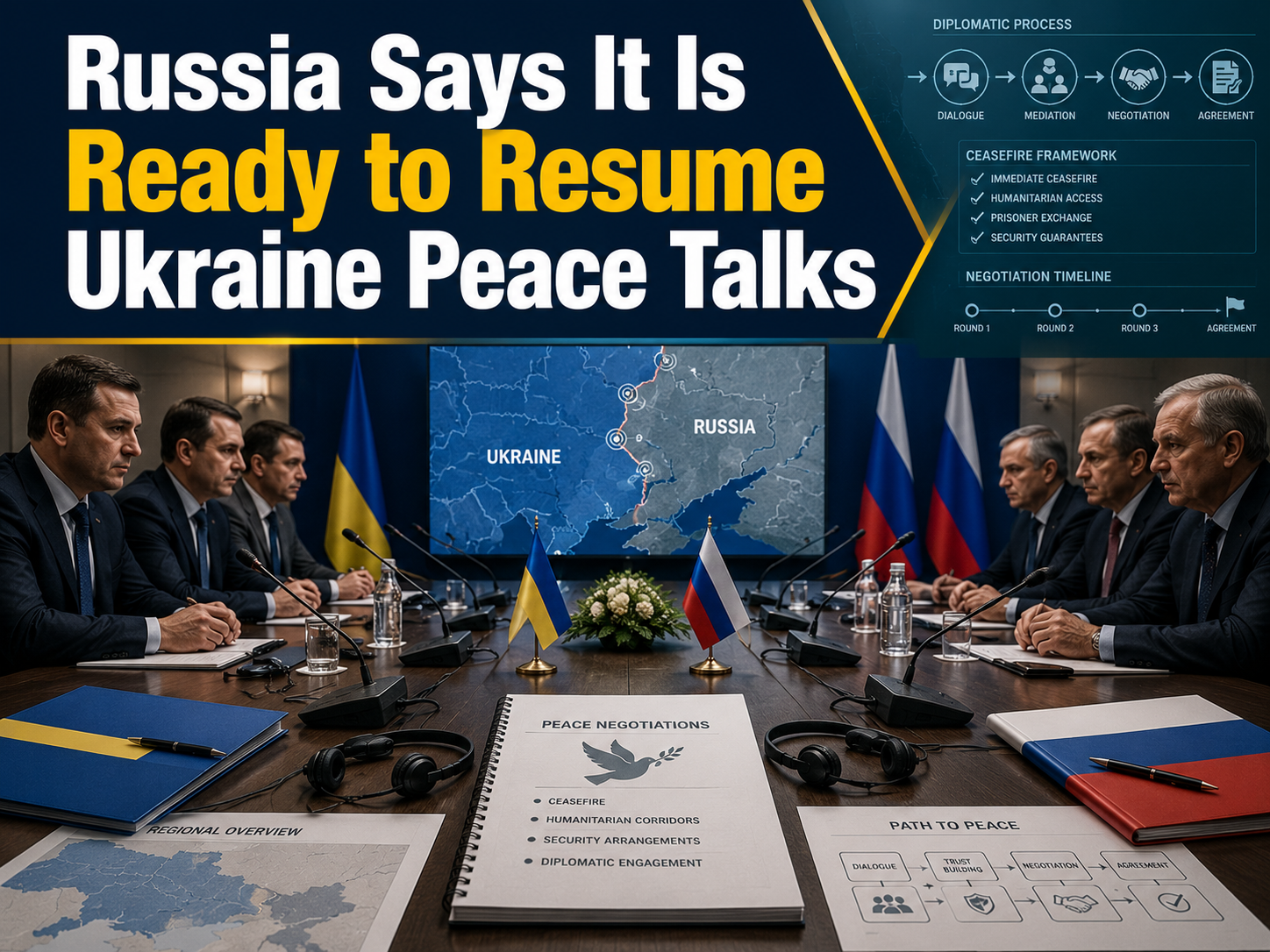
Russia Says It Is Ready to Resume Ukraine Peace Talks
Advanced | June 29, 2026
✨ 혼자서 기사를 소리 내어 읽거나 튜터를 따라 각 단락을 반복해서 읽으세요. 레벨...
Russia Ukraine Peace Talks Return to the Spotlight
Russian Foreign Minister Sergei Lavrov said Russia was ready to resume peace negotiations with Ukraine “from the point where they left off,” according to Reuters. Lavrov was referring to talks held in Istanbul soon after Russia’s full-scale invasion of Ukraine began in 2022, as well as talks that were resumed in 2025. On the surface, that sounds like progress. But, as usual with diplomacy, the fine print is where the dragons live.
Why the Russia Ukraine Peace Talks Matter
The Russia Ukraine peace talks matter because both sides are still far apart on the biggest issues. Lavrov said Moscow was ready to talk with Kyiv, but Reuters reported that he did not signal any shift in Russia’s demand that Ukraine give up the remaining part of the Donbas region that Kyiv still controls. Ukraine has strongly rejected that demand. In business terms, this is like saying, “We’re ready to negotiate,” while keeping the exact same non-negotiable condition on the table. Not exactly a smooth sales pitch.
Donbas Remains the Main Sticking Point
The Donbas region in eastern Ukraine has been one of the central issues of the war. Russia wants Ukraine to withdraw from territory it has defended for years. Ukraine says it will not hand over its land to Russia. Reuters later reported that Russian officials often refer to the “Spirit of Anchorage,” a phrase connected to earlier U.S.-Russia discussions in Alaska. Analysts say Moscow viewed that as a possible basis for Ukraine withdrawing from the remaining parts of Donbas in exchange for Russia freezing battle lines elsewhere. Kyiv has repeatedly rejected giving up territory without a fight.
Ukraine Says Its Patience Is Not Endless
Ukraine has also been talking about negotiations, but from a very different position. According to Reuters, Ukraine’s envoy to the United Nations, Andrii Melnyk, said Ukraine was ready to engage in direct negotiations with Russia for a “just and lasting peace” under the UN Charter. However, he warned that Ukraine’s “patience is not endless.” He also said Ukraine might revise its offer of a ceasefire along the current front line if the UN Security Council failed to support a full and unconditional end to hostilities.
The U.S. Role Is Still Important
The United States remains an important player in the diplomatic process. Reuters reported that the last U.S.-mediated peace talks took place in February 2026, before the United States and Israel launched a war against Iran. A separate Reuters report said Kremlin spokesman Dmitry Peskov expected contacts with U.S. envoys Steve Witkoff and Jared Kushner to resume once they became available again. Peskov described their work as constructive and said Russia valued their willingness to listen to all sides.
Diplomacy and Battlefield Pressure
Even while Russia says it is open to talks, the war continues. Another Reuters report said Russian President Vladimir Putin planned to keep pushing for control of four Ukrainian regions: Donetsk, Luhansk, Zaporizhzhia, and Kherson. Putin also rejected a Ukrainian proposal to mutually halt long-range strikes, saying Russia would not be distracted from its main battlefield goals. So, while diplomats talk about negotiations, soldiers and civilians are still living with the reality of war every day.
The Bigger Picture for Peace
The Russia Ukraine peace talks show how difficult peace negotiations can be when both sides see the conflict in completely different ways. Russia says it is ready to resume talks, but it continues to make demands Ukraine sees as unacceptable. Ukraine says it is open to a ceasefire, but it wants a just peace that protects its sovereignty. For English learners, this story is useful because it includes important diplomatic vocabulary: ceasefire, negotiation, compromise, envoy, sovereignty, and mediation. It also teaches an important real-world lesson: saying “we’re ready to talk” is not the same as saying “we’re ready to compromise.”
Vocabulary
- Resume (verb) – to start again after stopping.
Example: “Russia said it was ready to resume peace talks with Ukraine.” - Negotiation (noun) – a formal discussion to reach an agreement.
Example: “The negotiation focused on possible ways to end the war.” - Ceasefire (noun) – an agreement to stop fighting for a period of time.
Example: “Ukraine offered a ceasefire along the current front line.” - Envoy (noun) – a person sent to represent a government or organization.
Example: “Ukraine’s UN envoy spoke during the Security Council meeting.” - Mediation (noun) – help from a third party to solve a dispute.
Example: “The United States played a mediation role in earlier talks.” - Compromise (noun) – an agreement where each side gives up something.
Example: “Both sides would need compromise for a peace deal.” - Sovereignty (noun) – the right of a country to govern itself and control its territory.
Example: “Ukraine says any peace deal must protect its sovereignty.” - Territory (noun) – land controlled by a country or group.
Example: “The two sides disagree over Ukrainian territory in Donbas.” - Hostilities (noun) – acts of war or fighting.
Example: “Ukraine called for a full and unconditional end to hostilities.” - Sticking point (noun) – a problem that prevents agreement.
Example: “Donbas remains a major sticking point in the talks.”
Discussion Questions (About the Article)
- What did Sergei Lavrov say Russia was ready to resume?
- Why are the Russia Ukraine peace talks still difficult?
- What is Russia demanding regarding the Donbas region?
- What warning did Ukraine’s UN envoy Andrii Melnyk give?
- Why is the United States still important in the negotiation process?
Discussion Questions (About the Topic)
- Can peace talks succeed if one side refuses to change its main demand?
- Should countries accept territorial compromise to stop a war? Why or why not?
- What role should outside countries play in peace negotiations?
- How can leaders build trust after years of war?
- What is more important in a peace deal: speed or fairness?
Related Idiom
“The ball is in their court” – it is now someone else’s responsibility to make the next move.
Example: “Russia says it is ready to resume talks, but Ukraine may feel the ball is still in Moscow’s court if Russia refuses to change its demands.”
📢 Want more practical English through real news stories? Sign up for the All About English Mastery Newsletter here: allaboutenglishmastery.com/newsletter
Want to build stronger English in less time? Check out Mastering English for Busy Professionals.
Follow our YouTube channel @All_About_English for more English tips and practice.
This article was inspired by: Reuters, Reuters, Reuters, Reuters, and Reuters


 한국어
한국어  English