

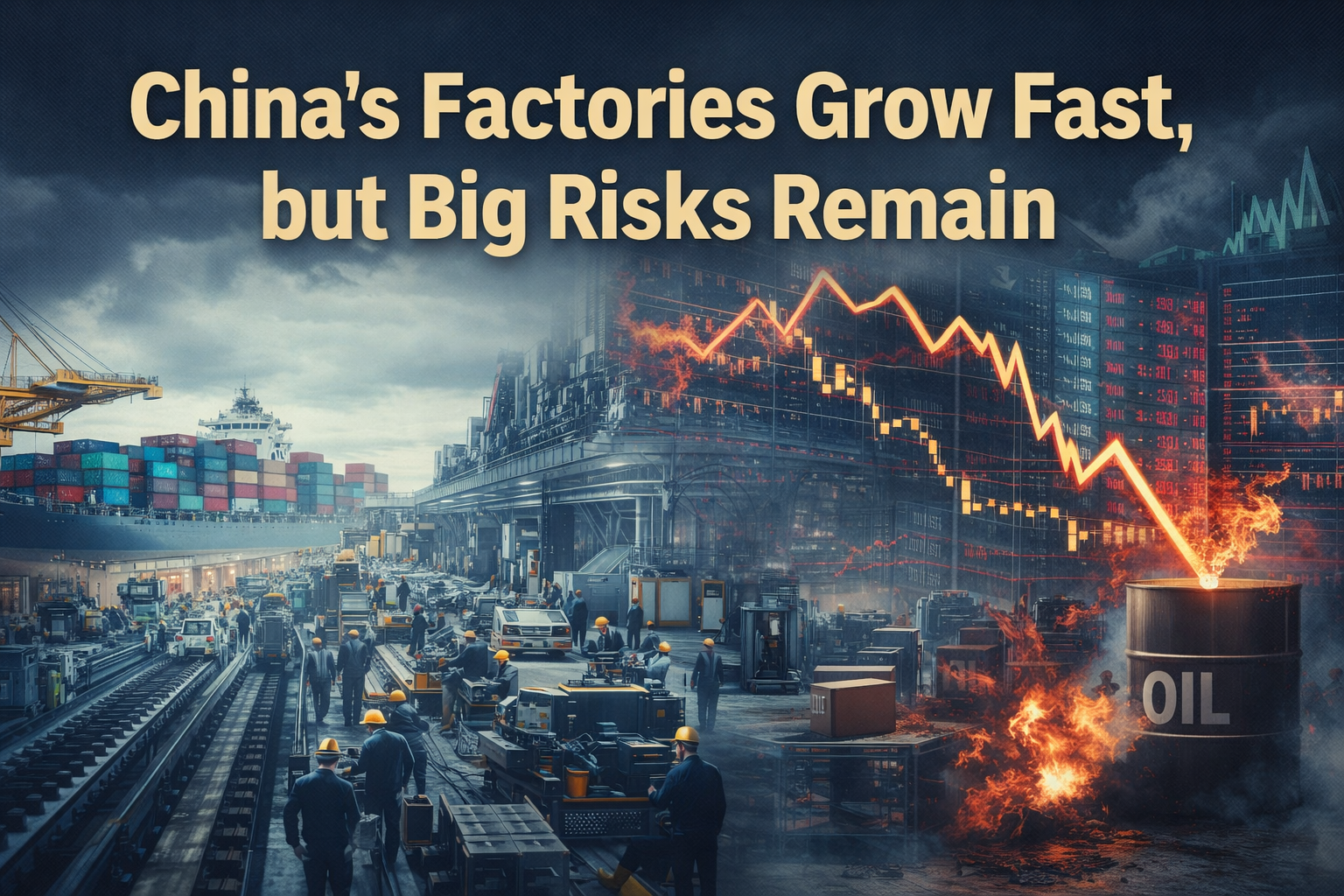
China’s Factories Grow Fast, but Big Risks Remain
Intermediate | April 5, 2026
✨ 혼자서 기사를 소리 내어 읽거나 튜터를 따라 각 단락을 반복해서 읽으세요. 레벨...
China Factory Growth Returns
China’s factories had a stronger March, and that gave many investors a little breathing room. According to China’s official data, the manufacturing PMI rose to 50.4, up from 49.0 in February. A number above 50 shows growth, so this was an encouraging change after recent weakness. (Reuters, NBS of China)
A Better Month for Production and Orders
The rebound was helped by stronger demand and the return to normal work after the long Lunar New Year holiday. China’s National Bureau of Statistics said the production index rose to 51.4 and the new order index climbed to 51.6. In other words, factories were making more goods and receiving more business. That is usually a sign that companies are feeling more active and confident. (NBS of China)
Why the Mood Is Still Careful
Even so, nobody is opening the champagne just yet. Reuters reported that rising war risks in the Middle East are making markets nervous about slower global growth and supply chain problems. Raw material prices also jumped sharply, which means factories may soon face higher costs. When input costs rise but selling prices do not rise as fast, profit margins can get squeezed. That is the kind of pressure that can make businesses more cautious. (Reuters)
China Factory Growth Still Faces Export Pressure
Another weak point is exports. Reuters said the new export orders reading improved to 49.1 from 45.0, which is better, but still below the 50 line. That means foreign demand is still not fully back in growth mode. This matters because China has leaned heavily on exports while domestic demand has stayed weak. A long property slump and softer consumer spending have already made life harder at home. (Reuters, AP News)
The Energy Risk Hanging Over Everything
The biggest cloud over this story may be energy. AP reported that analysts are watching the impact of war-related disruptions around the Strait of Hormuz, a route that normally handles roughly a fifth of the world’s oil. If energy flows stay disrupted for weeks or months, China could face higher fuel costs, shipping problems, and shortages of important industrial materials. That could slow factories down again, even after this stronger March report. (AP News)
A Good Sign, Not a Final Victory
So, what should learners take away from this story? March brought real improvement, and that matters. China’s factory sector showed life again, and that is good news for business confidence. But the global picture is still shaky. If war risks, energy prices, and weak export demand continue, this recovery could lose steam in a hurry. For now, the story is hopeful—but it is still walking on thin ice.
Vocabulary
- PMI (noun) – a survey measure that shows whether business activity is growing or shrinking.
Example: The PMI moved above 50, which signaled growth in factory activity. - manufacturing (noun) – the business of making goods in factories.
Example: China’s manufacturing sector had a stronger month in March. - rebound (noun) – a recovery after a fall or weak period.
Example: The rebound in production gave the market some hope. - demand (noun) – the need or desire for goods or services.
Example: Stronger demand helped factories receive more new orders. - input costs (noun) – the cost of materials and resources used to make products.
Example: Rising input costs can reduce company profits. - profit margin (noun) – the difference between sales income and costs.
Example: A company’s profit margin can shrink when costs rise too fast. - exports (noun) – goods sold to other countries.
Example: China depends on exports to support part of its economy. - domestic demand (noun) – demand from consumers and businesses inside a country.
Example: Weak domestic demand has remained a problem for China. - disruption (noun) – a problem that interrupts normal activity.
Example: Supply chain disruption can slow production and delay deliveries. - momentum (noun) – forward movement or growing strength.
Example: The factory recovery could lose momentum if energy prices stay high.
Discussion Questions (About the Article)
- What does the rise in China’s PMI tell us about factory activity in March?
- Why did production and new orders improve after February?
- Why are investors still worried even though the factory data looked better?
- Why do export orders matter so much for China’s economy right now?
- How could higher energy costs hurt factories in the coming months?
Discussion Questions (About the Topic)
- Why do wars in one region often affect businesses around the world?
- Do you think countries should depend less on exports? Why or why not?
- What industries in your country are most sensitive to energy prices?
- How do higher shipping or fuel costs affect ordinary consumers?
- What signs do you usually look for when judging whether an economy is healthy?
Related Idiom
“Walking on thin ice” – being in a risky situation where things could go wrong quickly.
Example: China’s factory recovery looks promising, but it may be walking on thin ice if global energy problems get worse.
📢 Want more practical English practice with real-world stories? Sign up for the All About English Mastery Newsletter! Click here to join us.
Want to finally master English but don’t have the time? Mastering English for Busy Professionals is built for busy people like you.
Follow our YouTube Channel @All_About_English for more useful English tips and real-world practice.
This article was inspired by: Reuters, National Bureau of Statistics of China, and AP News


 한국어
한국어  English