

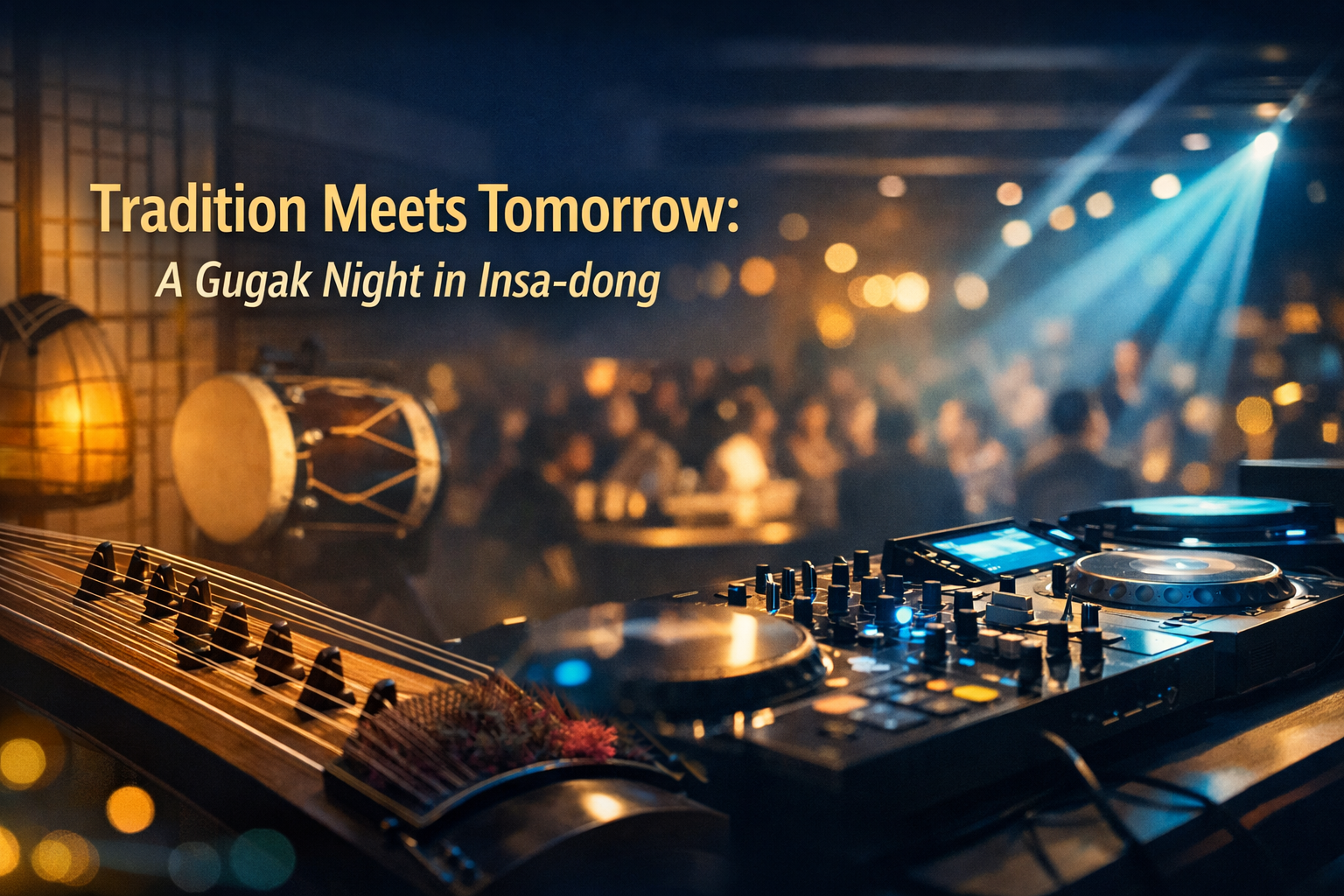
Tradition Meets Tomorrow at KOTE: A Gugak Night With DJs
Beginner | January 16, 2026
✨ 혼자서 기사를 소리 내어 읽거나 튜터를 따라 각 단락을 반복해서 읽으세요. 레벨...
What’s Happening in Insa-dong?
If you’re in Seoul this weekend, there’s a cultural event that mixes old Korea with modern sound. It’s called KOTE, and it’s happening in Insa-dong (central Seoul) on Saturday, Jan. 31. The main idea is simple: bring traditional Korean music (gugak) into a modern setting—without losing its heart. (koreatimes.co.kr)
A Gugak Event at KOTE With DJs and Live Tradition
This gugak event at KOTE isn’t a quiet museum-style concert. On the ground floor, there will be two DJ sets. One DJ will blend traditional motifs with contemporary beats, and another will add modern energy on top of ancient melodies. (koreatimes.co.kr)
Downstairs: A Pansori Jam You Can Join
In the basement, the vibe changes again. A group called Bikabi—a troupe of foreign pansori singers—will lead an interactive pansori jam. That means it’s not only a performance; it’s also a chance for the audience to feel the rhythm and be part of it. (koreatimes.co.kr)
(Quick note: pansori* is a Korean storytelling style performed by a singer and a drummer, and it can be very expressive—almost like acting with music.)* (ich.unesco.org)
Who’s Behind It—and Why They’re Doing It
The event is organized by Muzikey, led by Cindy Kwak (founder & CEO) with Garry Kwon (COO and co-founder). Kwak said gugak is more than a music genre—it’s a mix of philosophy, craftsmanship, and emotional depth. She also said that while modern music can become “mass-produced,” traditional sound has a kind of authenticity that still hits people emotionally today. (koreatimes.co.kr)
Why the Gugak Event at KOTE Matters
In business, we talk a lot about innovation, but the best innovation usually starts with strong roots. This gugak event at KOTE is a good example: it doesn’t throw tradition away—it updates the “packaging” so more people can experience it. If you’re learning English, it’s also a great reminder that blending old and new can make you more confident and more interesting in conversation.
Vocabulary
- tradition (noun) – a long-established custom or way of doing something.
Example: “Insa-dong is a great place to see Korean tradition.” - performer (noun) – a person who sings, plays music, or acts for an audience.
Example: “The performers will mix gugak with modern sounds.” - motif (noun) – a repeated theme or pattern (in music, art, or design).
Example: “One DJ will use traditional motifs inside modern beats.” - contemporary (adjective) – modern; happening now.
Example: “The show blends contemporary music with older styles.” - melody (noun) – the main musical tune you can hum.
Example: “Ancient melodies will be remixed in a new way.” - interactive (adjective) – involving participation, not only watching.
Example: “The basement will have an interactive pansori jam.” - audience (noun) – the people watching or listening to a performance.
Example: “The audience may join in during parts of the show.” - organizer (noun) – a person or group that plans an event.
Example: “Muzikey is the organizer behind the KOTE event.” - craftsmanship (noun) – skill and care in making something well.
Example: “She said gugak has deep craftsmanship behind it.” - reinterpret (verb) – to give something a new meaning or style.
Example: “The DJs will reinterpret traditional Korean music.”
Discussion Questions (About the Article)
- What is KOTE, and where is it happening?
- What makes this event different from a normal traditional concert?
- Why do you think DJs are being included in a gugak event?
- What is Bikabi, and what will they do at the event?
- What did Cindy Kwak say about gugak and modern music?
Discussion Questions (About the Topic)
- Do you like traditional music? Why or why not?
- How do people in your country modernize traditional culture?
- What are the benefits of mixing old and new styles?
- If you could remix a traditional song, what would you add?
- How can culture events help a city’s image and tourism?
Related Idiom
“The best of both worlds” – getting the good parts of two different things.
Example: “KOTE tries to give the best of both worlds: traditional gugak and modern club energy.”
📢 Want more learner-friendly news like this? 👉 Sign up for the All About English Mastery Newsletter! Click here
Want to finally master English but don’t have the time? Mastering English for Busy Professionals is built for you.
Follow our YouTube Channel @All_About_English for more tips.
This article was inspired by The Korea Times. (koreatimes.co.kr)

 한국어
한국어  English