

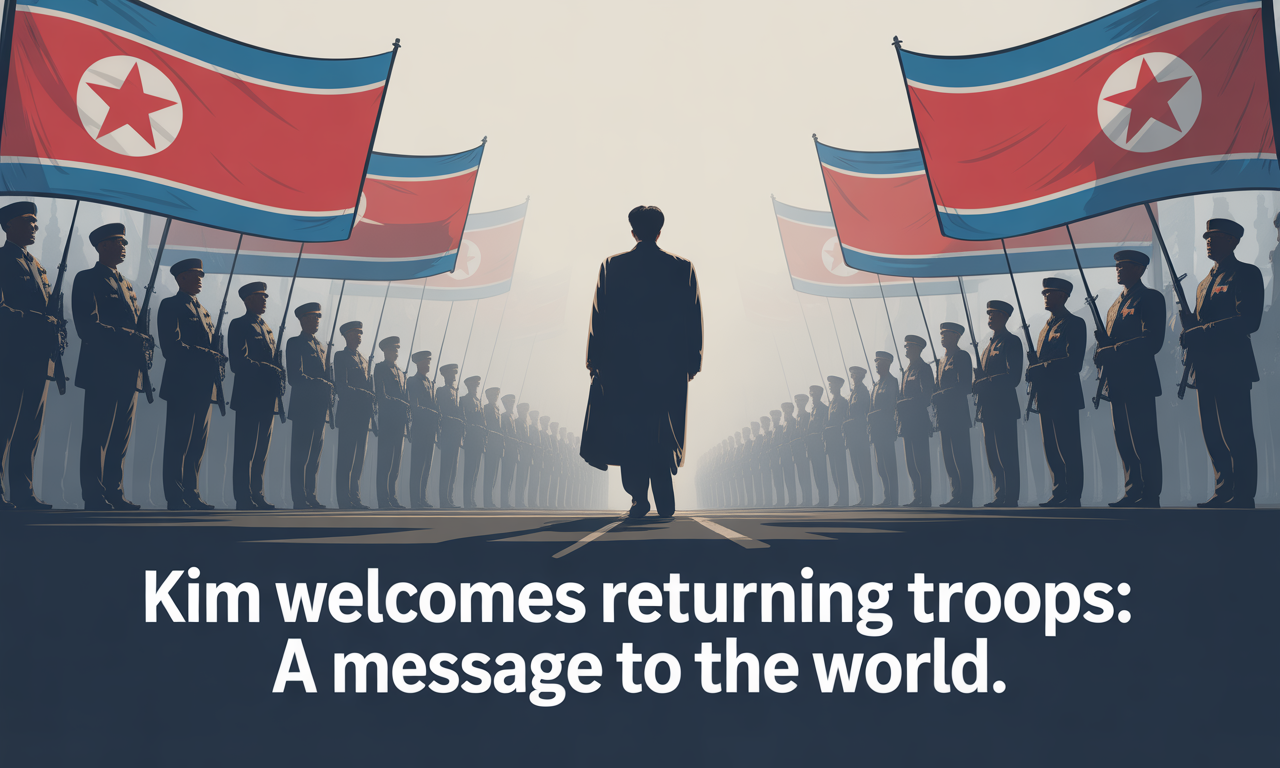
Kim Welcomes Returning Troops: A Message to the World
Intermediate | December 16, 2025
✨ 혼자서 기사를 소리 내어 읽거나 튜터를 따라 각 단락을 반복해서 읽으세요. 레벨...
Kim welcomes returning troops — and the timing matters
North Korea’s state media showed a very public scene this week: leader Kim Jong Un welcoming home a military engineering unit after an overseas deployment linked to Russia’s war in Ukraine. According to Reuters, Kim attended a ceremony in Pyongyang for the 528th Regiment of Engineers, praising them for “heroic” actions and “mass heroism” after a 120-day mission in Russia’s Kursk region.
What the unit reportedly did in Russia
Reuters reports that KCNA said the regiment was dispatched in early August and carried out combat and engineering tasks, including mine-clearing under combat conditions. A separate Reuters background report noted that Russian officials had previously credited North Korean forces with helping de-mine areas of the Kursk region. Video footage released by North Korea showed soldiers disembarking from an aircraft and Kim greeting returning troops—images clearly designed to communicate pride, unity, and momentum.
Honors, losses, and a big gap in the numbers
In the same Reuters report, Kim announced top military honors for the regiment, including the Order of Freedom and Independence for the unit, along with posthumous “Hero of the DPRK” titles for nine fallen soldiers.
But here’s the part that makes analysts pay attention: Reuters noted that external reports from South Korean, Ukrainian, and Western sources have claimed much higher death tolls—thousands—among North Korean troops reportedly deployed to help Russia. Additional coverage from Al Jazeera has also highlighted the gap between official North Korean statements and outside estimates. That contrast doesn’t just look like a disagreement; it looks like information management.
Why the ceremony matters beyond North Korea
When Kim welcomes returning troops, it’s not just a “homecoming.” It’s a strategic signal. A public ceremony tells domestic audiences that the mission was successful and honorable. It also tells international audiences that cooperation with Russia is real—and that Pyongyang is willing to show it on camera.
The business angle: risk, sanctions, and uncertainty
Even if you’re not a geopolitics person, events like this matter because they shape the global environment that companies operate in. As Reuters and regional analysts have pointed out, deeper Russia–North Korea ties can increase sanctions pressure, complicate regional security, and raise uncertainty for trade and investment—especially in Northeast Asia. In plain English: when tensions rise, markets get jumpy, and businesses become more cautious.
Bottom line
For English learners, this story is a good reminder that public events can be part ceremony, part strategy. And for the world, it shows that North Korea is continuing to publicly back its partnership with Russia—while carefully controlling the message about costs and casualties.
Vocabulary
- Regiment (noun) – a large military unit.
- Example: “The regiment returned to Pyongyang after its deployment.”
- Deployment (noun) – sending troops or resources to a location.
- Example: “The deployment lasted about 120 days.”
- Mine-clearing (noun/gerund) – removing explosive mines from an area.
- Example: “Mine-clearing is dangerous work, especially during combat.”
- Ceremony (noun) – a formal public event.
- Example: “Kim attended a ceremony to welcome the soldiers home.”
- Posthumous (adjective) – given after someone has died.
- Example: “The soldier received a posthumous award.”
- Honor (noun/verb) – respect shown through awards or praise.
- Example: “The unit was honored for its service.”
- Contrast (noun) – a clear difference between two things.
- Example: “There was a contrast between official and outside casualty reports.”
- Signal (noun/verb) – a message that suggests intentions.
- Example: “The ceremony signaled strong ties with Russia.”
- Sanctions (noun) – penalties placed on a country to pressure behavior.
- Example: “Sanctions can affect trade, banking, and supply chains.”
- Uncertainty (noun) – not knowing what will happen next.
- Example: “Uncertainty can make businesses delay big decisions.”
Discussion Questions (About the Article)
- Who did Kim welcome home, and what did Reuters say the unit did in Russia?
- Why do you think North Korea held such a public ceremony?
- What details in the story suggest the event was meant to “send a message”?
- Why is there a difference between the casualty numbers reported by KCNA and outside sources?
- How could this story affect the way other countries respond to North Korea?
Discussion Questions (About the Topic)
- Why do governments sometimes use ceremonies to shape public opinion?
- How can media coverage change the way people interpret the same event?
- In international conflicts, why are casualty numbers often disputed?
- How can sanctions impact ordinary businesses and workers?
- What should global companies do when political risk increases in a region?
Related Idiom / Phrase
“Send a signal” – to communicate intentions without saying them directly.
Example: “When Kim hails troops returning from Russia mission, the ceremony sends a signal that the partnership is strong.”
📢 Want more tips like this? 👉 Sign up for the All About English Mastery Newsletter! Click here to join us!
Want to finally master English but don’t have the time? Mastering English for Busy Professionals is the course for you! Check it out now!
Follow our YouTube Channel @All_About_English for more great insights and tips.
This article was inspired by: Reuters (Dec 12, 2025), with supporting context from Al Jazeera, Xinhua, and an earlier Reuters report.


 한국어
한국어  English