

McCormick and Unilever Shake Up the Food Business
Intermediate | April 7, 2026
✨ 혼자서 기사를 소리 내어 읽거나 튜터를 따라 각 단락을 반복해서 읽으세요. 레벨...
A Huge Food Deal Gets Everyone’s Attention
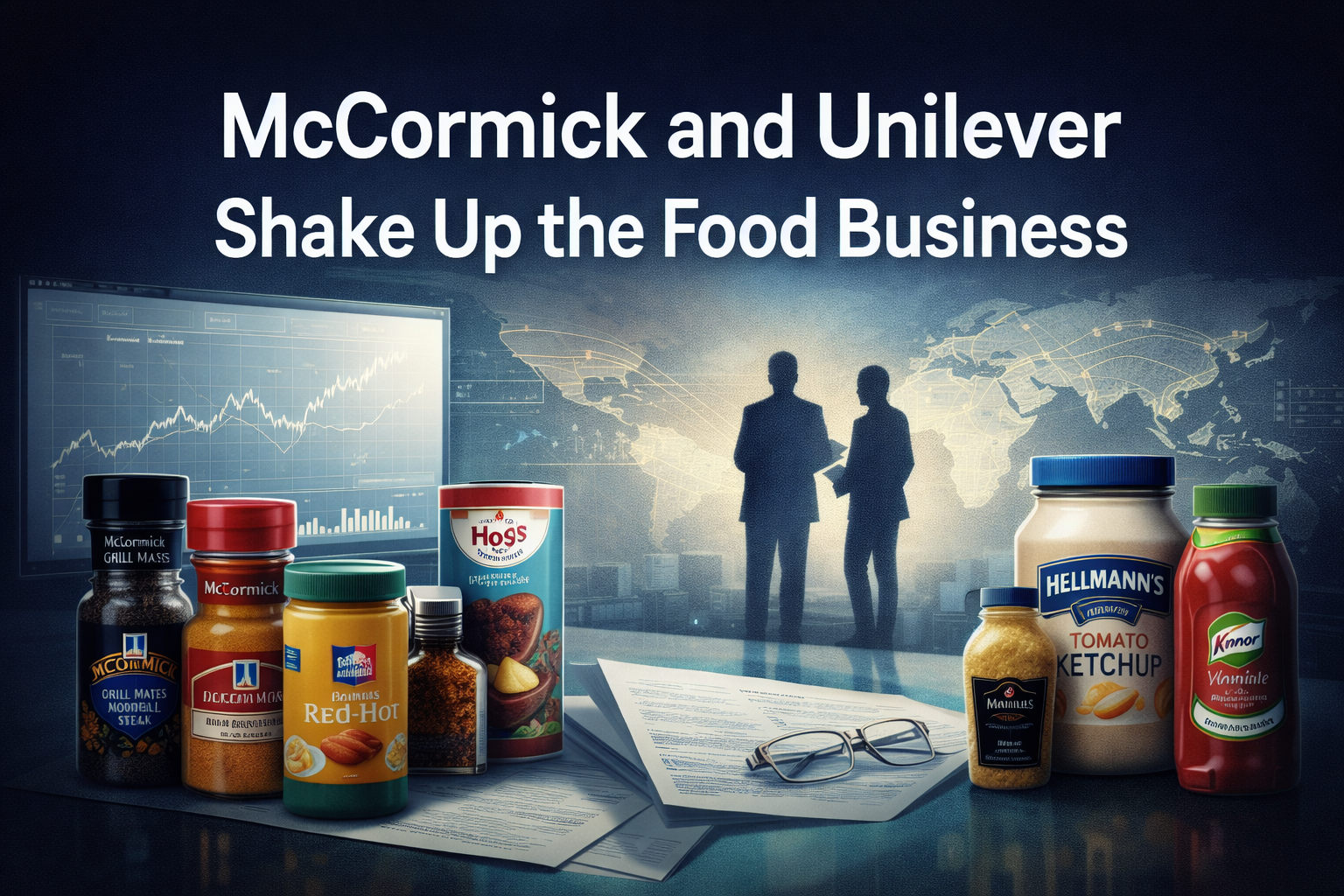
On March 31, 2026, Unilever and McCormick announced a major deal involving Unilever’s food business. Many headlines described it as McCormick buying Unilever’s food arm in a $44.8 billion deal. That headline catches attention, but the real structure is a little more complex. Unilever said it will separate its food division and combine it with McCormick, creating a much larger food company built around brands such as Knorr, Hellmann’s, McCormick, French’s, Frank’s RedHot, and Cholula. (Reuters)
Why the McCormick Unilever Food Deal Matters
The McCormick Unilever food deal matters because it could reshape the global packaged-food industry. Reuters reported that the new company would be worth around $65 billion, making it the second-largest food transaction in history. McCormick and Unilever said the combined business would have about $20 billion in 2025 revenue. In plain English, this is not some small side move—it is a serious power play in sauces, seasonings, condiments, and cooking products. (Reuters)
What Each Company Gets Out of It
Under the agreement, Unilever and its shareholders are expected to own 65% of the new company’s equity, while McCormick shareholders would own 35%. Reuters reported that Unilever would also receive $15.7 billion in cash, while the equity portion tied to Unilever shareholders was valued at about $29.1 billion. The companies are using a structure called a Reverse Morris Trust, which can offer tax benefits. That may sound technical, but the basic idea is simple: Unilever wants to slim down and focus on household and personal care, while McCormick wants more scale, more brands, and stronger global reach. (Reuters; Unilever)
A Bigger Global Flavor Business
AP reported that the deal could give McCormick stronger access to Latin America and Asia, where Unilever already has a big presence. At the same time, it could strengthen Unilever’s food brands in North America, where McCormick is stronger. The companies also said they expect $600 million in annual cost savings and more strength in food service, not just supermarket shelves. In other words, they are betting that bigger size and better distribution will help them stay competitive in a market where consumers are changing habits and watching prices carefully. (AP News)
Why Unilever Is Moving Away from Food
This deal also shows how much Unilever has changed. In recent years, the company has moved away from slower-growth food categories and pushed harder into beauty, wellbeing, personal care, and home care. Reuters noted that Unilever already spun off its ice cream business and has sold other food-related brands in recent years. The company’s food division still made up more than a quarter of overall sales, but growth was lagging behind faster-moving parts of the business. So Unilever seems to be saying, “Let’s stop trying to do everything and focus where growth looks stronger.” That is a classic big-business move. (Reuters; AP News)
Not Everyone Is Cheering Yet
Even though the deal is huge, investors were not throwing confetti in the streets. Reuters reported that Unilever shares fell and McCormick shares also dropped after the announcement, as some analysts questioned the structure and value of the transaction. That tells us something important: big deals may sound exciting, but the market still asks tough questions. Will the two companies work well together? What about the savings? Will they really happen? Will regulators approve everything? The deal is expected to close by mid-2027, so there is still a long road ahead. (Reuters; AP News)
Final Take
For English learners, this story is a great example of how business news can sound simple on the surface but become more interesting once you dig into the details. Yes, many people say McCormick is buying Unilever’s food arm. But the deeper story is about strategy, restructuring, ownership, global expansion, and the future of major consumer brands. The McCormick Unilever food deal is not just about ketchup, hot sauce, and mayonnaise. It is about how global companies try to stay sharp when growth slows down and competition heats up.
Vocabulary
- division (noun) – a major part of a company that focuses on a specific area of business.
Example: Unilever decided to separate its food division from the rest of the company. - combine (verb) – to join two things together.
Example: The deal will combine Unilever’s food business with McCormick. - equity (noun) – ownership in a company.
Example: Unilever and its shareholders are expected to hold 65% of the new company’s equity. - stake (noun) – a share or financial interest in a business.
Example: Investors watched closely to see how large each company’s stake would be. - revenue (noun) – the money a company brings in from sales.
Example: The combined business is expected to have about $20 billion in revenue. - transaction (noun) – a business deal or exchange.
Example: Reuters described this as the second-largest food transaction in history. - scale (noun) – the size or reach of a business.
Example: McCormick wants more global scale after the deal. - distribution (noun) – the system of getting products to stores or customers.
Example: Better distribution could help the new company grow faster. - regulator (noun) – an authority that checks whether companies follow rules and laws.
Example: Regulators still need to review the deal before it can close. - streamline (verb) – to make something simpler and more efficient.
Example: Unilever wants to streamline its business and focus on fewer categories.
Discussion Questions (About the Article)
- Why are some headlines calling this a purchase, even though the deal structure is more complicated?
- What brands will become part of the new combined food company?
- Why does Unilever want to move away from some food businesses?
- What advantages could McCormick gain from this deal?
- Why do you think investors reacted negatively after the announcement?
Discussion Questions (About the Topic)
- Do you think big companies should focus on fewer business areas or try to stay diversified?
- What are the risks of very large mergers in the food industry?
- How can global brands stay competitive when shoppers become more price-sensitive?
- Do you think consumers care who owns the brands they buy? Why or why not?
- What makes a business deal sound attractive in headlines but risky to investors?
Related Idiom
“Trim the fat” – to remove unnecessary parts in order to become more efficient.
Example: “Unilever seems to be trimming the fat by moving away from slower-growth food categories and focusing on higher-growth areas.”
📢 Want more practical English practice with real-world stories? Sign up for the All About English Mastery Newsletter! Click here to join us.
Want to finally master English but don’t have the time? Mastering English for Busy Professionals is built for busy people like you.
Follow our YouTube Channel @All_About_English for more useful English tips and real-world practice.
This article was inspired by: Reuters, Reuters, AP News, and Unilever

 한국어
한국어  English