

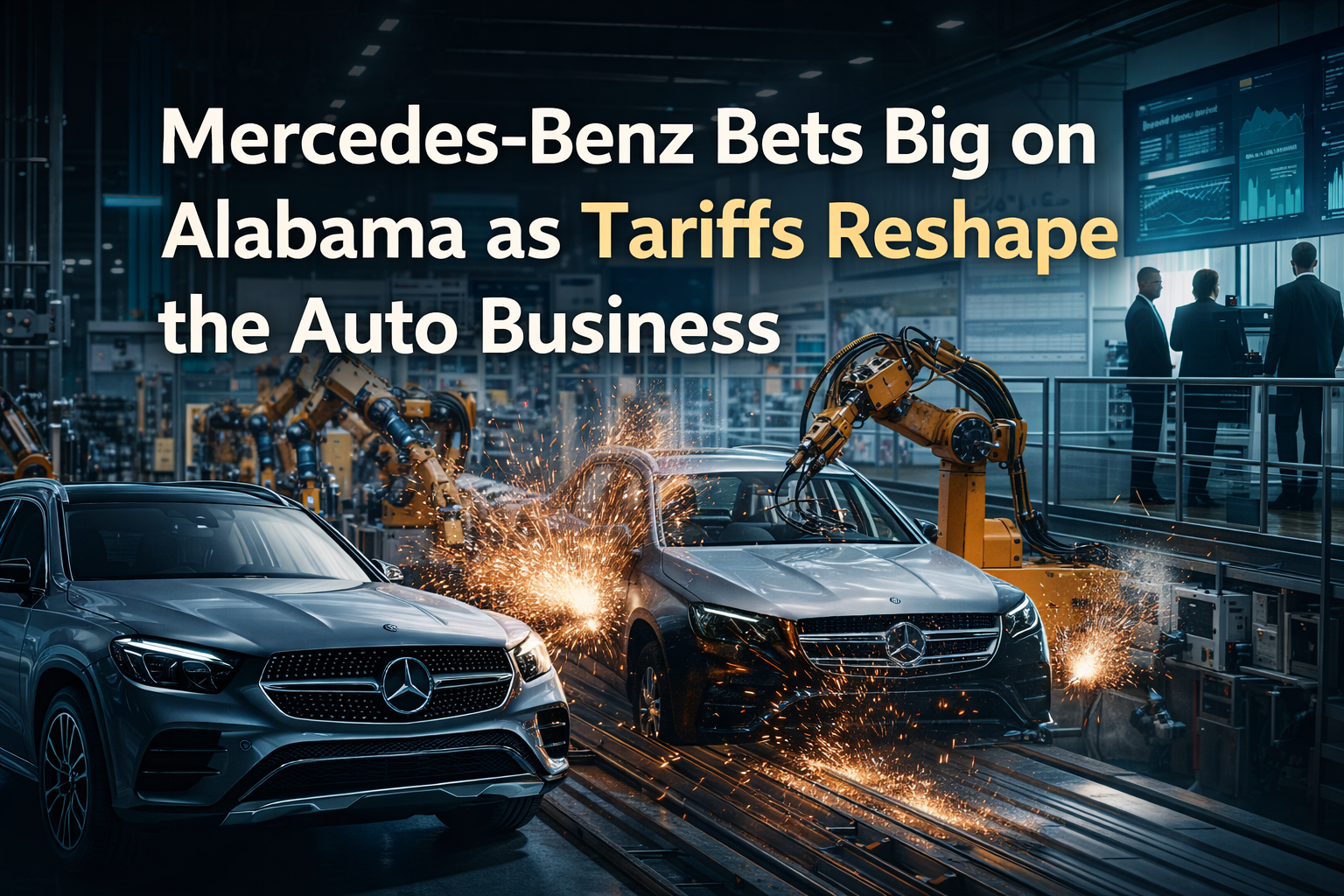
Mercedes-Benz Bets Big on Alabama as Tariffs Reshape the Auto Business
Advanced | April 2, 2026
✨ 혼자서 기사를 소리 내어 읽거나 튜터를 따라 각 단락을 반복해서 읽으세요. 레벨...
Mercedes Alabama Investment Signals a Big Move in Alabama
Mercedes-Benz says it will invest $4 billion in its Alabama plant through 2030 as the company adjusts to heavy U.S. auto tariffs. This Mercedes Alabama investment is one of the clearest signs yet that global automakers are reworking production plans to deal with new trade pressure. The investment is focused on boosting SUV production in Tuscaloosa, Alabama, and it is part of a broader plan to invest more than $7 billion in U.S. operations in the coming years. According to reports, this move is meant to help Mercedes reduce the pressure caused by tariffs on imported vehicles and parts. (Reuters)
Why Mercedes Is Making This Move
This decision did not come out of nowhere. President Trump’s tariff strategy has changed the math for foreign automakers selling cars in the United States. Mercedes had already said it would shift production of the GLC SUV from Germany to Alabama, and now the company is going even bigger. Mercedes-Benz North America CEO Jason Hoff said local production for high-volume vehicles makes strong business sense in the current environment. In plain English, the company is trying to make more of its popular vehicles inside the U.S. instead of paying a tariff bill that could eat away at profits. (Reuters, Fox Business)
The Pressure Behind the Announcement
Mercedes has a real reason to move fast. In February, the company said its group operating profit had dropped by more than half to 5.8 billion euros, with about 1 billion euros in tariff costs helping drive that decline. That is a painful hit, and it shows how government policy can quickly shake up global business strategy. The company also said U.S. passenger car sales rose 1% last year to about 303,000 vehicles, so the American market is still too important to ignore. When a company sees steady demand but rising costs, it usually starts looking for a smarter setup. That seems to be exactly what is happening here. (Reuters)
More Than Just One Factory
This is not only about one plant in Alabama. Reports say Mercedes plans to move up to 500 jobs from different parts of the country into a new research and development hub in Atlanta. At the same time, Alabama officials highlighted another major milestone: the Tuscaloosa plant has now built its 5 millionth vehicle. Local coverage also noted that Mercedes is using this moment to push for stronger U.S. sales growth by 2030 and to deepen its long-term footprint in the American market. So, this is part factory expansion, part political response, and part long-term U.S. growth strategy. (Reuters, Made in Alabama, WVTM 13)
What This Means for the U.S. Auto Industry
This story matters because it shows how tariffs can push global companies to rethink where they build products, where they hire workers, and where they place future investment. The Mercedes Alabama investment story is also a good example of how fast a company can change direction when costs and policy start pulling in opposite directions. For Alabama, the news is obviously a win: more investment, more attention, and likely more jobs tied to production and related industries. For Mercedes, it is a defensive move, but also a strategic one. The company is trying to stay competitive in a market where politics and manufacturing are now tightly linked. One way or another, the message is clear: when trade rules change, companies do not just complain—they move money, jobs, and production lines.
The Bigger Lesson for Business
For English learners in business, this is a useful story because it brings together several real-world ideas: tariffs, supply chains, manufacturing, profitability, and long-term strategy. It also reminds us that business decisions are rarely just about one thing. Mercedes is reacting to political pressure, protecting profit, and trying to stay close to customers at the same time. That is a lot of moving parts. In business, when the ground shifts, smart companies do not sit around wringing their hands. They start making moves.
Vocabulary
- Tariff (noun) – a tax placed on imported goods.
Example:
The new tariff made imported vehicles more expensive. - Reshape (verb) – to change the form or direction of something.
Example:
Government policy can reshape the auto industry very quickly. - Investment (noun) – money put into a project or business to create future growth.
Example:
Mercedes announced a major investment in its Alabama plant. - Operating profit (noun) – the money a company makes from its main business activities.
Example:
The company’s operating profit fell sharply last year. - Localize (verb) – to move production or services closer to a local market.
Example:
Mercedes wants to localize more SUV production in the United States. - Footprint (noun) – the size or presence of a company in a region or market.
Example:
The company is expanding its footprint in the U.S. market. - Mitigate (verb) – to reduce the severity of something.
Example:
The investment may help mitigate the effect of tariffs. - Competitive (adjective) – able to compete successfully in a market.
Example:
Companies must stay competitive even when costs rise. - Strategy (noun) – a long-term plan designed to achieve a goal.
Example:
This factory move is part of Mercedes’ larger U.S. strategy. - Milestone (noun) – an important stage or achievement.
Example:
Building the plant’s 5 millionth vehicle was a major milestone.
Discussion Questions (About the Article)
- Why is Mercedes-Benz investing so much money in Alabama now?
- How did tariffs influence Mercedes’ production strategy?
- Why is the U.S. market still important for Mercedes despite higher costs?
- What does the Atlanta research and development hub add to the story?
- Do you think this move is mostly defensive, strategic, or both? Why?
Discussion Questions (About the Topic)
- Should governments use tariffs to push companies to produce locally?
- What are the advantages of building products close to the customer?
- How can political decisions change business strategy?
- What industries in your country are most affected by trade policy?
- When costs rise, what is the smartest way for a company to respond?
Related Idiom
“Put your money where your mouth is” – to take real action to support what you say.
Example:
Mercedes is putting its money where its mouth is by investing billions in U.S. production instead of only talking about change.
📢 Want more practical English using real news? 👉 Sign up for the All About English Mastery Newsletter! Click here to join us!
Want to finally Master English but don’t have the time? Mastering English for Busy Professionals is the course for you! Check it out now!
Follow our YouTube Channel @All_About_English for more great insights and tips.
This article was inspired by: Reuters, Fox Business, Made in Alabama, and WVTM 13


 한국어
한국어  English