

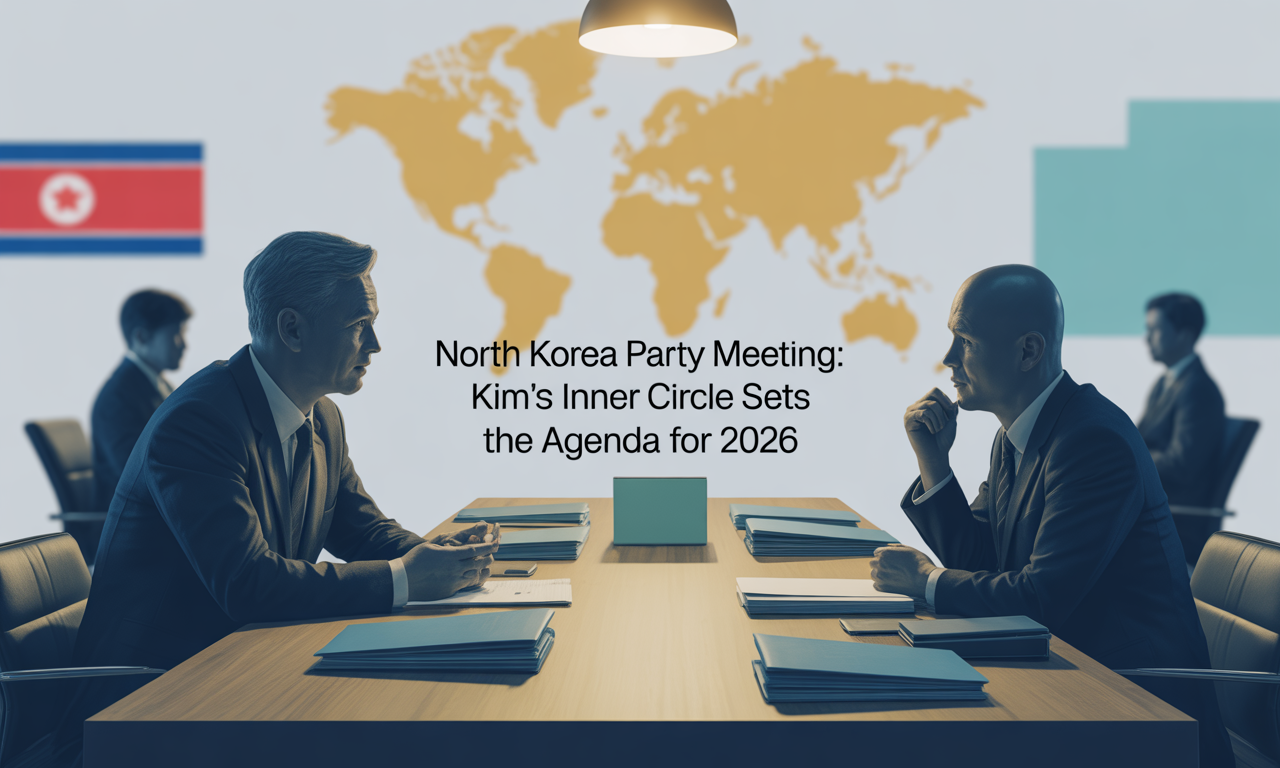
North Korea Party Meeting: Kim’s Inner Circle Sets the Agenda for 2026
Advanced | December 23, 2025
✨ 혼자서 기사를 소리 내어 읽거나 튜터를 따라 각 단락을 반복해서 읽으세요. 레벨...
North Korea party meeting: A Year-End “Board Meeting” with Real Consequences
North Korea just held one of its most important political gatherings of the year: a Workers’ Party of Korea (WPK) Central Committee plenary meeting in Pyongyang. State media said Kim Jong Un chaired the session as senior officials reviewed 2025 policies and discussed preparations for the next party congress—the first full congress in five years. (AP, KCNA)
Think of this as a high-stakes “board meeting,” but for a one-party state. When the WPK sets priorities, ministries, factories, and the military all take their marching orders.
What Happened This Week
According to North Korean reporting, the 13th plenary meeting of the 8th Central Committee ran from December 9 to 11. Participants included Central Committee members and a long list of “observers,” such as senior officials from ministries, regional leadership bodies, major industrial sites, and even military commanders. (KCNA)
The official agenda included reviewing how well the state carried out this year’s plans and sorting out preparations for the upcoming 9th Party Congress.
Why This North Korea Party Meeting Matters
Outside analysts care about these meetings because they often preview what North Korea will emphasize next—especially on the economy, weapons development, and foreign policy. South Korean intelligence has suggested the 9th Party Congress could happen in January or February, and it may include a new multi-year economic plan. (Korea Times)
In other words, this isn’t just ceremony. It’s where the regime tries to align its leadership, budgets, and messaging before a big public “relaunch.”
The Diplomatic Backdrop: Talks Still Frozen
This North Korea party meeting also comes with diplomacy stuck in a long stalemate. The U.S. and South Korea have signaled they want to restart talks, but Pyongyang has repeatedly rejected those calls since its negotiations with the U.S. collapsed in 2019. Some experts say the 2026 congress could hint at whether Kim wants to reopen dialogue—or double down on confrontation. (AP)
Military Tension in the Background
At the same time, tensions on the peninsula haven’t gone away. South Korea’s military said North Korea fired artillery rounds off its west coast around the time the meeting began—something observers often link to seasonal training, but which still raises the temperature. (AP)
And remember: North Korea has recently hardened its stance toward the South, with reporting that Kim ordered constitutional changes to label South Korea as a permanent enemy. That context shapes how people interpret every major party gathering.
What to Watch Next
Between now and early 2026, three signals matter:
- Congress timing — when Pyongyang officially announces the 9th Party Congress.
- Policy priorities — whether Kim emphasizes economic recovery, military goals, or both.
- Messaging to the outside world — whether the regime leaves any “door open” for talks.
Bottom line: this North Korea party meeting is a reminder that the regime plans in long cycles—and it uses these meetings to set the next cycle’s priorities.
Vocabulary
- Plenary (adjective) – complete; involving all members of a group.
Example: The plenary meeting included top officials from across the party and government. - Congress (noun) – a large official meeting where a party sets major goals.
Example: North Korea’s party congress can reshape national priorities for years. - Agenda (noun) – a list of topics to be discussed in a meeting.
Example: The agenda focused on reviewing 2025 policies and planning the next congress. - Implementation (noun) – putting a plan into action.
Example: Leaders reviewed the implementation of this year’s policy goals. - Elite (noun) – the most powerful group in a society or organization.
Example: The ruling elite gathered to coordinate plans for the next political cycle. - Priorities (noun) – the most important goals to focus on.
Example: The party meeting helps set priorities for the economy and security. - Rebuff (verb) – to reject or refuse.
Example: North Korea has rebuffed calls to restart talks in recent years. - Stalemate (noun) – a situation where progress stops.
Example: Diplomacy has stayed in a stalemate since the 2019 talks collapsed. - Constitutional (adjective) – related to a country’s basic legal framework.
Example: Constitutional changes can signal a long-term shift in national policy. - Budget (noun) – a plan for how money will be spent.
Example: Reports said the meeting discussed budget planning for the next year.
Discussion Questions (About the Article)
- What is the purpose of this North Korea party meeting?
- Who attended the plenary session, according to state media?
- Why do outside analysts pay attention to party meetings and congresses in North Korea?
- What is expected at the 9th Party Congress in early 2026?
- How does military activity affect how people interpret political meetings?
Discussion Questions (About the Topic)
- Why do governments and companies hold “year-end review” meetings?
- How can long-term planning be both a strength and a weakness?
- What usually causes diplomatic stalemates to break—trust, pressure, or incentives?
- How do you think national budgets shape policy priorities?
- Should the international community engage with North Korea more, or apply more pressure? Why?
Related Idiom / Phrase
“Read between the lines” – to look for the hidden meaning behind official words.
Example: Analysts often read between the lines of North Korea’s party meetings to guess what comes next.
📢 Want more news‑based English practice like this? 👉 Sign up for the All About English Mastery Newsletter!
https://allaboutenglishmastery.com/newsletter
Want to finally master English but don’t have the time? Mastering English for Busy Professionals is the course for you!
Follow our YouTube Channel @All_About_English for more great insights and tips.
This article was inspired by:
- AP / Yahoo News
- Associated Press (full story)
- KCNA Watch (KCNA English release)
- The Korea Times (Yonhap)


 한국어
한국어  English