

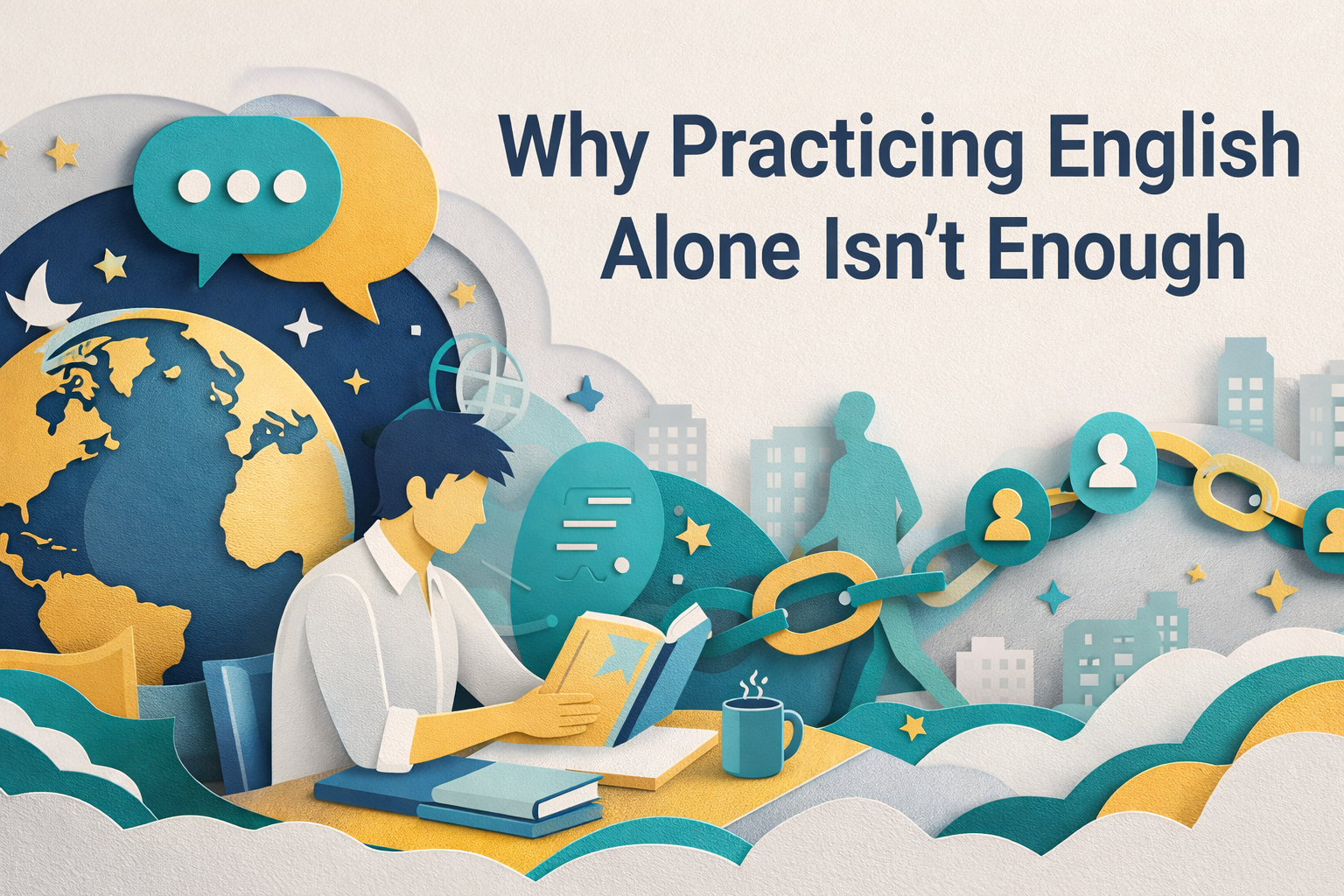
Why Practicing English Alone Isn’t Enough 🤝
Advanced Level | April 6, 2026
혼자서 기사를 소리 내어 읽거나 튜터를 따라 각 단락을 반복해서 읽으세요. 레벨...
A lot of busy professionals practice English alone. They read articles, watch videos, memorize vocabulary, and maybe even talk to themselves in the mirror. That kind of practice is useful. It builds knowledge, sharpens awareness, and gives you time to think. But here’s the hard truth: practicing alone is only part of the job. If your goal is real communication, solo study cannot carry the whole load.
You can think of English like basketball. You can shoot free throws by yourself all day long, and that will help. But eventually, you need to play with other people. You need movement, pressure, reaction, and timing. Language works the same way. Real conversations are messy, fast, and unpredictable. They force you to listen, react, adjust, and stay calm when things do not go exactly as planned.
Why Practicing English Alone Has Limits
When you practice by yourself, you control everything. You choose the topic, the speed, the words, and even the silence. That makes solo practice comfortable, but comfort can become a trap. In real life, nobody hands you the perfect script. A client may interrupt you. A colleague may use an unfamiliar phrase. A manager may ask a question you did not expect. If you only study alone, those moments can hit you like a surprise tax bill nobody asked for.
Another problem is that solo study does not always show you your blind spots. You may think your sentence is clear, but another person may not understand it. Additionally, you may believe your pronunciation is strong, but listeners may still struggle. At the same time, you may know the grammar, yet freeze when someone suddenly asks, “So what do you think?” Interaction reveals the gap between what you know and what you can actually do.
Real Growth Happens in Real Interaction
When you speak with other people, your English becomes active. You stop simply recognizing words and start using them under pressure. That matters. Real conversations train your brain to organize ideas faster. They teach you how to recover from mistakes, ask follow-up questions, and keep the conversation moving even when your mind goes briefly blank.
This is also where confidence is built. Many learners think confidence comes first, and then conversation becomes easier. Usually, it works the other way around. You gain confidence by surviving real conversations again and again. A short chat before a meeting, a quick comment during a Zoom call, or a few lines with a customer can do more for your speaking ability than another silent hour with a textbook.
The Best Mix: Solo Practice Plus Human Practice
This does not mean practicing alone is bad. Far from it. Solo practice is great for building vocabulary, noticing patterns, reading aloud, shadowing videos, and preparing ideas. But it works best when it supports live communication. Think of solo practice as training camp and real conversation as game day. One prepares you. The other proves you can actually perform.
A smart routine for busy professionals might look like this: read an article alone in the morning, review useful expressions during lunch, and then use one or two of those expressions in a real conversation later that day. That simple system creates a bridge between study and action. And that bridge is where fluency begins.
Stop Waiting to Feel “Ready”
One reason learners stay stuck is that they wait too long. They want more vocabulary, better grammar, cleaner pronunciation, and perfect timing before they start talking more. But perfection is a sneaky little thief. It steals momentum. The truth is, you do not become ready and then speak. You speak, and that is how you become ready.
If you want better English for work, business, travel, or relationships, make interaction part of your training. Join a discussion group. Speak to your tutor more actively. Comment during meetings. Ask one more question. Share one more opinion. Use English with living, breathing humans—not just with pages and screens.
Final Thought
Why practicing English alone isn’t enough? Because English is not just a subject to study. It is a tool for connection. And connection cannot be mastered in isolation. Practice alone to prepare. Practice with people to grow. When you combine both, your English becomes more natural, more flexible, and far more useful in the real world.
Vocabulary List
- Isolation (noun) — the state of being alone or separated from others.
Example: Too much isolation can slow your speaking progress. - Unpredictable (adjective) — not able to be known or expected in advance.
Example: Real conversations are often unpredictable. - Blind spot (noun) — a weakness or problem you do not notice in yourself.
Example: Feedback from others helps you find your blind spots. - Interact (verb) — to communicate or work with other people.
Example: You need chances to interact in English every week. - Pressure (noun) — a feeling of stress caused by demands or expectations.
Example: Speaking under pressure helps build real fluency. - Recover (verb) — to return to a normal condition after a problem or mistake.
Example: Good speakers know how to recover after small mistakes. - Flexible (adjective) — able to change or adapt easily.
Example: Strong communicators are flexible in fast conversations. - Momentum (noun) — forward movement or growing progress.
Example: Daily conversation practice builds momentum over time. - Fluency (noun) — the ability to speak smoothly and easily.
Example: Fluency grows when study and real use come together. - Connection (noun) — a relationship or feeling of understanding between people.
Example: Language is powerful because it creates connection.
5 Questions About the Article
- Why is practicing English alone helpful but limited?
- How is learning English similar to practicing basketball?
- What kinds of blind spots can solo practice hide?
- Why does real interaction help build confidence?
- What is one example of combining solo practice with live communication?
5 Open-Ended Discussion Questions
- How do you usually practice English when you are alone?
- What makes real conversations difficult for you sometimes?
- Where could you use more English in your daily or professional life?
- Do you think too many learners wait too long before speaking? Why?
- What would a balanced English practice routine look like for you?
📢 Want more tips like this? 👉 Sign up for the All About English Mastery Newsletter! Click here to join us!
Want to finally Master English but don’t have the time? Mastering English for Busy Professionals is the course for you! Check it out now!
Follow our YouTube Channel @All_About_English for more great insights and tips.

 한국어
한국어  English