

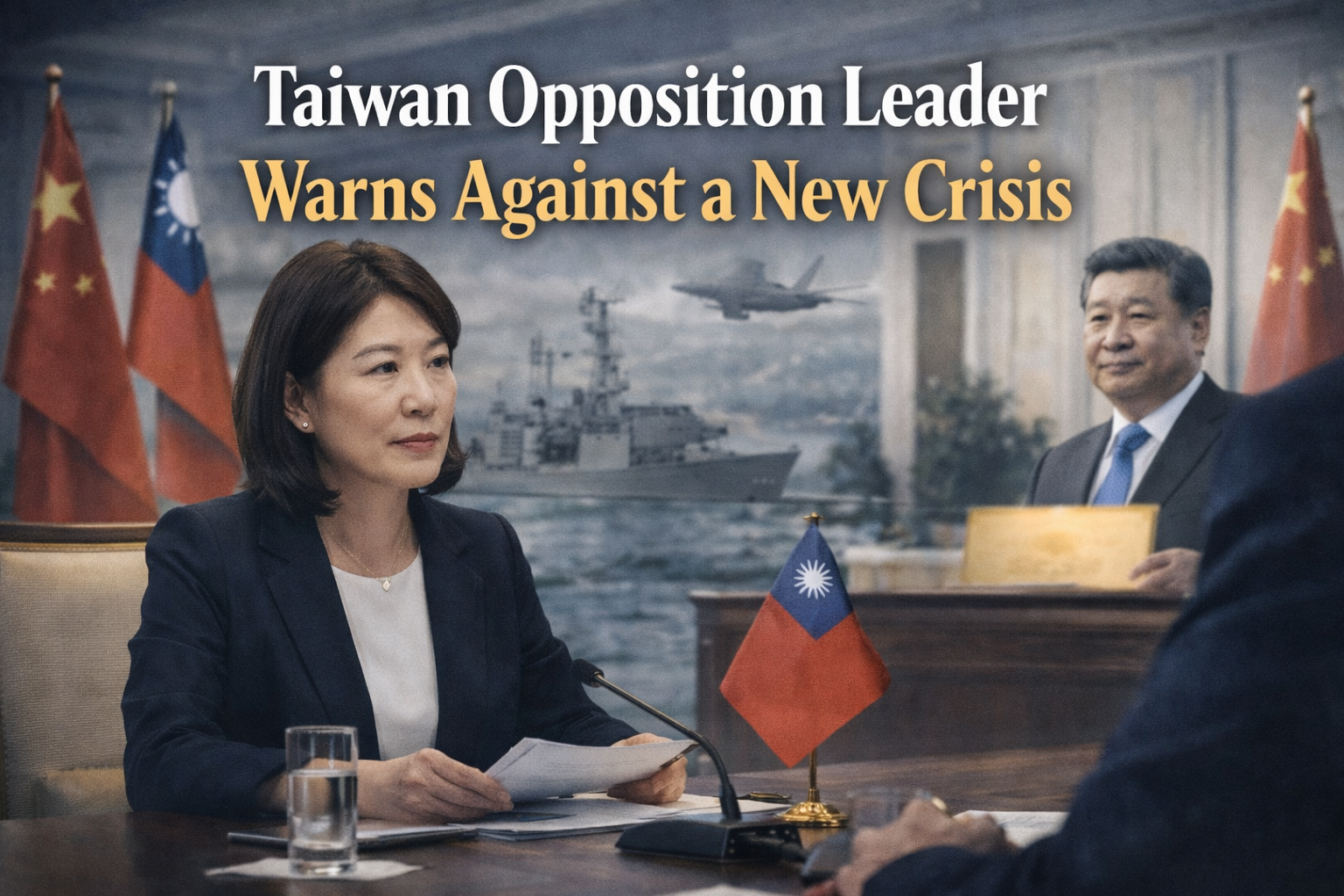
Taiwan Opposition Leader Warns Against a New Crisis
Advanced | April 10, 2026
✨ 혼자서 기사를 소리 내어 읽거나 튜터를 따라 각 단락을 반복해서 읽으세요. 레벨...
A Peace Message Before a Risky Trip
At the start of April, Taiwan opposition leader Cheng Li-wun said the world does not need another crisis over Taiwan as she prepared for a six-day trip to China. Cheng, who leads the Kuomintang (KMT), said she wanted reconciliation both inside Taiwan and across the Taiwan Strait. Her comments came at a tense moment, with China increasing military and political pressure on the island and refusing to speak to Taiwan’s president, Lai Ching-te. (Reuters)
Why the Taiwan Crisis Warning Matters
The Taiwan crisis warning matters because it highlights one of the biggest geopolitical flashpoints in the world. Cheng said Taiwanese people do not want the island to become one of the world’s most dangerous hotspots. At the same time, Taiwan’s government has warned that China’s goal of annexing Taiwan has not changed. That makes her message of peace sound hopeful, but also politically delicate. (Reuters)
Dialogue on One Side, Pressure on the Other
One reason this story is so interesting is the contrast. Cheng called for peace, but Beijing kept up its pressure. Reuters reported on April 9 that while Cheng was in China, Taiwan’s defence ministry detected six Chinese military aircraft and eight warships around the island in just 24 hours. In other words, the language of reconciliation did not make the military pressure disappear. (Reuters)
A Trip With Political Symbolism
The visit itself was politically significant. AP reported that Cheng’s journey was the first by a Taiwanese opposition leader to China in a decade. She described it as a “journey for peace,” but she was also stepping into a very sensitive political space. Cheng may speak for the KMT, but she does not represent Taiwan’s government, and she cannot make formal policy deals with Beijing. That means the trip had symbolic power, even if its practical limits were obvious. (AP News)
Defence Spending Added More Tension
The trip also landed in the middle of an argument over Taiwan’s security budget. Reuters said Taiwan’s opposition-controlled parliament had stalled a proposed $40 billion defence plan backed by President Lai. The KMT says it supports defence, but not what it calls “blank cheques.” Critics, however, argue that delaying military spending sends the wrong signal when China is increasing pressure. That disagreement turned Cheng’s peace mission into part of a larger debate about whether Taiwan should focus more on dialogue, deterrence, or both. (Reuters)
Peace Words, Hard Reality
By April 10, the tone had grown even sharper. Reuters reported that Xi Jinping told Cheng that China would “absolutely not tolerate” Taiwan independence and called for efforts to advance reunification. Cheng responded by saying she hoped the Taiwan Strait would no longer be a focal point for possible conflict. The Taiwan crisis warning now feels even more important, because it shows how peace language and strategic threats can exist side by side. (Reuters)
Vocabulary
- Reconciliation (noun) – the process of restoring friendly relations.
Example: Cheng said her trip was meant to promote reconciliation across the Taiwan Strait. - Flashpoint (noun) – a place or issue that could suddenly become dangerous.
Example: Taiwan is often described as a major flashpoint in Asia. - Annex (verb) – to take control of a place and add it to another state.
Example: Taiwan’s government says China still wants to annex the island. - Deterrence (noun) – action meant to discourage an attack.
Example: Some lawmakers argue stronger deterrence is necessary for peace. - Sovereignty (noun) – the right of a country to govern itself.
Example: Taiwan insists that its sovereignty cannot be decided by Beijing. - Opposition party (noun) – a political party not currently in power.
Example: The KMT is Taiwan’s largest opposition party. - Strait (noun) – a narrow stretch of water between two land areas.
Example: The Taiwan Strait separates Taiwan from mainland China. - Pressure (noun) – force or influence used to make someone act.
Example: China has increased military pressure on Taiwan in recent years. - Reunification (noun) – joining together again as one political unit.
Example: Beijing says reunification is its long-term goal. - Symbolic (adjective) – important mainly for what it represents.
Example: Cheng’s visit had symbolic importance even without formal negotiations.
Discussion Questions (About the Article)
- What did Cheng Li-wun say before leaving for China?
- Why is Taiwan considered a dangerous geopolitical flashpoint?
- How did China’s military activity affect the meaning of Cheng’s peace message?
- Why was Cheng’s trip seen as historically significant?
- How did the defence budget debate shape reactions to her visit?
Discussion Questions (About the Topic)
- Can dialogue reduce tensions even when military pressure continues?
- Should Taiwan focus more on peace talks, defence spending, or both?
- Why do symbolic political visits matter in international relations?
- How can opposition parties influence foreign policy without controlling the government?
- What makes Taiwan such an important issue for the wider world?
Related Idiom or Phrase
“Walk a tightrope”
This phrase means to operate in a difficult situation where one mistake could cause serious problems.
Example: Taiwan’s opposition leaders often have to walk a tightrope between calling for peace and avoiding the appearance of weakness.
📢 Want more practical English practice with real-world stories? Sign up for the All About English Mastery Newsletter! Click here to join us.
Want to finally master English but don’t have the time? Mastering English for Busy Professionals is built for busy people like you.
Follow our YouTube Channel @All_About_English for more useful English tips and real-world practice.
This article was inspired by Reuters, Reuters, Reuters, and AP News.


 한국어
한국어  English