

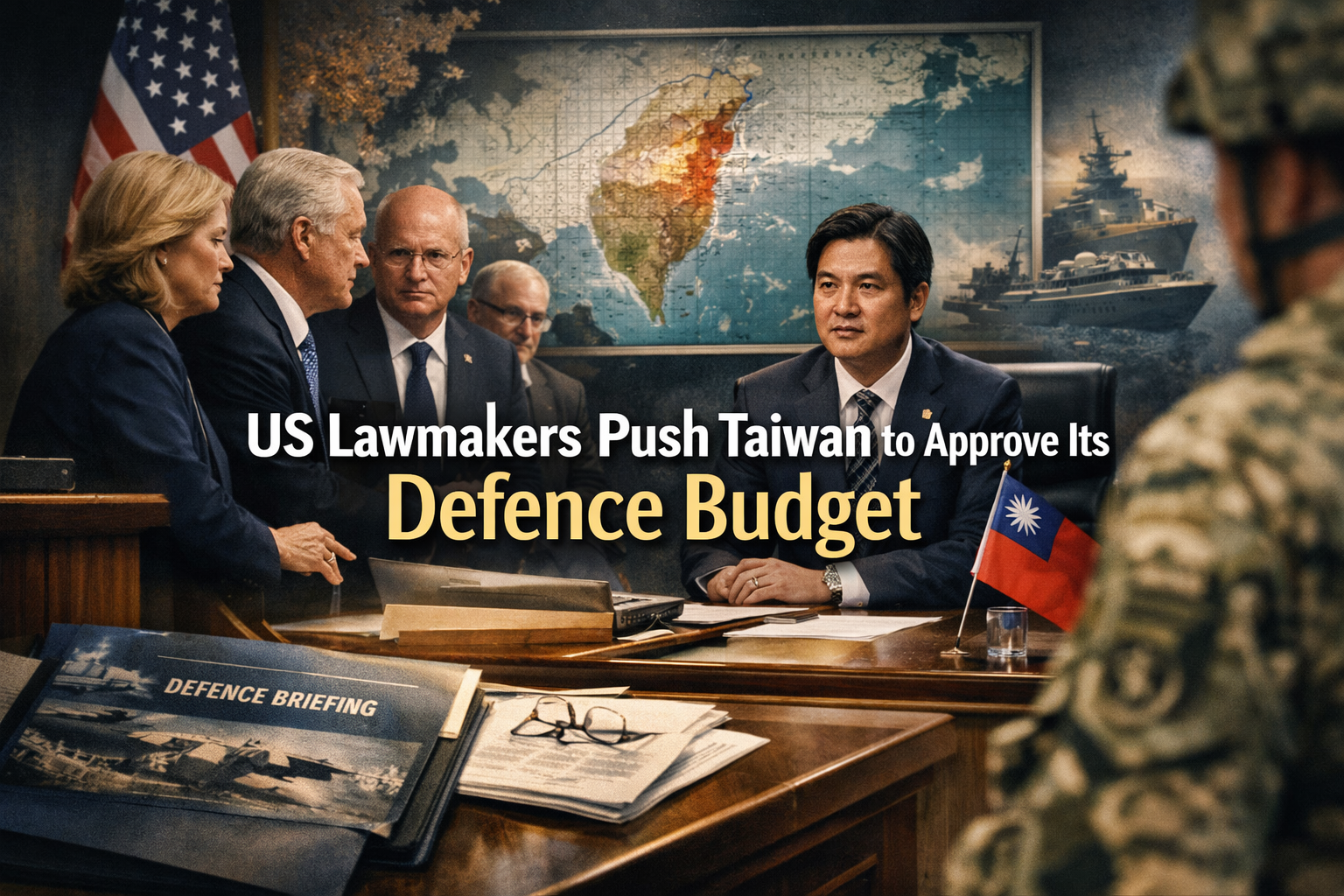
US Lawmakers Push Taiwan to Approve Its Defence Budget
Intermediate | April 11, 2026
✨ 혼자서 기사를 소리 내어 읽거나 튜터를 따라 각 단락을 반복해서 읽으세요. 레벨...
A High-Pressure Message from Washington
A group of U.S. lawmakers visited Taipei in late March and urged Taiwan’s parliament to approve a stalled $40 billion special defence budget. The visiting delegation included Senators Jeanne Shaheen, Thom Tillis, John Curtis, and Jacky Rosen. They warned that long delays could weaken Taiwan’s ability to respond to growing military pressure from China. Taiwan already depends heavily on U.S. security support and arms sales, so the message was clear: support from friends matters, but Taiwan also needs to show that it is serious about its own defence. (Reuters)
Why the Taiwan Defence Budget Is Stuck
The Taiwan defence budget was proposed by President Lai Ching-te in November 2025. It is a huge package meant to strengthen the island’s military and improve what Taiwan calls its asymmetric defence capabilities. In simple terms, that means building the kind of defence tools that can make any attack much more difficult and expensive for China. But Taiwan’s opposition-controlled parliament has slowed the bill down, arguing over cost, priorities, and whether the full package is necessary. (Reuters, President of Taiwan)
A Debate About Security, Money, and Politics
This debate is not only about weapons. It is also about politics inside Taiwan. Reuters reported in February that a bipartisan group of 37 U.S. lawmakers had already expressed concern about the delay and pushed Taiwan’s legislative leaders to treat the bill as a priority. Opposition parties suggested a smaller and cheaper plan that would cover only part of what Lai’s government wants. So while everyone says defence matters, they clearly do not agree on how much to spend or how fast to move. (Reuters, Reuters)
Some Progress, But Not the Full Deal
There has been at least one step forward. In March, Taiwan’s three main political parties agreed to let the government sign agreements for four U.S. arms sales packages worth about $9 billion after officials warned that Taipei could lose its place in line if it missed the deadline. That was important, but it did not solve the bigger fight over the full Taiwan defence budget. In other words, Taiwan moved one piece on the board, but the bigger game is still very much alive. (Reuters, Reuters)
Why This Story Matters Beyond Taiwan
This story matters because Taiwan sits at the center of one of the world’s most dangerous political flashpoints. China claims Taiwan as its territory and has increased military and political pressure in recent years, while Taiwan rejects Beijing’s sovereignty claims. When U.S. lawmakers publicly push Taiwan to approve more defence spending, they are not just talking about money. They are talking about deterrence, credibility, and whether Taiwan can show unity at a tense moment. That is why this debate has caught attention far beyond Taipei. (Reuters, Reuters)
What Could Happen Next?
The next big question is whether Taiwan’s leaders can get on the same page. U.S. Senator Jim Banks said this week that passing the bill would send a signal to China and the world that Taiwan believes in “peace through strength.” But Taiwan’s opposition still says defence should be balanced with caution over spending and with efforts to keep talking to Beijing. So this issue is far from over. For English learners, it is also a useful reminder that politics often moves slowly—even when the pressure is intense. (Reuters, Reuters)
Vocabulary
- stalled (adjective) – delayed or stopped before being completed.
Example: The defence bill has stalled in parliament for months. - delegation (noun) – an official group sent to represent a country or organization.
Example: The U.S. delegation met leaders in Taipei during the visit. - deter (verb) – to stop someone from doing something by making the risk too high.
Example: Taiwan wants stronger defences to deter a possible attack. - asymmetric (adjective) – using different and often smarter methods against a stronger opponent.
Example: Taiwan is focusing on asymmetric defence to make invasion harder. - opposition-controlled (adjective) – led or dominated by political parties not in government.
Example: Taiwan’s opposition-controlled parliament has slowed the bill. - priority (noun) – something treated as more important than other things.
Example: U.S. lawmakers said the budget should be a priority. - authorise (verb) – to officially give permission for something.
Example: Parliament authorised the government to sign arms agreements. - deterrence (noun) – the strategy of preventing an attack through strength or threat.
Example: Many leaders say deterrence is necessary in the Taiwan Strait. - credibility (noun) – the quality of being believable and trustworthy.
Example: Taiwan’s credibility could be affected if the budget remains blocked. - flashpoint (noun) – a place or situation that could quickly become dangerous.
Example: Taiwan is often described as a flashpoint in East Asia.
Discussion Questions (About the Article)
- Why did U.S. lawmakers visit Taipei, and what was their main message?
- Why has the Taiwan defence budget been delayed?
- What is the difference between the full $40 billion plan and the $9 billion arms agreements?
- Why are U.S. lawmakers concerned about the delay?
- What does this debate show about politics inside Taiwan?
Discussion Questions (About the Topic)
- Should a country spend more on defence when it faces outside threats? Why or why not?
- How should leaders balance security needs with budget concerns?
- Do you think foreign allies should publicly pressure another country on defence policy?
- What are the risks when political parties cannot agree on national security?
- How can strong communication help reduce international tension?
Related Idiom
“Put your money where your mouth is” – to support your words with real action.
Example: U.S. lawmakers are basically telling Taiwan to put its money where its mouth is on national defence.
📢 Want more practical English practice with real-world stories? Sign up for the All About English Mastery Newsletter! Click here to join us.
Want to finally master English but don’t have the time? Mastering English for Busy Professionals is built for busy people like you.
Follow our YouTube Channel @All_About_English for more useful English tips and real-world practice.
This article was inspired by: Reuters and the Office of the President, Taiwan


 한국어
한국어  English