

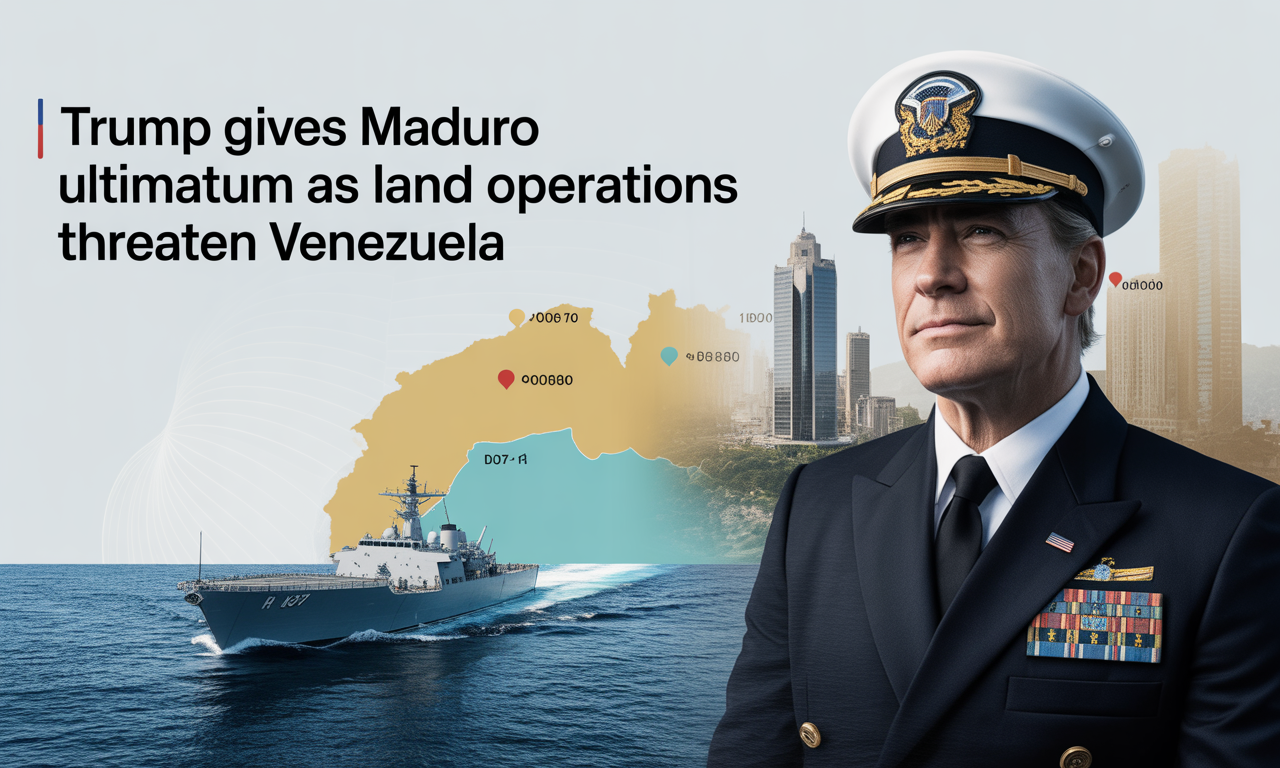
Trump Gives Maduro Ultimatum as Land Operations Threaten Venezuela
Advanced | December 7, 2025
✨ 혼자서 기사를 소리 내어 읽거나 튜터를 따라 각 단락을 반복해서 읽으세요. 레벨...
A Blunt Warning from Washington: Trump Ultimatum to Maduro
In late November 2025, the Trump ultimatum to Maduro became a central point of global discussion. In late November 2025, President Donald Trump delivered a stark message to Venezuelan leader Nicolás Maduro: leave Venezuela now or face possible U.S. land operations. According to reporting based on U.S. and Venezuelan sources, the warning came during a tense phone call in which Washington offered Maduro safe evacuation for himself, his wife Cilia Flores, and their son—if he agreed to resign immediately. (Fox News, Miami Herald)
Closing the Skies and Raising the Pressure
After the reported ultimatum, Trump moved to tighten the screws further. Instead of issuing a formal directive, he posted on X that Venezuelan airspace was “closed in its entirety” to commercial and private flights. The message was framed as an effort to choke off drug trafficking and arms smuggling tied to Maduro’s allies. U.S. officials did not announce a formal order, but the public warning itself signaled that the White House was prepared to escalate pressure well beyond sanctions and diplomatic isolation. (New York Post, Fox News)
Troops, Warships, and Talk of Land Operations
The Trump ultimatum to Maduro did not come out of nowhere. Since early September, the U.S. has carried out more than twenty airstrikes on suspected drug-smuggling vessels in the Caribbean and Eastern Pacific, killing dozens of people under Operation Southern Spear. At the same time, the Pentagon has deployed the USS Gerald R. Ford carrier group, destroyers, amphibious ships, and thousands of U.S. personnel to waters near Venezuela. Analysts say these moves have increased fears that sea and air operations could eventually expand to land-based targets inside Venezuela. (AP News, Reuters)
Maduro’s Defiance and Demands
Publicly, Maduro has tried to project strength. Local and international reports say he rejected Trump’s demand to step down and instead floated the idea of a “global amnesty” for himself and his inner circle—protection from prosecution in the U.S. and other countries. Maduro also appeared in televised events brandishing a ceremonial sword and urging Venezuelan troops to defend “every inch” of the country from foreign threats. His message to supporters: he does not plan to run.
Growing Pushback at Home and Abroad
Even as Trump talks tough, there is serious debate inside and outside the U.S. about how far Washington should go. Some U.S. senators from both parties have warned they will push a war powers resolution to stop any large-scale invasion, arguing that Americans do not want a new conflict in Venezuela. Human rights groups and religious leaders, including Pope Leo, have urged diplomacy, warning that military action would likely deepen Venezuela’s humanitarian crisis rather than solve it.
For professionals who use English at work, this situation is a useful example of how politics, security, economics, and diplomacy all connect—and how the language around those topics is used in global media.
Vocabulary
- Ultimatum (noun) – a final demand, with clear consequences if it is rejected.
Example: “Trump’s ultimatum gave Maduro a narrow set of options.” - Escalation (noun) – a rapid increase in seriousness or intensity.
Example: “The deployment of carriers marked a major escalation in pressure.” - Deployment (noun) – the movement of troops or equipment into position for action.
Example: “The deployment of thousands of U.S. personnel alarmed regional leaders.” - Incursion (noun) – a sudden or brief attack or invasion into another country.
Example: “Analysts debated whether a land incursion was really on the table.” - Amnesty (noun) – an official decision to forgive people for crimes or political offenses.
Example: “Maduro reportedly asked for global amnesty for himself and his allies.” - Humanitarian crisis (noun) – a situation where large numbers of people lack food, safety, or basic services.
Example: “Venezuela’s humanitarian crisis has forced millions to flee.” - Sanctions (noun) – official penalties, often economic, used to pressure a government or group.
Example: “Years of sanctions have damaged Venezuela’s economy.” - Narcotics trafficking (noun) – illegal production and transportation of drugs.
Example: “The airstrikes were officially justified as part of a narcotics trafficking crackdown.” - Showdown (noun) – a final conflict or confrontation that will decide an outcome.
Example: “Commentators warned that a military showdown could be disastrous.” - War powers (noun) – legal authority related to when and how a government can use military force.
Example: “Lawmakers considered using war powers tools to limit any invasion.”
Discussion Questions (About the Article)
- What specific steps did President Trump take to increase pressure on Maduro besides the ultimatum itself?
- How does the deployment of carriers and bombers near Venezuela change the risk level in the region?
- Why do some U.S. lawmakers want to limit Trump’s freedom to use military force in Venezuela?
- How is the anti-drug campaign connected to the broader political struggle with Maduro?
- Which parts of this situation are most worrying for ordinary Venezuelan citizens?
Discussion Questions (About the Topic)
- When, if ever, is it appropriate for one country to demand that another country’s leader step down?
- What are the risks and benefits of using military force to solve political crises?
- How should democratic governments balance fighting drug trafficking with respecting international law?
- What non-military tools could the international community use to influence leaders like Maduro?
- How do media stories about conflict shape public opinion and government decisions?
Related Idiom
“Play hardball” – to act in a very tough or aggressive way to achieve what you want.
Example: “By combining an ultimatum with airspace closures and military deployments, Trump is clearly playing hardball with Maduro.”
📢 Want more tips like this? 👉 Sign up for the All About English Mastery Newsletter! Click here to join us!
Want to finally master English but don’t have the time? Mastering English for Busy Professionals is the course for you!
Follow our YouTube Channel @All_About_English for more great insights and tips.
This article was inspired by:


 한국어
한국어  English