

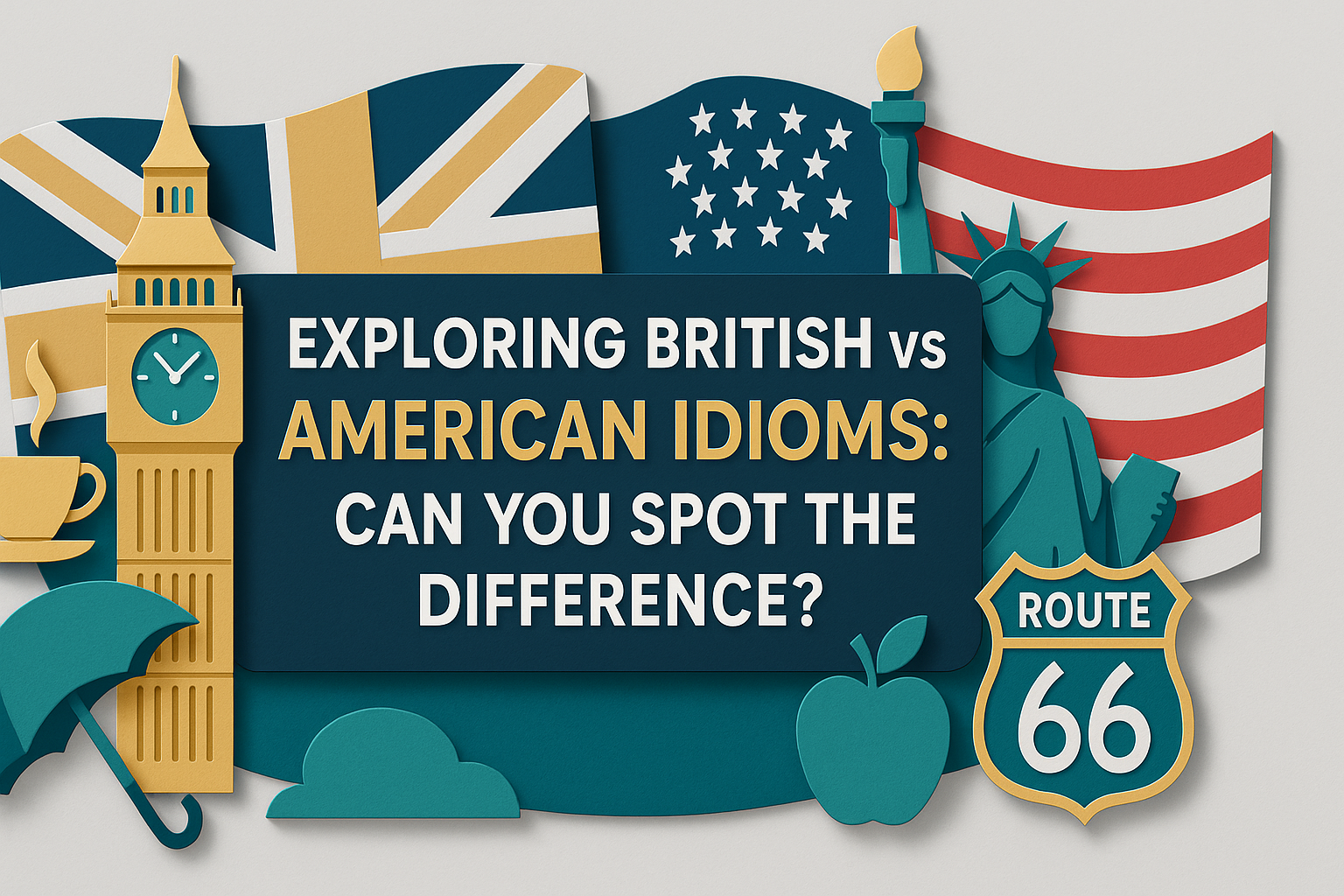
Exploring British vs American Idioms: Can You Spot the Difference? 🇬🇧🇺🇸
Intermediate Level | September 2, 2025
Read the article aloud on your own or repeat each paragraph after your tutor.
Idioms are colorful expressions that make a language come alive. But here’s the challenge for English learners: British and American English often use different idioms for the same ideas. For busy professionals, knowing both styles helps you connect better with international colleagues and clients.
Today, we’ll explore some common idioms and see how they change across the Atlantic.
Why British vs American Idioms Matter
Idioms add personality to your English. They show that you understand culture, not just grammar. Imagine a business call with partners in London. If you say, “We’re on the same page,” they’ll understand perfectly—but they might also use “singing from the same hymn sheet” to mean the same thing. Learning both versions makes your English more flexible and impressive.
Example 1: “Break a Leg” vs “Smash It”
In the U.S., people often say “Break a leg” to wish someone good luck before a big presentation. In the U.K., a colleague might say “Smash it” instead. Both mean “do really well,” but the flavor is different. Knowing both phrases keeps you from feeling confused—and lets you respond naturally.
Example 2: “Bite the Bullet” vs “Grasp the Nettle”
Americans often say “bite the bullet” when facing something unpleasant but necessary, like giving tough feedback. In Britain, you might hear “grasp the nettle.” Both mean to face a difficult situation bravely.
Example 3: “Piece of Cake” vs “Easy Peasy”
When something is very simple, Americans say “It’s a piece of cake.” Brits, on the other hand, might say “Easy peasy.” Imagine a coworker explaining a new tool—either phrase tells you it’s not complicated.
Example 4: “Out of Left Field” vs “A Bolt from the Blue”
Americans often say “out of left field” when something surprising happens unexpectedly. In Britain, people might use “a bolt from the blue” for the same idea. Both describe sudden surprises, but each one paints a different picture.
Example 5: “Call It a Day” vs “Pack It In”
In the U.S., workers often say “Let’s call it a day” to signal it’s time to stop working. In the U.K., you may hear “Let’s pack it in.” Both mean wrapping up for the day or ending a task.
These examples show how idioms reflect culture and everyday habits. By learning both British vs American idioms, you’ll not only avoid confusion but also sound more natural in global conversations.
Vocabulary List
- Idiom (noun) — A phrase with a meaning different from the literal words.
Example: “Kick the bucket” is an idiom for “die.” - Flexible (adjective) — Able to adapt to new situations.
Example: She is flexible when working with different teams. - Confused (adjective) — Unable to understand clearly.
Example: I was confused by the different accents on the call. - Presentation (noun) — A formal talk given to share information.
Example: He prepared slides for his presentation. - Bravely (adverb) — With courage, without fear.
Example: She bravely answered tough questions. - Colleague (noun) — A person you work with.
Example: My colleague helped me finish the report. - Unpleasant (adjective) — Not enjoyable, difficult.
Example: Giving negative feedback can feel unpleasant. - Flavor (noun) — The unique style or character of something.
Example: Each idiom adds a cultural flavor to the language. - Simple (adjective) — Easy to do or understand.
Example: The new software is simple to use. - Impressive (adjective) — Causing admiration or respect.
Example: Her clear English was impressive during the meeting.
5 Questions About the Article
- Why are idioms important for professionals?
- What does “Break a leg” mean, and what is the British version?
- Which idiom means to face something unpleasant bravely?
- What do “Piece of cake” and “Easy peasy” both mean?
- Give two pairs of idioms from the article that show British and American differences.
5 Open-Ended Discussion Questions
- Do you prefer British or American English? Why?
- Which idiom from today’s article do you like the most?
- Have you ever heard an idiom that confused you at first?
- How could using idioms make your English sound more natural?
- Can you think of an idiom in your language that doesn’t translate well into English?
📢 Want more tips like this? 👉 Sign up for the All About English Mastery Newsletter! Click here to join us!
Want to finally Master English but don’t have the time? Mastering English for Busy Professionals is the course for you! Check it out now!
Follow our YouTube Channel @All_About_English for more great insights and tips.
 English
  한국어
한국어