

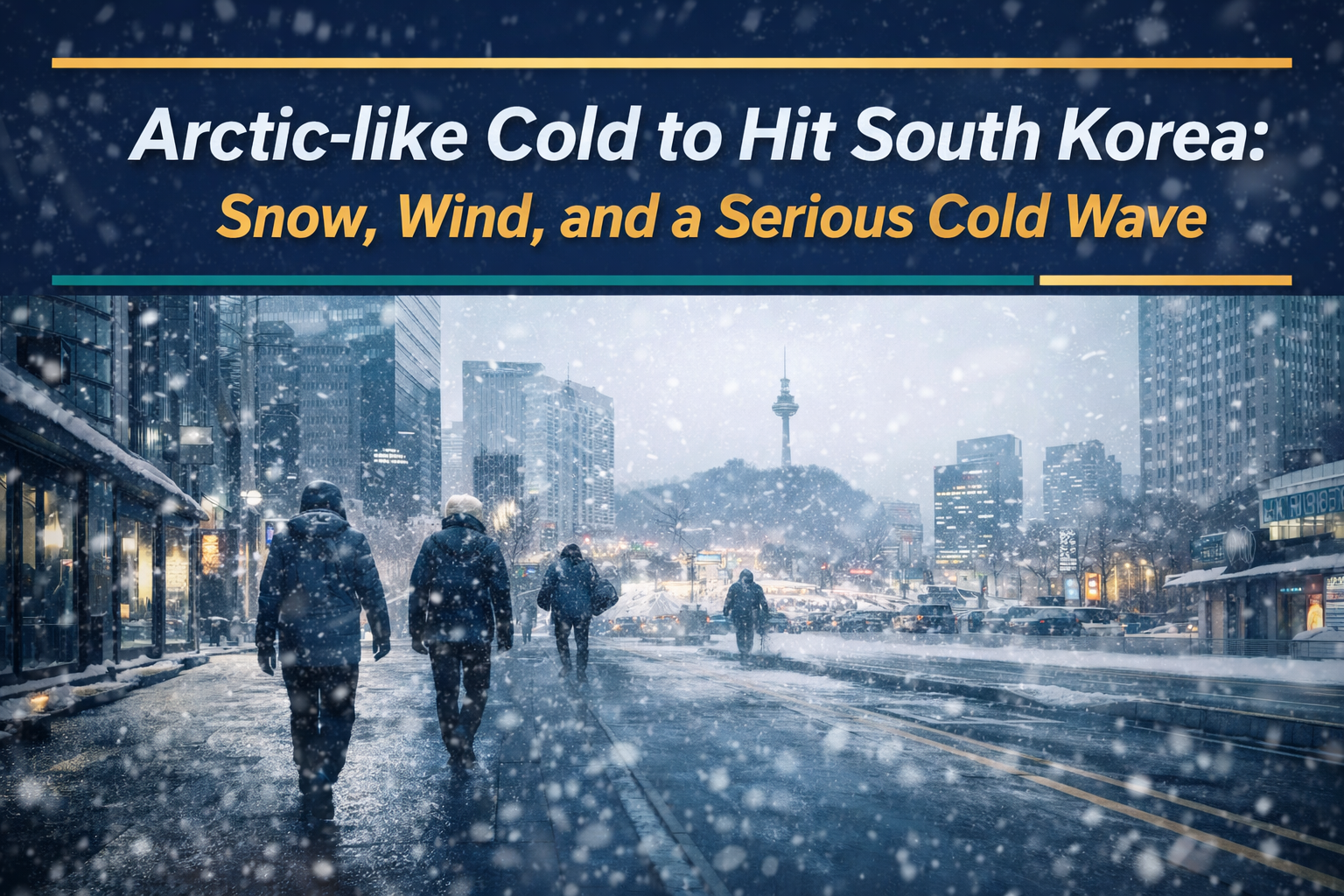
Arctic-like Cold to Hit South Korea: Snow, Wind, and a Serious Cold Wave
Intermediate | January 9, 2026
✨ Read the article aloud on your own or repeat each paragraph after your tutor.
What’s Happening: A Weekend Winter Storm Rolls In
South Korea is bracing for a powerful winter storm this weekend, with heavy snow, strong winds, and a sharp drop in temperatures expected across many regions. This South Korea cold wave is arriving with the storm, which means the snow may come with biting wind and dangerous wind chill. Korea’s national weather agency said snow could start on Saturday in northeastern Gyeonggi and Gangwon, then spread south on Sunday as colder air pushes in from the north. (Korea JoongAng Daily)
Meteorologists warned that Gangwon, the Honam region, and Jeju Island could get hit hard, with snowfall rates as high as 5 cm per hour in some places. That kind of speed can turn roads into skating rinks fast, so this is one of those “plan ahead” weekends. (Korea JoongAng Daily)
Snow Forecast: Where It Could Pile Up
Here’s the rough range of what forecasters expect:
- Eastern Gyeonggi + inland South Gyeongsang: about 3–8 cm
- Jeolla (Jeonbuk/Jeonnam): about 5–15 cm
- Mountainous Gangwon: 15+ cm
- Jeju Island (especially higher areas): 20+ cm
- Seoul: lighter snow, about 1–3 cm
In Korea’s alert system, a heavy snow warning is issued when at least 20 cm is expected in 24 hours (or 30 cm in mountainous areas). Even if your area doesn’t hit “warning” levels, a few centimeters plus strong wind can still cause major delays. (Korea JoongAng Daily)
South Korea cold wave: The Real Problem Might Be the Wind
The snow is only half the story. As Arctic air moves south, temperatures are expected to fall sharply. Forecasters said Sunday morning lows could drop to around -10°C in many areas. In Seoul, the temperature is forecast to hit about -8°C, but wind chill could make it feel closer to -16°C—and some parts of the metro area could feel like -20°C. (Korea JoongAng Daily)
This matters because cold + wind is where people get caught off guard. It’s also tough on infrastructure: frozen pipes, slippery roads, transport delays, and higher fire risk if people use heaters unsafely. A senior forecaster at the weather agency described it as a “complex” situation with heavy snow, strong winds, and dry conditions happening at the same time. (Korea JoongAng Daily)
Cold Wave Advisories: What They Mean in Plain English
Earlier in the week, the weather agency announced cold wave advisories for parts of Seoul and other regions. In other words, the South Korea cold wave isn’t just a forecast—it’s already affecting real planning and public safety responses. A cold wave advisory is generally issued when the morning low is forecast to stay at or below -12°C for at least two days, or when temperatures are expected to drop fast enough to cause major disruption. In response, Seoul said it would move into 24-hour emergency operations in affected districts, checking on vulnerable residents and sharing safety guidance. (Korea JoongAng Daily)
Bottom line: this isn’t just “cold weather.” It’s the kind of cold that can impact your commute, your weekend plans, and your health—especially for kids and older adults.
Vocabulary
- brace (verb) — to prepare for something difficult or intense.
Example: “Korea is bracing for a weekend winter storm.” - forecast (noun) — a prediction about future weather.
Example: “The forecast shows heavy snow in parts of Gangwon and Jeolla.” - accumulation (noun) — the amount that builds up over time.
Example: “Snow accumulation could reach 20 centimeters on Jeju.” - gust (noun) — a sudden strong burst of wind.
Example: “A gust of wind can blow snow across the road and reduce visibility.” - wind chill (noun) — how cold it feels when wind makes the temperature feel lower.
Example: “The wind chill in Seoul could feel like -16°C.” - disrupt (verb) — to interrupt normal activity.
Example: “Heavy snow can disrupt traffic and public transportation.” - advisory (noun) — an official warning or alert.
Example: “A cold wave advisory was issued for parts of Seoul.” - vulnerable (adjective) — easily harmed or at risk.
Example: “Older people are more vulnerable during extreme cold.” - infrastructure (noun) — basic systems like roads, power, and water.
Example: “Severe cold can damage infrastructure like water pipes.” - precaution (noun) — an action taken to prevent problems.
Example: “Wear layers as a precaution when going out.”
Discussion Questions (About the Article)
- Which regions are expected to see the heaviest snow, and why?
- What does “5 cm of snow per hour” mean for daily life and transportation?
- Why can wind chill be more dangerous than the actual temperature?
- What kinds of disruptions do you expect from this storm (work, school, travel)?
- What safety steps would you recommend to a friend who has to travel this weekend?
Discussion Questions (About the Topic)
- How does your city or country prepare for winter storms?
- What’s the biggest danger during extreme cold: health, transportation, or something else?
- Should local governments open more warming shelters during cold waves? Why or why not?
- How do weather warnings change people’s behavior (if at all)?
- What are smart “winter habits” that reduce risk but don’t cost much money?
Related Idiom / Phrase
“Better safe than sorry” — it’s smarter to take precautions now than regret it later.
Example: “With snow, wind, and Arctic air arriving together, it’s better safe than sorry—leave early and dress warmer than you think you need.”
📢 Want more real news made simple for English practice? 👉 Sign up for the All About English Mastery Newsletter! Join here: Join the newsletter
Want to finally master English but don’t have the time? Mastering English for Busy Professionals is built for you: Explore the course
Follow our YouTube Channel @All_About_English for more: Subscribe on YouTube
This article was inspired by: Yonhap News Agency reporting and weather coverage (via Korea JoongAng Daily, Korea JoongAng Daily, and Asiae English).


 English
  한국어
한국어