

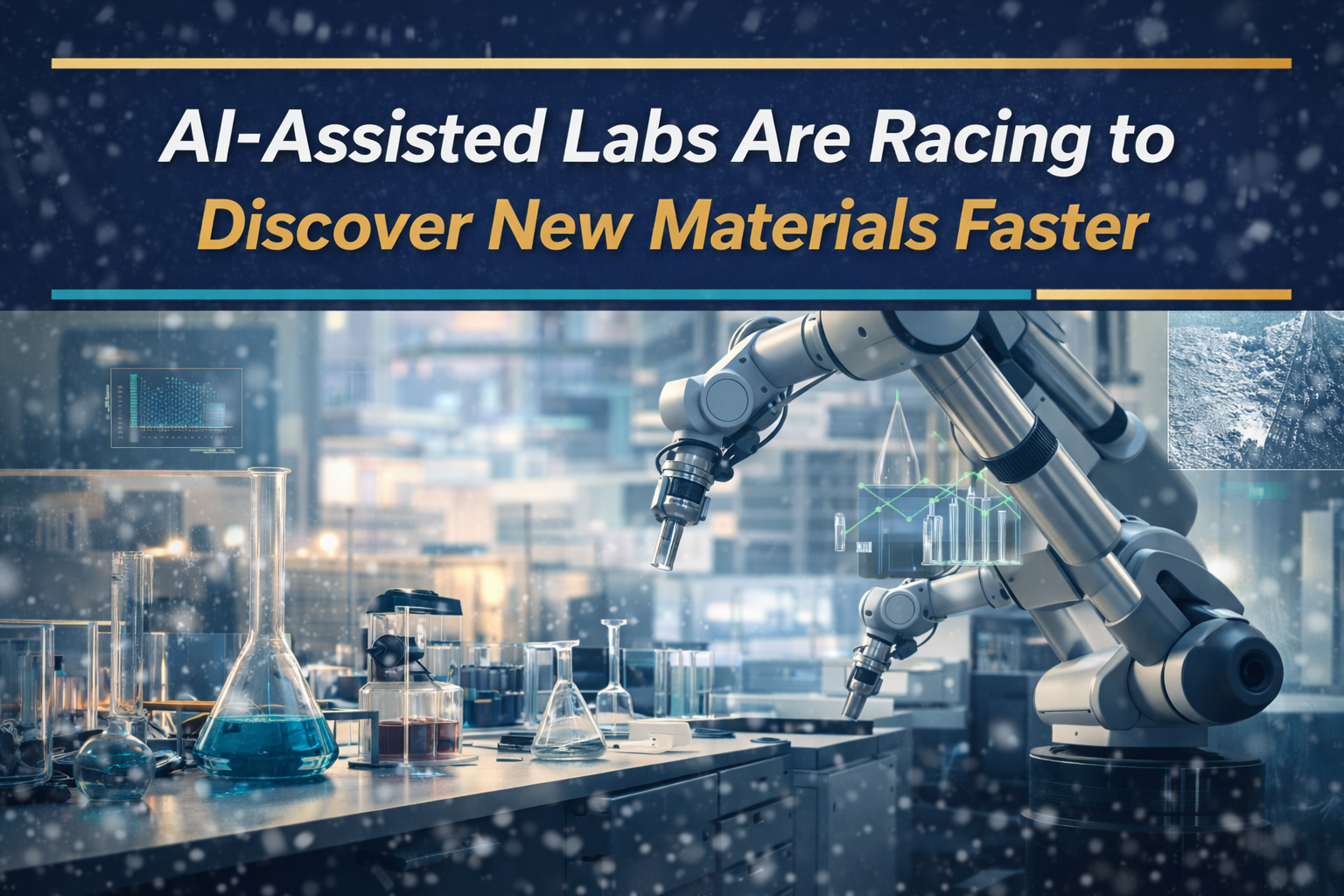
AI-Assisted Labs Are Racing to Discover New Materials Faster
Intermediate | January 9, 2026
✨ Read the article aloud on your own or repeat each paragraph after your tutor.
A New Kind of R&D Team: AI materials discovery + Robots + Real Experiments
Imagine a laboratory where robots run experiments all day and all night, and an AI system decides what to test next. That’s the big idea behind a growing wave of AI materials discovery startups. They’re building “self-driving” labs to search for new materials faster—materials that could improve batteries, chips, clean energy, or even medicines.
Why This Matters: Materials Usually Take Forever
Finding a useful new material is normally slow, expensive, and full of trial-and-error. Researchers might spend years testing tiny changes—different ingredients, temperatures, or methods—just to find one promising result. But MIT-linked reporting noted that if these AI-driven labs succeed, they could shorten the discovery timeline “from decades to a few years or less.” That’s the kind of productivity jump that gets investors excited. (MIT News, MIT DMSE)
A Big Example: Lila Sciences and the “AI Science Factory”
One high-profile company is Lila Sciences, co-founded by MIT professor Rafael Gómez-Bombarelli. The company is building automated labs where AI helps plan, run, and analyze experiments—aiming to speed up materials development for energy, sustainability, and computing. (MIT DMSE)
According to Reuters, Lila raised US$115 million in extension funding, pushing its valuation to more than US$1.3 billion. Reuters also reported that Lila’s funding totals reached US$350 million for Series A and US$550 million overall, and that the company signed a 235,500-square-foot lab lease in Cambridge, Massachusetts to build what it calls “AI Science Factories”—robot-heavy facilities that can run experiments continuously. (Reuters)
Another Player: Periodic Labs and a $300M Bet
This isn’t just one company. Periodic Labs came out of stealth with a US$300 million seed round, reported by TechCrunch. The founders include Liam Fedus (former VP of Research at OpenAI) and Ekin Dogus Cubuk (formerly at Google Brain/DeepMind). Their plan is straightforward but ambitious: build “AI scientists” that don’t just write ideas, but also run robotic experiments, collect data, and improve their next round of tests. TechCrunch says their first target is inventing better superconductors. (TechCrunch)
The Big Bottleneck: Great Predictions, Not Enough Real-World Testing
Here’s the problem: AI has gotten very good at predicting “possible” materials—but a prediction isn’t a product. For example, Google DeepMind’s GNoME project reported 2.2 million candidate crystal structures and 381,000 predicted stable materials. That’s huge. But the next step—actually making and testing them—still takes real labs and real equipment. This is why the push into automated lab factories is so important for AI materials discovery. (Google DeepMind, Nature)
So Why Are They “Waiting for Their ChatGPT Moment”?
Even with big funding, these labs still need a clear, headline-worthy win: a material that truly outperforms what we already have, and can be manufactured at scale. Until then, it’s a high-stakes race—lots of promise, lots of capital, and a lot of engineering details that can make or break the business case.
Vocabulary
- assisted (adjective) — supported by something (often technology).
Example: “AI-assisted labs can test ideas faster than humans alone.” - prototype (noun) — an early version used for testing.
Example: “The team built a prototype system before scaling up the lab.” - automated (adjective) — operated by machines with little human control.
Example: “An automated lab can run experiments overnight.” - iterate (verb) — to repeat a process to improve results.
Example: “The AI can iterate experiments until it finds a better option.” - breakthrough (noun) — a major advance or success.
Example: “Investors are waiting for a breakthrough material.” - valuation (noun) — an estimated company value.
Example: “The startup reached a billion-dollar valuation.” - leverage (verb) — to use something to gain an advantage.
Example: “The company leverages robotics to speed up testing.” - pipeline (noun) — a process with stages from start to finish.
Example: “They want a faster pipeline from discovery to production.” - scale (verb) — to grow to a larger size or output.
Example: “A lab discovery is exciting, but it must scale to manufacturing.” - constraint (noun) — a limitation or restriction.
Example: “Cost is a major constraint for new materials.”
Discussion Questions (About the Article)
- What is an “AI-assisted lab,” and how is it different from a traditional lab?
- Why does materials research often take so long?
- What details from Reuters made Lila Sciences sound like a serious business operation?
- Why are investors willing to put hundreds of millions of dollars into this idea?
- What do you think would count as a true “ChatGPT moment” for materials discovery?
Discussion Questions (About the Topic)
- Should scientific research be driven more by markets and investors, or by universities and government funding?
- What industries would benefit most from faster materials discovery (energy, chips, medicine, aerospace, etc.)?
- What risks come with automating experiments (errors, safety, bias, accountability)?
- How can companies prove their AI results are reliable and repeatable?
- If you ran one of these startups, what would you focus on first: speed, accuracy, or commercialization?
Related Idiom / Phrase
“Put your money where your mouth is” — don’t just talk; take real action and accept real risk.
Example: “With $300M seed rounds and giant lab leases, investors are putting their money where their mouth is on AI-driven science.”
📢 Want more real news made simple for English practice? 👉 Sign up for the All About English Mastery Newsletter! Join here: Join the newsletter
Want to finally master English but don’t have the time? Mastering English for Busy Professionals is built for you: Explore the course
Follow our YouTube Channel @All_About_English for more: Subscribe on YouTube
This article was inspired by: MIT Department of Materials Science and Engineering, MIT News, Reuters, TechCrunch, Google DeepMind, and Nature.


 English
  한국어
한국어