

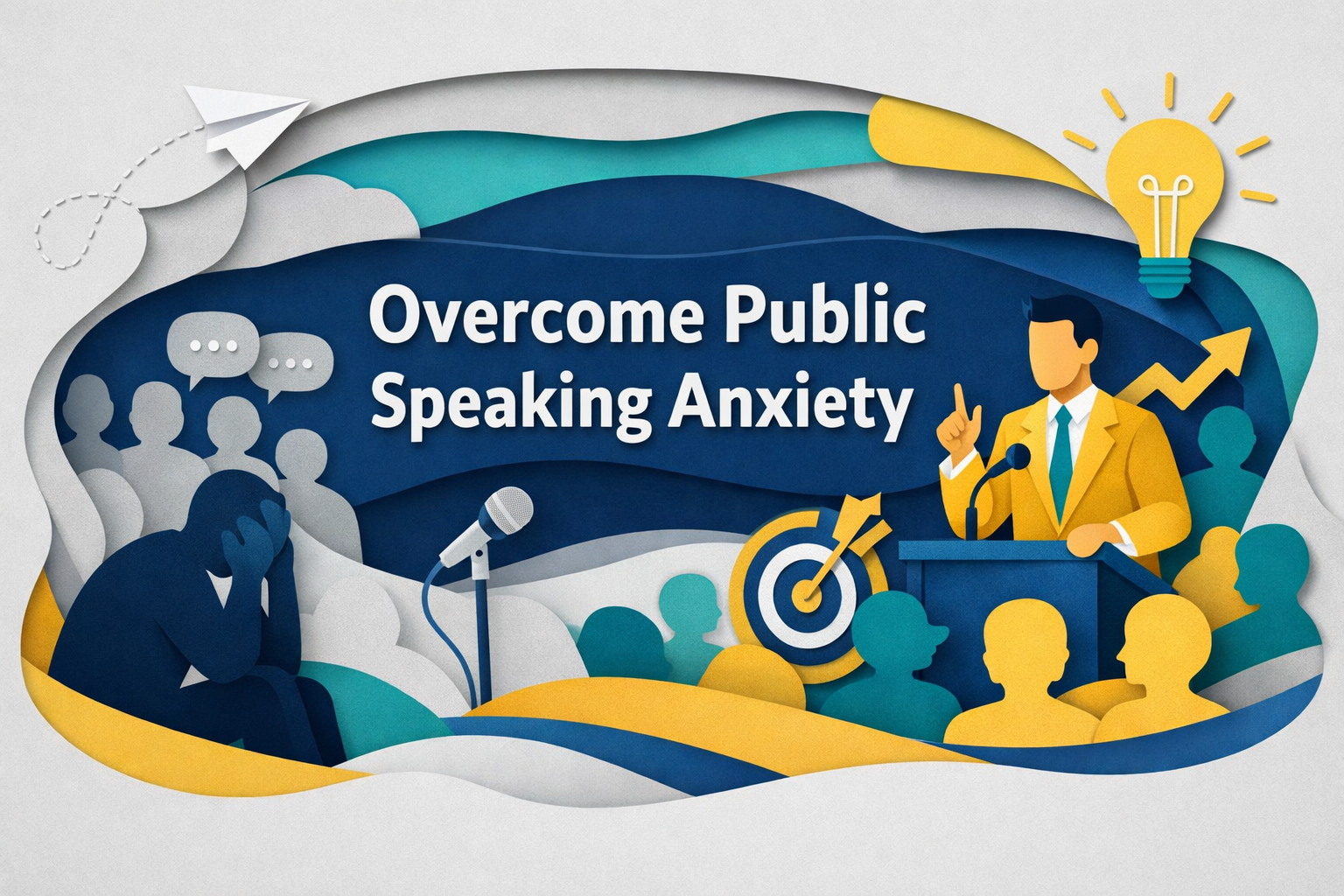
Overcome Public Speaking Anxiety: It’s Not About Fear—It’s About Staying Silent 🎤
Advanced Level | February 3, 2026
Read the article aloud on your own or repeat each paragraph after your tutor.
Most professionals don’t avoid public speaking because they’re weak. They avoid it because their brain whispers a very convincing lie: “If I speak, I might mess up.” So they choose the “safe” option—silence. The strange part is that fear itself is normal. The real career damage often comes from what fear makes you do: stay quiet when your voice is needed.
If you want to overcome public speaking anxiety, don’t start by trying to delete the fear. Start by changing your relationship with the fear. Think of fear like a smoke alarm. It makes noise, but it isn’t always a real fire. Your job isn’t to turn the alarm off forever. Your job is to keep moving—while it’s ringing.
Why Staying Silent Feels Safe (But Costs You)
Silence feels professional… until it doesn’t. In meetings, silence can look like agreement, confusion, or lack of leadership—especially when everyone else is speaking up. When you don’t share your idea, someone else will. When you don’t ask the question, your team may walk forward with the wrong assumptions. The problem isn’t that you felt nervous. The problem is that the nervousness took the microphone.
The “Small Win” Strategy to overcome public speaking anxiety
Here’s the move: stop thinking of public speaking as one big performance. Think of it as a series of small wins. Start with one sentence. One clear point. One question. If that feels too big, start even smaller: read one paragraph aloud before your next meeting. Then speak one sentence in the meeting. That’s it. Confidence grows through evidence, not motivation.
A practical method is the One-Sentence Anchor. Before you speak, write one sentence you can say no matter what:
- “Here’s the main point I want to highlight.”
- “From my side, the biggest risk is…”
- “I have one question before we decide.”
Once you say your anchor sentence, your brain relaxes a little because you’re no longer frozen. You’re moving. And movement is the enemy of panic.
Use Pauses Like a Professional
Most nervous speakers talk too fast because they want to escape the moment. But speed makes mistakes more likely and reduces clarity. Instead, treat pauses like punctuation. Say a sentence. Pause. Let it land. It feels long to you, but to the audience it feels confident. A calm pause signals, “I’m in control,” even if your heart is doing cardio.
Make Fear Smaller With a Clear Structure
When your thoughts feel messy, your speaking will feel messy. Use a simple structure:
- Point (one clear message)
- Reason (why it matters)
- Example (a quick real-life detail)
- Next step (what you want people to do)
This structure gives your brain a path to follow. And when you have a path, you’re less likely to freeze.
Here’s the mindset shift that helps advanced learners the most: you’re not trying to sound perfect—you’re trying to sound useful. If you want to overcome public speaking anxiety, focus on being useful and clear, not flawless. The best speakers aren’t the ones with zero fear. They’re the ones who speak anyway.
Vocabulary List
- anxiety (noun) — strong nervousness or worry about something.
Example: She felt anxiety before the presentation, but she still spoke clearly. - convincing (adjective) — believable; able to make someone accept an idea.
Example: The excuse sounded convincing, but the manager asked for proof. - whisper (verb) — to speak very quietly; sometimes used for your thoughts.
Example: His mind whispered that he would fail, but he practiced anyway. - microphone (noun) — a device that makes your voice louder; also used as a metaphor for attention.
Example: In the meeting, she finally took the microphone and shared her idea. - assumption (noun) — a belief you accept as true without checking.
Example: The team made an assumption about the deadline and missed a key detail. - anchor (noun) — something that keeps you steady or stable.
Example: One prepared sentence can be an anchor when you feel nervous. - punctuation (noun) — symbols like commas and periods; also used for speaking pauses.
Example: He used pauses as punctuation to make his message clearer. - clarity (noun) — the quality of being clear and easy to understand.
Example: Her clarity improved when she slowed down and used a simple structure. - structure (noun) — the organization of parts into a clear order.
Example: With a strong structure, his talk was easy to follow. - freeze (verb) — to stop moving or speaking because of fear or surprise.
Example: He didn’t freeze this time—he asked one question and kept going.
5 Questions About the Article
- According to the article, what is the real cost of public speaking fear?
- What is the “One-Sentence Anchor,” and why does it help?
- Why do nervous speakers often talk too fast?
- What four-part structure can reduce freezing?
- What mindset shift does the article recommend for advanced learners?
5 Open-Ended Discussion Questions
- When do you tend to stay silent at work, even when you have an idea?
- What is one “small win” you could try this week in a meeting?
- How do you want others to describe your speaking style?
- What topic makes you most nervous to present—and why?
- If you could improve one speaking skill in 30 days, what would it be?
📢 Want more practical English for real work situations? 👉 Sign up for the All About English Mastery Newsletter! Click here to join us!
Want to finally Master English but don’t have the time? Mastering English for Busy Professionals is the course for you! Check it out now!
Follow our YouTube Channel @All_About_English for more great insights and tips.

 English
  한국어
한국어