

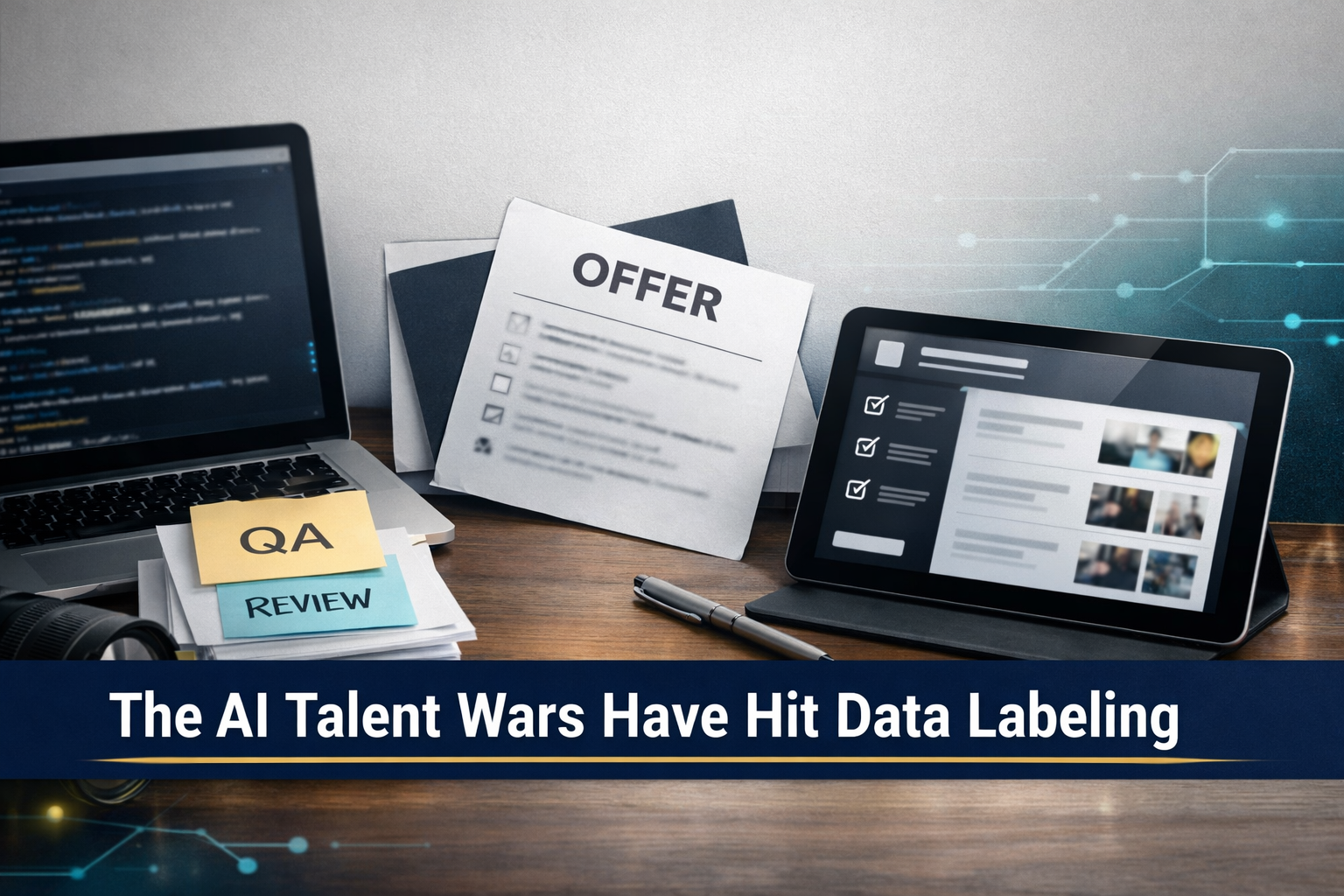
The AI Talent Wars Have Hit Data Labeling
Intermediate | February 8, 2026
✨ Read the article aloud on your own or repeat each paragraph after your tutor.
AI Data Labeling War: A Hiring War Moves to an Unexpected Place
When people talk about “AI talent wars,” they usually mean superstar researchers getting recruited with absurd pay packages. But this week, the drama reportedly moved into a less glamorous (but very important) part of the AI world: data labeling—the human work that turns messy information into training data AI systems can learn from. In other words, this AI data labeling war is about who can build better training data faster—and who can hire the people to do it.
“Keep This Confidential…”: Aggressive Recruiting Messages
In a post discussing her reporting, Forbes AI journalist Anna Tong said that staff at micro1 began receiving unsolicited recruiting messages from rival Mercor. One message, which she said was viewed by Forbes, opened with: “Happy to keep this confidential, given the sensitivity of the situation. Let me know if you have ten minutes to chat tonight.” The notes reportedly started with generic praise (“I’m extremely impressed with your work”) and then escalated quickly. (Anna Tong on LinkedIn)
The Numbers That Made Everyone Blink
According to Tong’s description, the offers included cash signing bonuses of $500,000, $1 million, and even up to $2 million. And here’s the twist: these bonuses reportedly weren’t only for engineers—they were also aimed at salespeople and project management leads. That’s a strong signal that AI companies aren’t just fighting over “brains,” they’re fighting over the people who can run the machine—manage projects, coordinate contractors, and deliver high-quality results on time. (Anna Tong on LinkedIn; Forbes on LinkedIn)
Why Data Labeling Is Suddenly Strategic
AI labs have a simple problem: models improve when they train on better data—not just more data. That pushes companies like micro1 and Mercor to compete on speed, quality control, and access to specialized human workers. In fact, Reuters previously reported that micro1 competes with Scale AI and has been growing quickly by using an AI-based recruiting approach to hire specialized experts, as demand for high-quality labeled data rises. (Reuters)
What This Means for Workers and for Business
For workers, this is leverage—if you can deliver outcomes in a high-pressure AI environment, you may suddenly be worth more than your title suggests. For businesses, it’s a reminder that in fast-moving markets, operations is a competitive advantage. The “support layer” (data pipelines, labeling workflows, QA systems, project leadership) can become the bottleneck—and the bottleneck is where the money goes.
The Big Takeaway
Even if you’re not building AI models yourself, you’re watching a familiar business story: when an industry gets hot, companies don’t only compete on product—they compete on people. And apparently, the gloves are coming off in the world of data labeling. If this AI data labeling war keeps escalating, expect even more aggressive recruiting and bigger budgets for the teams that run training-data operations.
Vocabulary
- Unsolicited (adjective) – not asked for; unexpected.
Example: She received unsolicited recruiting messages from a rival company. - Recruiting (noun) – the process of finding and hiring workers.
Example: Recruiting got more intense as competition increased. - Rival (noun) – a competitor.
Example: Mercor is described as a rival to micro1. - Signing bonus (noun) – extra money paid for accepting a job offer.
Example: The signing bonus was offered in cash. - Escalate (verb) – to increase quickly or become more serious.
Example: The messages escalated from polite praise to big-money offers. - Sector (noun) – a part of the economy or an industry.
Example: The AI sector is expanding into new kinds of jobs. - Leverage (noun) – advantage or power you can use.
Example: Skilled workers gained leverage in a hot market. - Bottleneck (noun) – a point that slows down progress.
Example: Data quality became a bottleneck for improving AI models. - Quality control (noun) – checking work to meet standards.
Example: Quality control matters when training AI with labeled data. - Competitive advantage (noun) – a strength that helps you outperform others.
Example: Strong operations can be a competitive advantage.
Discussion Questions (About the Article)
- What surprised you most about this story?
- Why do you think Mercor targeted salespeople and project leads—not only engineers?
- What does this story suggest about how important data labeling is becoming?
- How might aggressive recruiting affect a company’s culture?
- If you were a manager at micro1, how would you respond?
Discussion Questions (About the Topic)
- In your industry, what roles are “behind the scenes” but essential?
- When is it reasonable to pay a large signing bonus? When is it reckless?
- Should companies set rules about poaching employees? Why or why not?
- What skills make someone hard to replace in a fast-growing market?
- Do you think AI will create more opportunities or more pressure for workers overall?
Related Idiom
“The gloves are off” – people stop being polite and start competing seriously.
Example: With million-dollar signing bonuses, the gloves are off in AI hiring.
📢 Want more tips like this? 👉 Sign up for the All About English Mastery Newsletter! Click here to join us!
Want to finally Master English but don’t have the time? Mastering English for Busy Professionals is the course for you! Check it out now!
Follow our YouTube Channel @All_About_English for more great insights and tips
This article was inspired by: Forbes (based on Anna Tong’s reporting, Feb. 2026), plus background reporting on the AI training-data market from Reuters.


 English
  한국어
한국어