

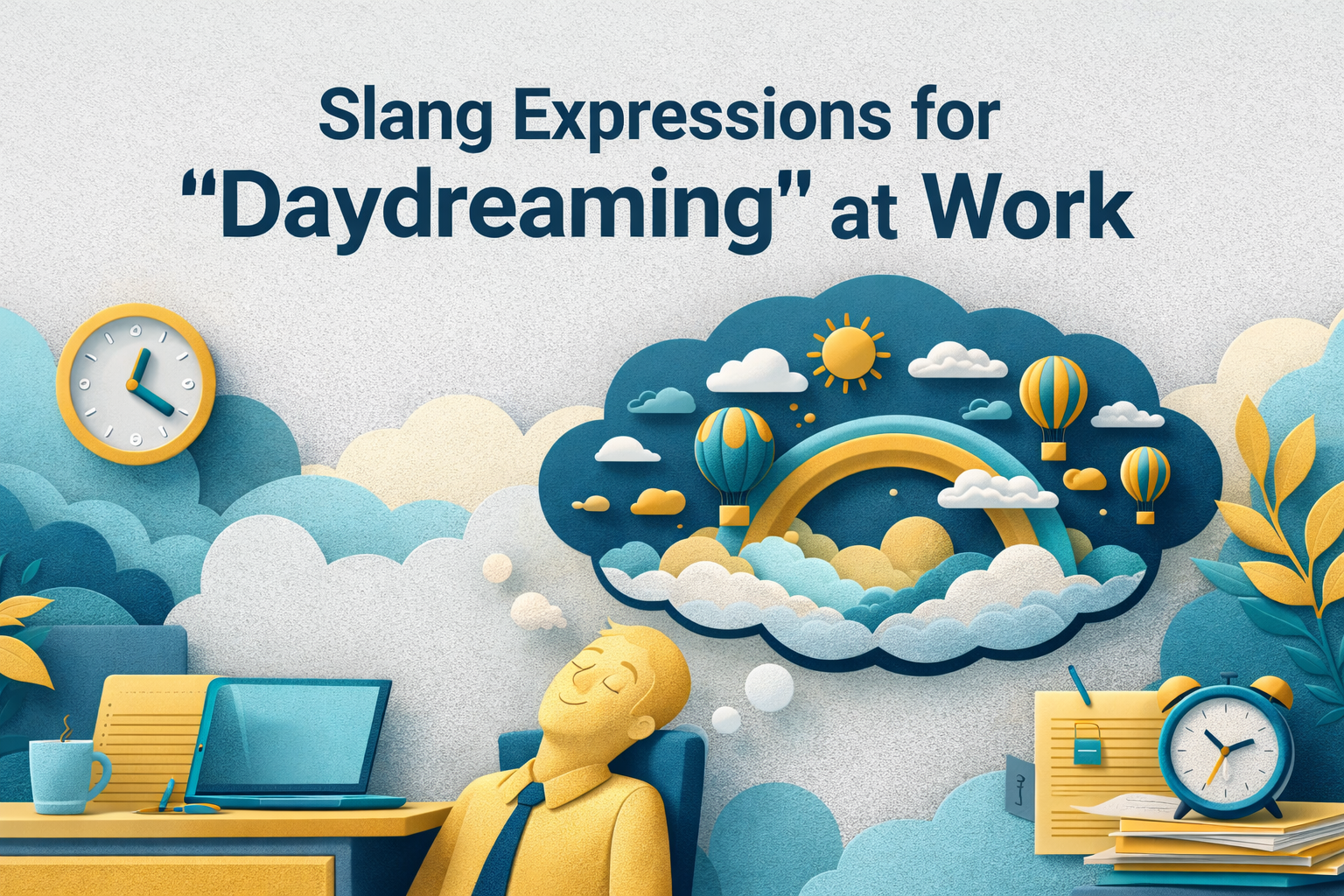
Slang for “Daydreaming” at Work: Sound Natural Without Sounding Lazy 😅
Intermediate Level | February 18, 2026
Read the article aloud on your own or repeat each paragraph after your tutor.
When Your Brain Quietly Leaves the Meeting 😅
We’ve all been there: you’re in a meeting, someone is sharing updates, and your brain quietly walks out of the room… without telling you. In English, people have lots of casual slang for daydreaming—but at work, you need the right kind. Some phrases sound funny and friendly. Others can make you sound rude or like you don’t care.
Today, you’ll learn natural slang expressions for “daydreaming” in work contexts—plus how to say them in a way that keeps the vibe positive and professional. These are great options for talking about daydreaming at work without sounding careless.
Safe Ways to Talk About Daydreaming at Work
First, let’s talk about the “safe” vibe. In an office, it’s better to describe daydreaming as a momentary distraction, not a character flaw. That’s why phrases like “my mind wandered” or “I zoned out for a second” work well—they suggest it was temporary, not intentional.
Common Slang Phrases You’ll Hear
Here are a few common expressions you’ll hear in real workplaces:
- “My mind wandered.” (polite, normal)
- “I spaced out for a sec.” (casual, friendly)
- “I zoned out.” (very common, a bit more casual)
- “I was on autopilot.” (useful when you did something automatically)
- “Sorry, I drifted for a moment.” (a little more formal)
The Secret Move: Add a Recovery Line
Now, here’s the key: add a quick recovery line so the other person feels respected. The recovery line is what turns “Oops” into “All good.” Try these:
- “Sorry—can you repeat the last point?”
- “I caught the first part. What was the decision?”
- “My bad—what’s the next step?”
Real Work Example (Zoom Moment)
Let’s put it in a realistic scene. Imagine you’re on Zoom, your manager asks a question, and you realize you missed the last 20 seconds (we’ve all committed that crime). You can say: “Sorry, I spaced out for a second—can you repeat that?” It’s honest, human, and it shows you’re back.
What to Avoid (So You Don’t Sound Rude)
One warning: some slang is too strong for work. For example, “I was checked out” can sound like you don’t care about the job. And “I wasn’t listening” is honest… but it can be a career-limiting hobby. If you want honesty and professionalism, stick with “mind wandered,” “zoned out,” or “spaced out,” and then recover quickly.
A Tiny Habit to Refocus Fast
Try this tiny habit: when you notice your attention drifting, write down one keyword from the conversation (like “deadline” or “client”) and repeat it in your head. That quick reset helps you stay present—and it also gives you a word to connect to if you need to ask a follow-up.
Why This Builds Connection
If you want to build stronger connection at work, these small moments matter. When you handle a “zoned out” moment smoothly, people don’t remember the slip—they remember that you recovered with confidence and respect.
Vocabulary List
- daydream (verb) — to think about pleasant or random things instead of what is happening now
Example: I started to daydream during the long presentation. - wander (verb) — to move or drift away from the main focus
Example: My attention wandered when the meeting went off-topic. - zone out (phrasal verb) — to stop paying attention for a short time
Example: I zoned out for a minute and missed the last slide. - space out (phrasal verb) — to become unfocused or distracted
Example: Sorry, I spaced out for a second—can you repeat that? - autopilot (noun) — a state of doing something automatically without thinking
Example: I was on autopilot while answering emails this morning. - drift (verb) — to slowly move away from a topic or focus
Example: I drifted for a moment, but I’m back now. - recover (verb) — to return to a good state after a mistake or problem
Example: I recovered quickly by asking a clear follow-up question. - repeat (verb) — to say something again
Example: Could you repeat the last point more slowly? - clarify (verb) — to make something easier to understand
Example: Can you clarify what you mean by “final approval”? - follow-up (noun) — an extra question or action after something happens
Example: I asked a follow-up to confirm the deadline.
5 Questions About the Article
- Why can some slang about daydreaming sound rude at work?
- Which phrase is more polite: “I wasn’t listening” or “My mind wandered”? Why?
- What is a “recovery line,” and why is it helpful?
- Give two examples of safe slang expressions for daydreaming.
- What is one quick habit to refocus during a meeting?
5 Open-Ended Discussion Questions
- When do you usually lose focus at work, and why?
- What’s a polite way to ask someone to repeat something in your workplace?
- Do you think it’s better to be honest or to be “smooth” when you miss something? Why?
- What strategies help you stay focused during long meetings?
- Have you ever recovered from a mistake in a meeting? What did you say?
📢 Want more practical English like this? 👉 Sign up for the All About English Mastery Newsletter! Click here to join us!
Want to finally Master English but don’t have the time? Mastering English for Busy Professionals is the course for you! Check it out now!
Follow our YouTube Channel @All_About_English for more great insights and tips

 English
  한국어
한국어