

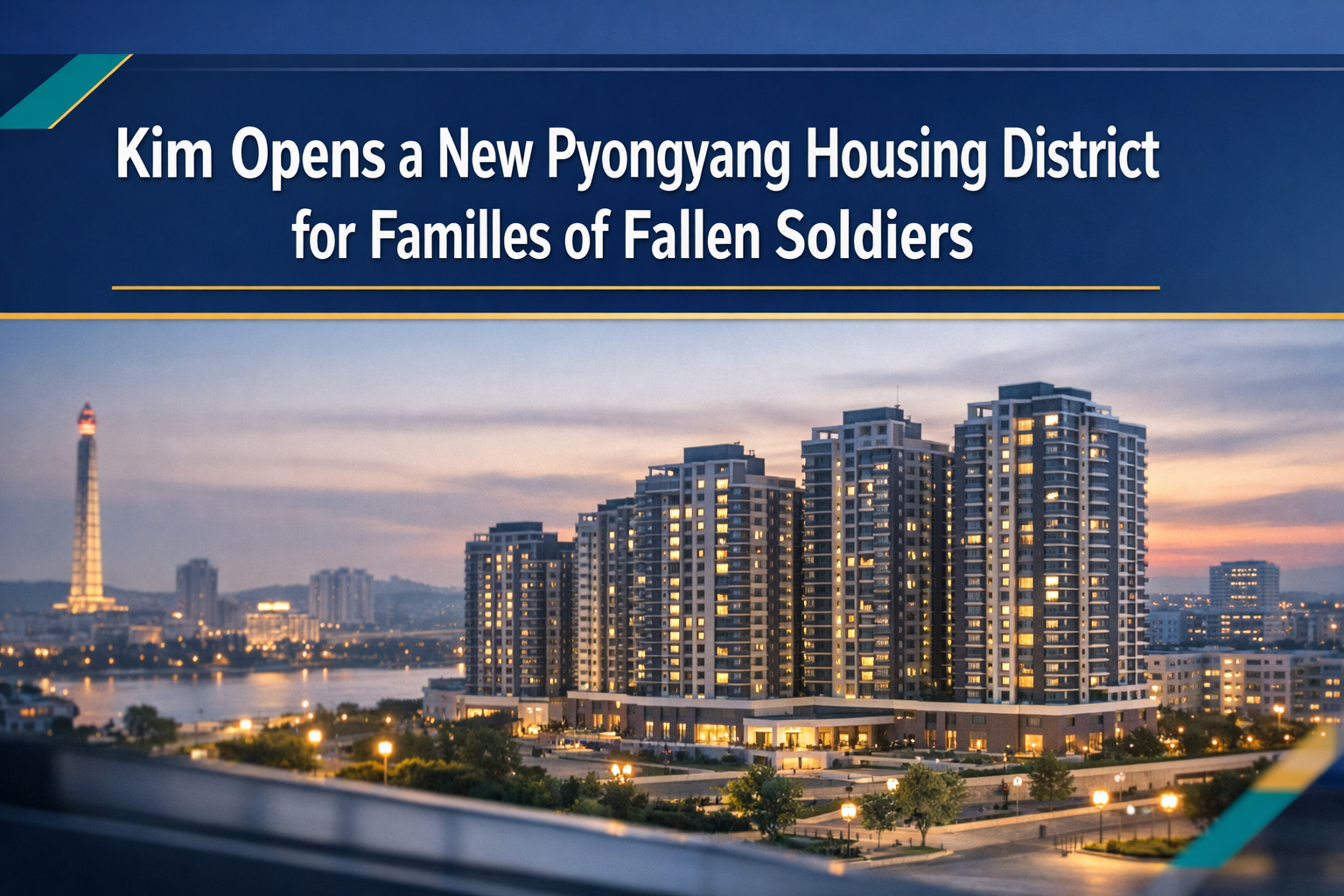
Kim Opens a New Pyongyang Housing District for Families of Fallen Soldiers
Advanced | February 19, 2026
✨ Read the article aloud on your own or repeat each paragraph after your tutor.
New Pyongyang Housing District: A New Neighborhood With a Message
North Korean leader Kim Jong Un has opened a new housing district in Pyongyang for the families of soldiers who died during “overseas military operations,” according to state media KCNA. (Reuters) The development is being presented as both a practical benefit (new apartments) and a symbolic reward for families who lost someone in service. In other words, the new Pyongyang housing district is being used as a public promise: loyalty will be rewarded.
At the completion ceremony, Kim said the new homes were meant to honor the “spirit and sacrifice” of the fallen soldiers and to bring comfort and pride to their families. (Reuters) In KCNA’s telling, this wasn’t just about construction—it was about sending a clear signal that the state will “take care of its own.”
Why “Overseas Operations” Matters
That phrase—“overseas military operations”—is doing a lot of work here. International reporting says North Korea has sent troops to support Russia’s war in Ukraine, and South Korean, Ukrainian, and Western sources have claimed thousands of North Korean soldiers were killed or wounded. (Al Jazeera; Reuters) North Korea has not publicly confirmed those battlefield details, but the new housing project strongly suggests Pyongyang is managing the domestic fallout: honoring the dead, supporting families, and shaping the story at home.
In other words, it’s a classic “reputation management” strategy—except the “brand” is the government.
Kim’s Speed Message: “We Built This Fast”
Kim also stressed urgency, saying he pushed for the project to be completed quickly for the bereaved families. (Reuters) That detail matters because North Korea has made large-scale housing construction a major political project—something Kim can point to as visible “progress.” Some South Korean reporting links this to a broader multi-year plan to add tens of thousands of housing units in Pyongyang.
For English learners who work in business: think of it like a leadership team announcing a flagship project and then staging a very public “grand opening” to prove they can deliver.
A Public Appearance With His Daughter
Photos published by state media showed Kim visiting the new homes and speaking with families—alongside his daughter, Kim Ju Ae, who has appeared more frequently at high-profile events. (Al Jazeera) Analysts often read these appearances as part of a long-term effort to strengthen the family’s image and possibly prepare the public for future leadership narratives.
Even if you ignore the succession rumors, the optics are clear: this is a “family + nation” moment designed to feel personal, emotional, and patriotic.
Timing: Just Before a Major Party Congress
The opening also comes as North Korea prepares for a major meeting of the ruling Workers’ Party (often described as a key political showcase). Big construction achievements and patriotic ceremonies are the kind of “wins” leaders like to highlight going into major policy events.
So yes, this is a housing story—but it’s also a messaging story. And like most messaging, the timing is not an accident.
Vocabulary
- Inaugurate (verb) – to officially begin or introduce something, especially with a ceremony.
Example: “Kim inaugurated the new housing district in Pyongyang.” - Bereaved (adjective) – suffering from the loss of a loved one.
Example: “The bereaved families were invited to move into the new homes.” - Propaganda (noun) – information used to influence public opinion, often politically.
Example: “State media used the event as propaganda to boost national pride.” - Symbolic (adjective) – representing an idea more than having practical value.
Example: “The apartments were symbolic of the government’s promise to reward sacrifice.” - Optics (noun) – how something looks to the public; public perception.
Example: “The optics of Kim visiting families were carefully planned.” - Narrative (noun) – a storyline or explanation that shapes how people understand events.
Example: “The government wants to control the narrative about overseas deployments.” - Showcase (noun/verb) – to display something proudly to impress others.
Example: “The ceremony helped showcase Pyongyang’s new development.” - Deployment (noun) – the movement of troops to a place for military action.
Example: “Reports suggest the deployment involved fighting abroad.” - Commemorate (verb) – to honor the memory of someone or something.
Example: “The state used the housing project to commemorate fallen soldiers.” - Subtle (adjective) – not obvious; indirect.
Example: “The wording was subtle, but it hinted at major events overseas.”
Discussion Questions (About the Article)
- Why do you think North Korea is offering housing to families of fallen soldiers?
- What does the phrase “overseas military operations” suggest, and why might leaders choose that wording?
- How does the government use construction projects to send political messages?
- What details in the story feel emotional, and what details feel strategic?
- If you were writing a neutral headline, what would you emphasize—and what would you avoid?
Discussion Questions (About the Topic)
- Should governments give special benefits to military families? Why or why not?
- How do countries use public ceremonies to shape public opinion?
- What are the pros and cons of linking national pride to construction projects?
- How can the media influence how people interpret war casualties?
- What “business-like” tactics do governments use to manage public perception during crises?
Related Idiom
“Put a good face on it” – to make something look better than it really is.
Example: “By opening a new housing district, the government is trying to put a good face on the human cost of overseas operations.”
📢 Want more practical English with real-world topics? 👉 Sign up for the All About English Mastery Newsletter! Click here to join us.
Want to finally Master English but don’t have the time? Mastering English for Busy Professionals is the course for you.
Follow our YouTube Channel @All_About_English for more great insights and tips.
This article was inspired by:
- Reuters — North Korea’s Kim opens new Pyongyang housing district for families of fallen soldiers, KCNA says
- Al Jazeera — North Korea opens new housing area for families of soldiers killed overseas
- Al Jazeera (Photo Gallery) — Photos: North Korea’s Kim unveils homes for families of fallen soldiers
- AP (via The Washington Post) — North Korea, Ukraine war dead; Kim Jong Un opens homes for families of soldiers
- NK News — North Korea unveils housing for families of soldiers killed in ‘overseas operations’


 English
  한국어
한국어