

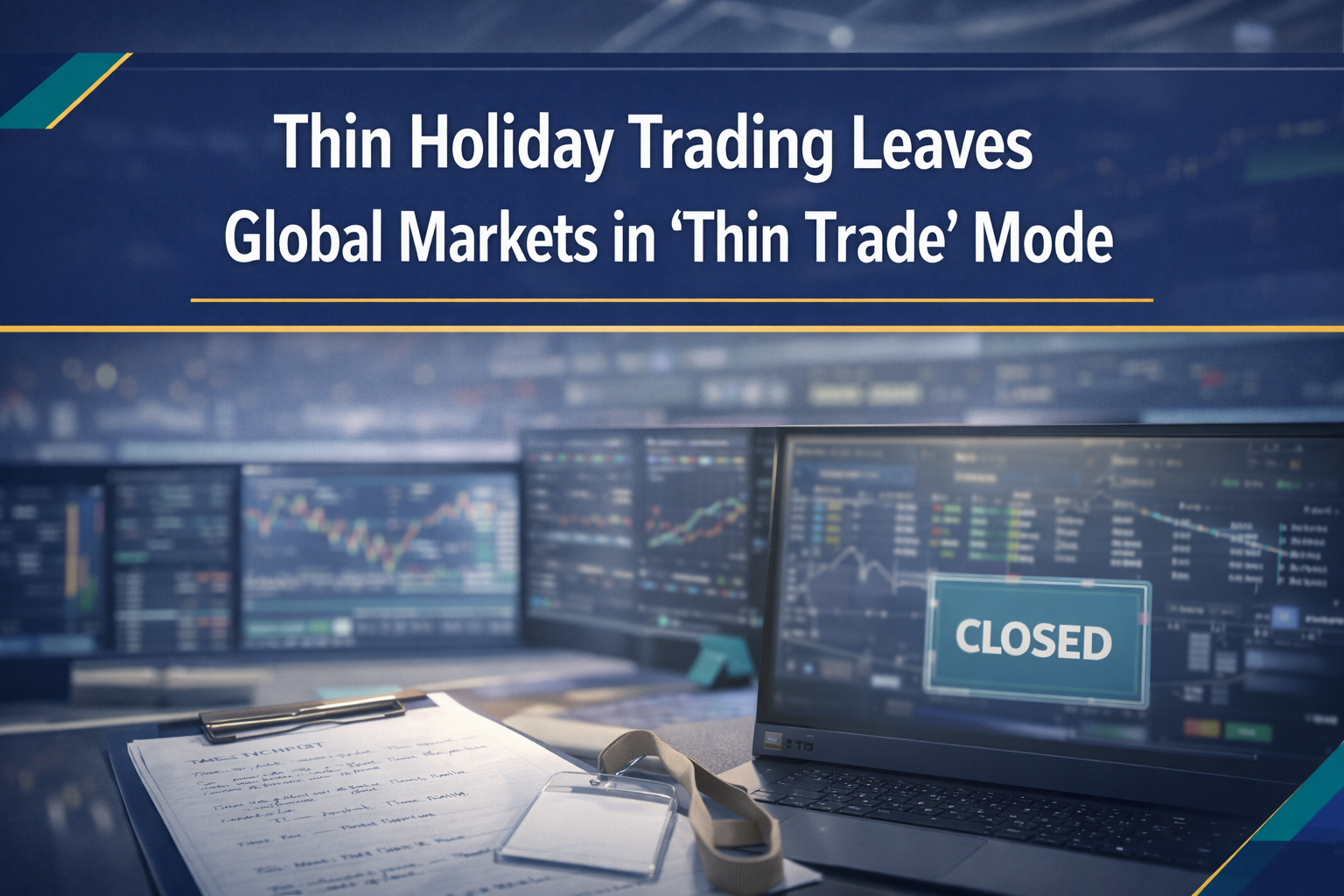
Thin Holiday Trading Leaves Global Markets in “Thin Trade” Mode
Advanced | February 19, 2026
✨ Read the article aloud on your own or repeat each paragraph after your tutor.
Thin Holiday Trading: A Quiet Day for Traders
On February 16, 2026, global financial markets felt unusually calm because several major markets were closed for holidays—especially China, South Korea, and Taiwan. When big players step away from the table, trading volume drops, price moves shrink, and investors often shift into “wait-and-see” mode. This is exactly what thin holiday trading looks like in real time. (Reuters)
What “Subdued Activity” Looked Like
Reuters described the session as thin holiday trading, with world shares mostly steady after a prior drop tied to AI-related market worries. With fewer buyers and sellers, markets can look stable even when people are nervous—because there simply aren’t enough trades happening to push prices in either direction. (Reuters)
Asia: Currencies Hold Tight Ranges
In Asia, the holiday effect was obvious. Reuters reported that many Asian currencies moved in tight ranges because China, South Korea, Taiwan, the U.S., and Indonesia were all closed. In that quiet environment, the Malaysian ringgit and Thai baht made modest gains, while most other currencies barely moved. (Reuters)
Thailand Was the Exception: Stocks Climbed
Even on a sleepy trading day, there was one standout. Reuters said Thai stocks climbed to their highest level since December 2024, supported by fresh foreign buying after a decisive election result and expectations of economic stimulus. It’s a good reminder that a “quiet” market doesn’t mean “nothing happens”—it just means fewer things move at the same time. (Reuters)
The Real Lesson: Liquidity Matters
For business people and investors, this story is basically about liquidity—how easy it is to buy or sell without dramatically changing the price. Holidays reduce liquidity. That can make markets feel calmer, but it can also make them more fragile, because a single big trade can move prices more than usual.
If you’ve ever tried to sell something online when “nobody’s shopping,” you already understand liquidity.
Vocabulary
- Subdued (adjective) – quieter than normal; not very active.
Example: “Market activity was subdued because several exchanges were closed.” - Thin trading (noun phrase) – low trading volume, with fewer buyers and sellers.
Example: “Thin trading can make prices move unpredictably.” - Exchange (noun) – a market where stocks, currencies, or commodities are traded.
Example: “Major exchanges were closed for holidays in Asia.” - Liquidity (noun) – how easily an asset can be bought or sold without big price changes.
Example: “Liquidity usually drops during holiday closures.” - Tight range (noun phrase) – small price movement up and down.
Example: “The currency traded in a tight range all day.” - Steady (adjective) – stable; not changing much.
Example: “World shares remained steady in quiet conditions.” - Investor sentiment (noun phrase) – the overall mood of investors.
Example: “Investor sentiment turned cautious after recent volatility.” - Stimulus (noun) – government action to support economic activity.
Example: “Investors expected stimulus after the election.” - Foreign inflows (noun phrase) – money coming into a market from overseas investors.
Example: “Thai stocks rose on foreign inflows.” - Wait-and-see (adjective/phrase) – delaying decisions until there’s clearer information.
Example: “Markets shifted into a wait-and-see stance.”
Discussion Questions (About the Article)
- Why do holiday closures reduce trading activity in global markets?
- What does “thin trading” mean, and why can it be risky?
- Why did Reuters say currencies moved in “tight ranges”?
- Why was Thailand an exception to the quiet market mood?
- What is liquidity, and why does it matter for both investors and businesses?
Discussion Questions (About the Topic)
- Have you seen “holiday effects” in your own industry (slower sales, fewer meetings, delayed decisions)?
- What happens in a company when decision-makers are “out of office” at the same time?
- Why do you think investors prefer to pause before major economic events or uncertainty?
- How can low liquidity create opportunities—and dangers?
- What should businesses do to prepare for predictable slow periods (holidays, end-of-quarter, etc.)?
Related Idiom
“On the sidelines” – not actively participating; waiting.
Example: “With so many markets closed, investors stayed on the sidelines and trading volume dropped.”
📢 Want more practical English with real-world topics? 👉 Sign up for the All About English Mastery Newsletter! Click here to join us.
Want to finally Master English but don’t have the time? Mastering English for Busy Professionals is the course for you.
Follow our YouTube Channel @All_About_English for more great insights and tips.
This article was inspired by:
- Reuters — Shares edge up in thinly-traded holiday markets
- Reuters — Asian FX steady in thin holiday trade; Thai stocks climb to over one-year high


 English
  한국어
한국어