

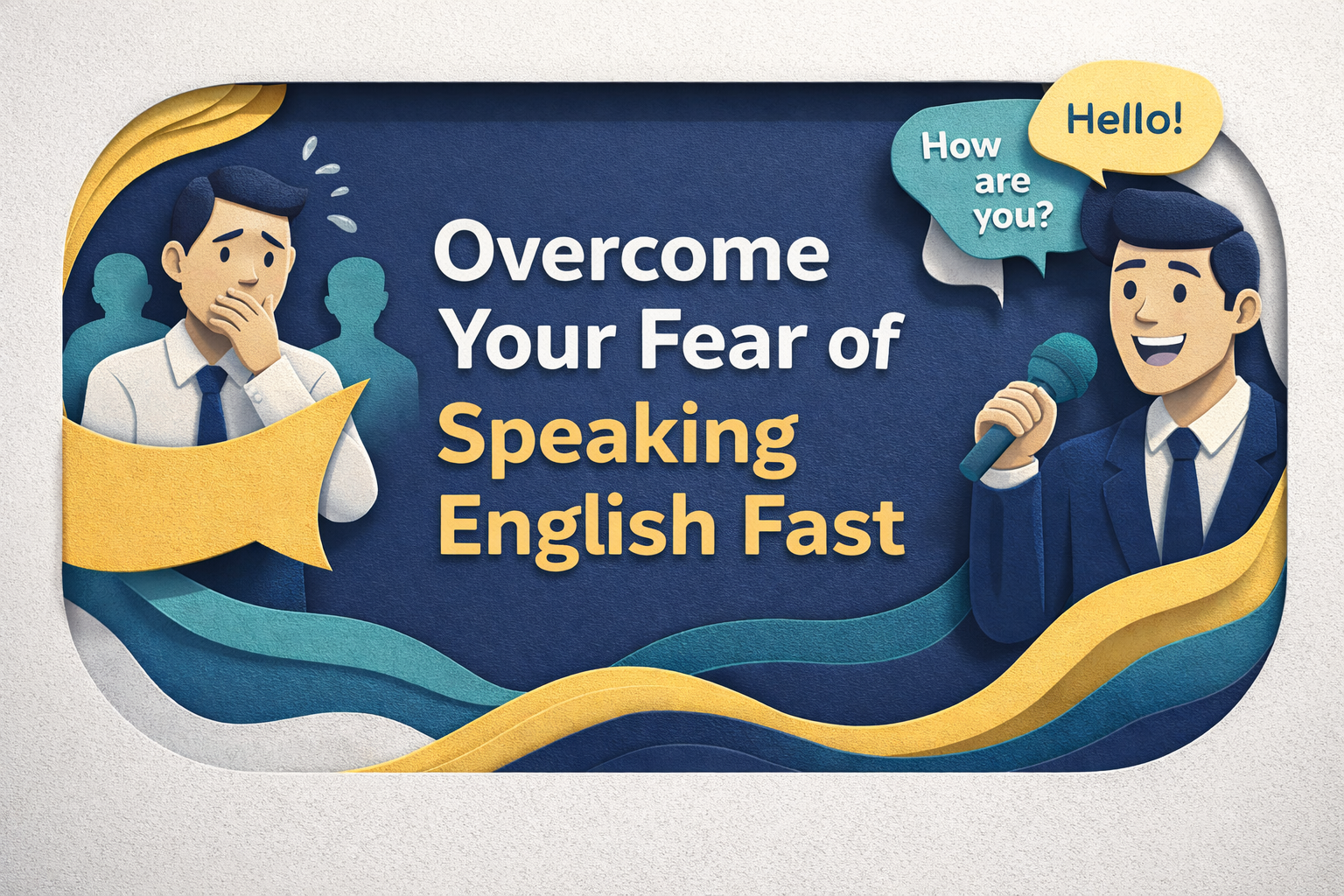
Overcome Your Fear of Speaking English Fast 🚀
Beginner Level | February 21, 2026
Read the article aloud on your own or repeat each paragraph after your tutor.
Many professionals can read English and understand meetings, but when it’s time to speak, they freeze. If you have a fear of speaking English, you’re not alone—and you’re not broken. Your brain suddenly says, “Too fast! Too risky!” and you start translating in your head. Then your sentence becomes a traffic jam.
Here’s the truth: you don’t need to speak fast to sound confident. You need to speak smoothly. Speed comes later—like running. First you walk. Then you jog. Then you sprint.
Today, you’ll learn a simple way to reduce a fear of speaking English and speak faster over time—without panicking, without memorizing scripts, and without trying to be perfect.
Why You Feel a Fear of Speaking English
When you feel nervous, your body goes into “danger mode.” Your heart beats faster, your mouth gets dry, and your mind feels blank. This is normal. But it makes English feel harder than it really is.
The solution is not “study more grammar.” The solution is to train your brain with small, safe speaking reps—like lifting light weights before heavy weights.
The 3-Step “Fast Speaking” Training
Step 1: Use Short, Safe Sentences
Start with sentences you can say without thinking too much. For example:
- “I’m working on a report.”
- “I have a quick question.”
- “Let me check and get back to you.”
Short sentences help you speak without fear. They also stop you from getting lost in long grammar.
Step 2: Speak in Chunks (Not Single Words)
Instead of building a sentence word-by-word, use chunks—common groups of words.
For example:
- “To be honest…”
- “From my point of view…”
- “The main reason is…”
Chunks are powerful because your brain can grab the whole phrase at once. That helps your speaking feel faster.
Step 3: Add a Timer (But Make It Friendly)
Set a timer for 60 seconds. Choose an easy topic:
- What you did today
- What you will do tomorrow
- What you are working on this week
Speak for 60 seconds. If you stop, that’s fine—restart. You’re training flow, not perfection.
A Simple Mindset Shift
If you wait until you feel “ready,” you may never start. Instead, use this mindset:
“I will speak, even if it’s simple.”
Simple English is strong English. People at work want clarity—not poetry.
Vocabulary List
- freeze (verb) — to suddenly stop because you feel nervous or scared.
Example: I freeze when someone asks me a question in English. - traffic jam (noun) — a situation where movement stops because things are blocked.
Example: My sentence becomes a traffic jam when I translate in my head. - smoothly (adverb) — in a calm, easy way without stopping.
Example: She spoke smoothly, even though her English was simple. - panic (verb) — to feel sudden, strong fear.
Example: Don’t panic if you forget a word—just keep going. - rep (noun) — a short practice attempt (like in exercise).
Example: I do speaking reps every morning for one minute. - solution (noun) — an answer to a problem.
Example: The solution is daily speaking practice, not more memorizing. - chunk (noun) — a group of words used together.
Example: “To be honest” is a useful chunk for meetings. - grab (verb) — to take quickly.
Example: My brain can grab the whole phrase faster than single words. - timer (noun) — a tool that counts time.
Example: I use a timer to practice speaking for 60 seconds. - mindset (noun) — the way you think about something.
Example: A strong mindset helps you speak with less fear.
5 Questions About the Article
- Why do many professionals freeze when they try to speak English?
- What is the difference between speaking fast and speaking smoothly?
- What is Step 1 of the “Fast Speaking” Training?
- Why are “chunks” helpful for speaking faster?
- What is the purpose of the 60-second timer practice?
5 Open-Ended Discussion Questions
- When do you feel most nervous speaking English (meetings, small talk, phone calls)? Why?
- What short “safe sentence” do you want to use at work this week?
- Which speaking chunk feels most natural for you? Which feels difficult?
- What topic would you choose for a 60-second speaking timer?
- How would your work or life change if you felt confident speaking English?
📢 Want more practical English you can use at work? 👉 Sign up for the All About English Mastery Newsletter! Click here to join us!
Want to finally Master English but don’t have the time? Mastering English for Busy Professionals is the course for you! Check it out now!
Follow our YouTube Channel @All_About_English for more great insights and tips

 English
  한국어
한국어