

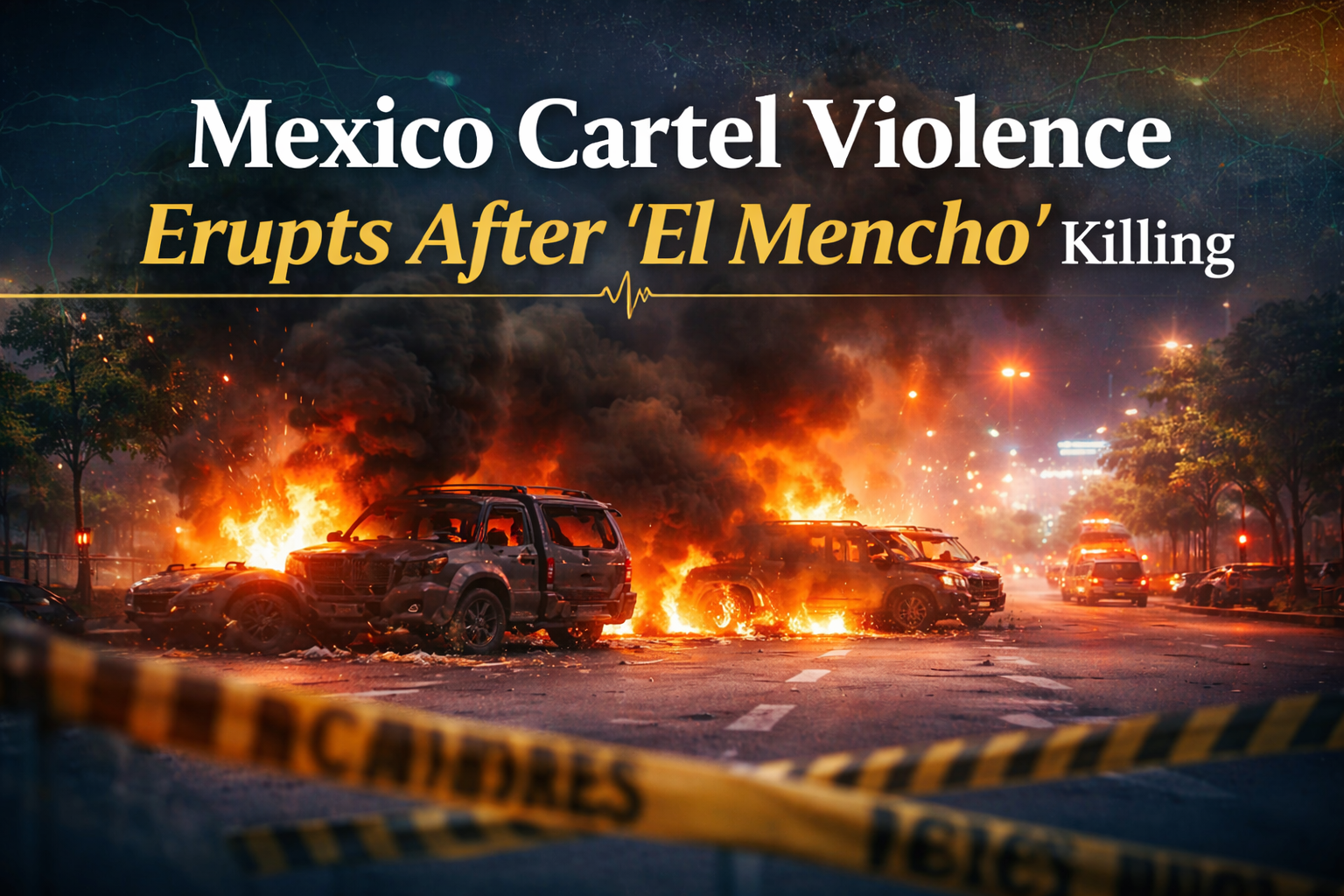
Mexico Cartel Violence Erupts After ‘El Mencho’ Killing
Advanced | February 25, 2026
✨ Read the article aloud on your own or repeat each paragraph after your tutor.
A Sudden Shock: Mexico Cartel Violence Spreads on Sunday
On Sunday, February 22, 2026, Mexico cartel violence flared across parts of the country after Mexican security forces announced the killing of Nemesio Rubén Oseguera Cervantes, better known as “El Mencho,” the alleged leader of the Jalisco New Generation Cartel (CJNG). Authorities and news outlets reported road blockades, vehicle fires, and attacks on security forces—classic pressure tactics designed to create fear and disruption. (Reuters)
What Happened: Roadblocks, Arson, and “Ghost Town” Streets
Multiple reports described burned vehicles used as barricades, sudden highway closures, and major disruptions in and around Jalisco, including the Guadalajara metro area. Some outlets noted that parts of the city felt unusually quiet as residents stayed indoors while authorities worked to restore order. (Al Jazeera)
Why Cartels Do This: Creating Leverage Through Chaos
If you want the business-casual translation, think of it as a brutal form of leverage. Cartels sometimes respond to a leader’s death by raising the “cost” for the government—forcing officials to deploy resources, calm markets, protect tourism, and reassure the public. Analysts also warn that removing a top boss can trigger succession fights or splintering, which may increase instability in the short term. (The Guardian)
Government Response: Troops, Cleanup, and Reassurance
Mexican officials said security forces moved to clear roadblocks and reestablish control, while media reports described a large-scale security deployment after the weekend violence. Coverage also highlighted concerns about travel disruptions in parts of western Mexico, including tourist areas, and how quickly normal life can be interrupted when organized crime wants attention. (Al Jazeera)
The Bigger Picture: Security, Tourism, and the 2026 World Cup
The timing matters. Guadalajara is scheduled to host matches during the 2026 FIFA World Cup, and the violence put international attention back on Mexico’s security challenge. President Claudia Sheinbaum publicly insisted there was “no risk” to visitors. Meanwhile, FIFA reported that they were monitoring the situation. Whether that reassurance holds depends on what happens next—and whether Mexico cartel violence fades or turns into a longer cycle of retaliation and power shifting. (The Guardian)
Bottom Line: Watch the Next Moves
In the coming days, the key questions are: Will the CJNG stay unified? Will rivals try to grab territory? And can authorities keep disruption from becoming the new normal? For everyday people, it’s a reminder that stability is fragile—and that organized crime often uses public disruption as a messaging strategy.
Vocabulary
- Retaliation (noun) – action taken in response to an attack or loss.
Example: “Authorities feared retaliation after the cartel leader was killed.” - Roadblock (noun) – an obstruction placed to stop or slow traffic.
Example: “Roadblocks forced drivers to change routes.” - Barricade (noun) – a barrier used to block movement.
Example: “Burned vehicles were used as a barricade on highways.” - Disruption (noun) – an interruption that prevents normal activity.
Example: “Flights and transport faced disruption after the violence.” - Deploy (verb) – to send people or resources to a place for action.
Example: “The government deployed additional troops to restore order.” - Leverage (noun) – power or influence used to get a result.
Example: “Cartels use chaos as leverage against the state.” - Succession (noun) – who takes leadership after someone leaves or dies.
Example: “Observers worried about succession inside the cartel.” - Fragmentation (noun) – breaking into smaller parts or groups.
Example: “Fragmentation can lead to more violence between factions.” - Reassure (verb) – to make someone feel less worried.
Example: “Officials tried to reassure residents and visitors.” - Nonstop coverage (noun phrase) – continuous news reporting.
Example: “The events triggered nonstop coverage across international media.”
Discussion Questions (About the Article)
- What event triggered the wave of violence on February 22, 2026?
- What kinds of disruption did the media report (roadblocks, fires, closures, etc.)?
- Why might cartels respond with public disruption after a leader is killed?
- What steps did authorities take to restore order?
- Why does the 2026 World Cup matter in how this story is discussed?
Discussion Questions (About the Topic)
- How should governments balance security and civil liberties when facing organized crime?
- Why do some groups use public disruption as “messaging”?
- What role do tourism and business confidence play in security policy?
- How can communities build resilience during sudden disruptions?
- What makes a news source trustworthy during fast-moving crises?
Related Idiom
“Send a message” – to do something that shows power or intention.
Example: “The cartel members used the roadblocks and fires to send a message after the cartel leader’s death.”
📢 Want more practical English with real-world topics? 👉 Sign up for the All About English Mastery Newsletter! (Newsletter)
Want to finally Master English but don’t have the time? Mastering English for Busy Professionals is the course for you.
Follow our YouTube Channel @All_About_English for more great insights and tips.
This article took inspiration from: Reuters, Al Jazeera, and The Guardian.


 English
  한국어
한국어