

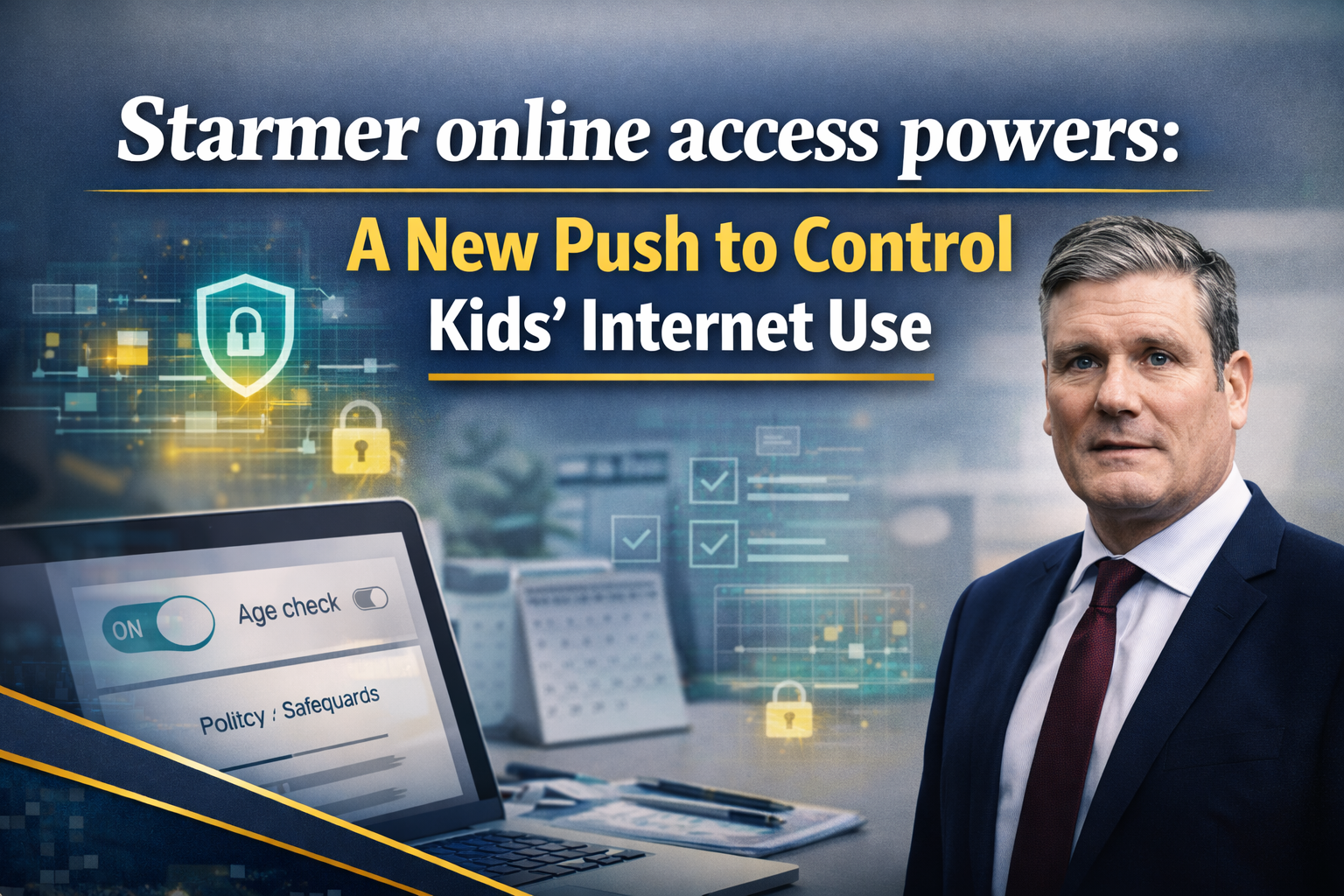
Starmer online access powers: A New Push to Control Kids’ Internet Use
Advanced | February 27, 2026
✨ Read the article aloud on your own or repeat each paragraph after your tutor.
Starmer online access powers: “Months, Not Years”
UK Prime Minister Keir Starmer says Britain needs faster, stronger powers to regulate online access—especially for children—because digital risks are changing too quickly for slow-moving laws. The government has signaled it wants the ability to act in months, not years, after an upcoming public consultation. (Reuters)
The Under-16 Social Media Ban Idea (And Why It’s Spreading)
One headline proposal is an Australia-style social media ban for under-16s, which the UK is consulting on. The Reuters report noted several European countries were discussing similar moves around the same time. Supporters say platforms are designed to be addictive and can expose kids to harmful content; critics argue a ban could be hard to define, enforce, and might push teenagers into less regulated corners of the internet. (Reuters)
Closing a “Chatbot Loophole” in the Online Safety Act
Another key point: the UK wants to close a gap in the 2023 Online Safety Act. Reuters reported that one-to-one interactions with AI chatbots were not clearly covered—so the government is looking to bring chatbot providers under stricter child-safety rules. That matters because chatbot conversations can be private, persistent, and extremely persuasive—especially for younger users. (Reuters)
The Financial Times also reported the government’s plan to explicitly include AI chatbots—naming tools like Grok, Gemini, and ChatGPT—and emphasized that “no platform gets a free pass” when it comes to illegal content and child safety. (Financial Times)
VPNs, Nude Images, and a Tougher Role for Ofcom
Starmer’s team has also floated restrictions aimed at the real-world ways kids bypass rules—like using VPNs to access adult content. UK broadcaster reporting says the proposals could also limit children’s access to certain chatbots and tighten rules around pornography and harmful material. (ITV News)
Meanwhile, Reuters reported a related crackdown: tech firms could be required to remove nonconsensual intimate images within 48 hours or face major penalties, enforced by Ofcom. This is part of the broader message: platforms—not victims—should carry more responsibility. (Reuters)
The Business Angle: Regulation Is a Cost—And a Competitive Weapon
Zooming out, Starmer online access powers isn’t only a parenting debate—it’s also a business story. Tighter rules can mean higher compliance costs, more age verification, more moderation tools, and more legal risk. But there’s another side: regulation can also become a competitive advantage for companies that build safer systems early (and a headache for those that don’t).
And if the UK moves aggressively, it could influence how other countries regulate tech—especially in Europe, where governments are already wrestling with the same problems.
Vocabulary
- Consultation (noun) – a period when the public is asked to give opinions before a decision.
Example: The government plans a consultation before making final rules. - Loophole (noun) – a gap in a law that allows people to avoid its purpose.
Example: Officials say chatbot conversations created a loophole in the Online Safety Act. - Regulate (verb) – to control through rules or laws.
Example: The UK wants stronger tools to regulate online access for minors. - Enforce (verb) – to make sure rules are followed.
Example: Ofcom would enforce penalties for violations. - Compliance (noun) – following laws and regulations.
Example: Tech firms may face higher compliance costs under stricter rules. - Age verification (noun) – confirming a user’s age before allowing access.
Example: Age verification could become more common across platforms. - Addictive (adjective) – hard to stop using; designed to keep users engaged.
Example: Some critics say social media features are addictive for teens. - Circumvent (verb) – to get around a rule or restriction.
Example: Kids may circumvent bans by moving to less regulated platforms. - Nonconsensual (adjective) – without permission or agreement.
Example: The law targets nonconsensual intimate images shared online. - Penalty (noun) – a punishment, often a fine.
Example: Companies could face penalties if they don’t remove illegal content quickly.
Discussion Questions (About the Article)
- What does Starmer say is the main reason the UK needs faster online regulation?
- What is the proposed rule about social media use for under-16s?
- What “loophole” involving AI chatbots does the government want to close?
- What role would Ofcom play if these proposals become law?
- Why might these changes affect tech companies’ costs and strategies?
Discussion Questions (About the Topic)
- Should governments be able to restrict children’s access to social media? Why or why not?
- What is the best way to protect kids online without invading adult privacy?
- Do AI chatbots need stricter rules than regular websites? Explain.
- If a country bans under-16 social media use, how should it be enforced?
- What responsibilities should tech companies have when harmful content spreads?
Related Idiom
“Moving the goalposts” – changing the rules or standards as the situation develops.
Example: With new AI tools appearing fast, lawmakers feel like platforms keep moving the goalposts—so they want powers that can respond faster.
📢 Want more practical English using real news? 👉 Sign up for the All About English Mastery Newsletter! Click here to join us!
Want to finally Master English but don’t have the time? Mastering English for Busy Professionals is the course for you! Check it out now!
Follow our YouTube Channel @All_About_English for more great insights and tips.
This article was inspired by: Reuters, Reuters (48-hour takedown rule), Financial Times, ITV News, and Al Jazeera.


 English
  한국어
한국어