

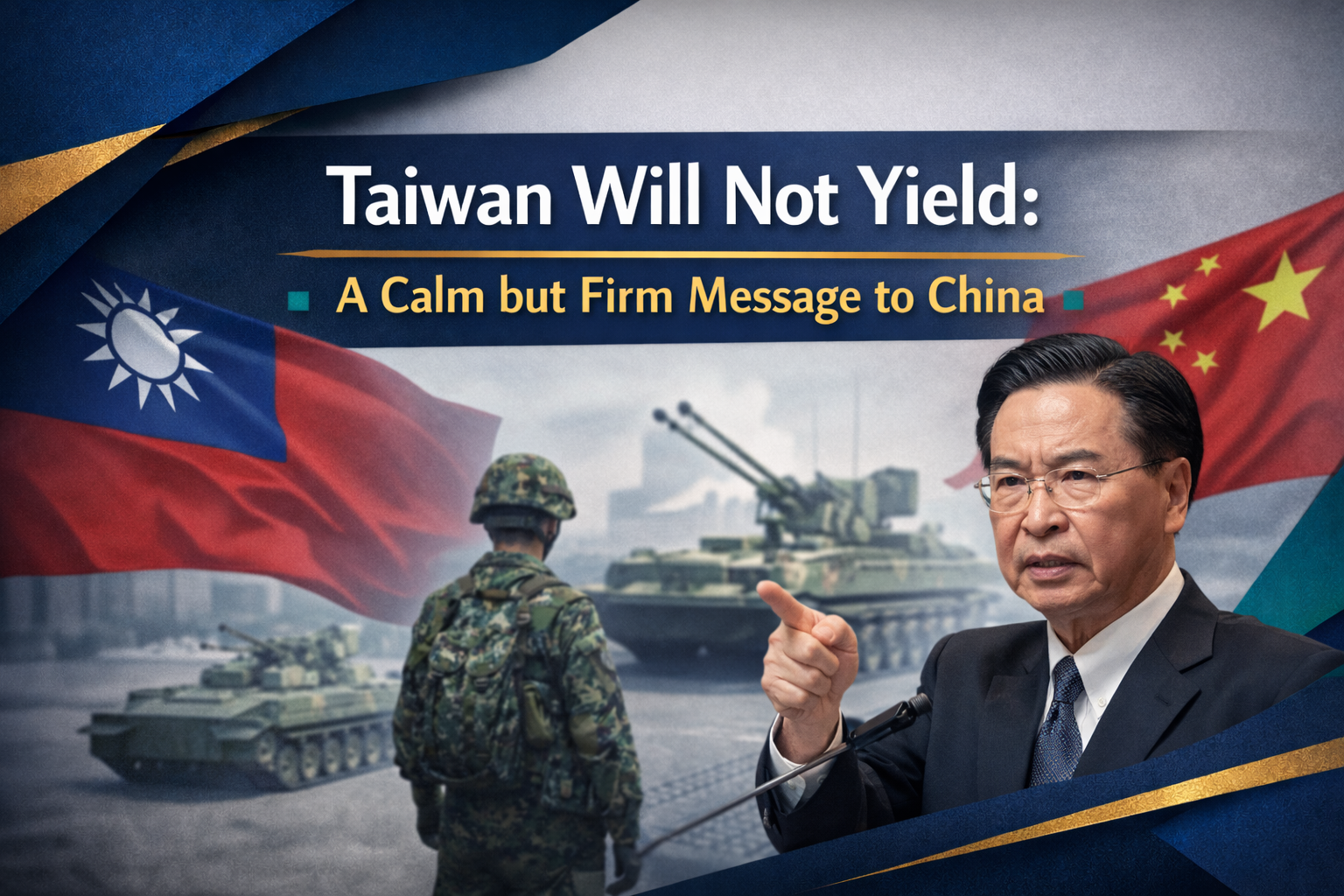
Taiwan Will Not Yield: A Calm but Firm Message to China
Intermediate | March 2, 2026
✨ Read the article aloud on your own or repeat each paragraph after your tutor.
Taiwan Will Not Yield—And That Wording Matters
Taiwan’s foreign minister, Lin Chia-lung, delivered a message that sounds calm but carries real weight: Taiwan “will not escalate” tensions, but it also “will not yield” to Chinese intimidation. He described China as an “authoritarian” power whose actions create wider risks for peace and stability in the Indo-Pacific. (Yahoo News / Fox News Digital)
What “Intimidation” Can Look Like in Real Life
When Taiwan talks about intimidation, it’s not just one thing. It can mean military pressure (more aircraft and ships near the island), diplomatic pressure (trying to isolate Taiwan internationally), and even economic pressure (trade limits or informal boycotts). Reuters has reported that China’s military activity around Taiwan has intensified, and Taiwanese officials worry people could become “numb” to it. (Reuters)
Why Taiwan Chooses “Calm but Firm” Language
This is the interesting part: Taiwan isn’t trying to sound dramatic. It’s trying to sound steady. Saying “we won’t escalate” signals restraint. Saying “we won’t yield” signals strength. Put together, it’s a strategy: reduce the chance of panic, while still drawing a clear boundary. That’s the business lesson too—professional leaders often sound calm, even when they’re setting hard limits.
The Wider Context: A War of Narratives
These statements don’t happen in a vacuum. On February 15, 2026, Reuters reported Taiwan’s foreign minister pushed back strongly after China’s foreign minister spoke at the Munich Security Conference, saying China is the real threat and rejecting Beijing’s claim that Taiwan is part of the PRC. (Reuters)
What This Means for Business and the Region
Even if you don’t follow politics closely, tension around Taiwan matters for business. The region sits on major shipping routes and supports critical tech supply chains. When risk headlines increase, markets can get cautious, companies reassess plans, and global partners watch every official statement for signals.
The Takeaway for English Learners
If you want to sound more professional in English, study this kind of communication. “Taiwan will not yield” is direct, but it’s not emotional. It’s controlled. In business, that’s a powerful combination—clear boundaries, calm delivery.
Vocabulary
- escalate (verb) – to increase or become more serious.
Example: The minister said Taiwan will not escalate tensions. - yield (verb) – to give in; to surrender.
Example: Taiwan said it will not yield to intimidation. - intimidation (noun) – actions meant to scare someone into doing what you want.
Example: The minister warned against intimidation from a larger power. - authoritarian (adjective) – controlling; not allowing much freedom or opposition.
Example: He described China’s system as authoritarian. - restraint (noun) – careful control; not reacting aggressively.
Example: The statement showed restraint while staying firm. - boundary (noun) – a clear limit.
Example: The message set a boundary without sounding hostile. - numb (adjective) – not reacting much after repeated exposure.
Example: Officials worry people may become numb to frequent drills. - narrative (noun) – a story or explanation used to shape opinions.
Example: Both sides are fighting a narrative battle. - supply chain (noun) – the system of making and moving goods.
Example: Regional tension can disrupt the global supply chain. - signal (noun/verb) – a message or sign; to communicate indirectly.
Example: Careful wording can signal strength without escalation.
Discussion Questions (About the Article)
- What does the phrase “will not escalate, but will not yield” communicate?
- Why might Taiwan want to sound calm and firm at the same time?
- What kinds of actions can count as “intimidation” in international relations?
- Why do markets and companies watch political statements closely?
- Which words in this article felt the most “diplomatic” to you?
Discussion Questions (About the Topic: Regional Tension)
- How should smaller countries respond to pressure from bigger countries?
- Do you think careful language prevents conflict—or increases it? Why?
- How can tension in one region affect the global economy?
- What role do alliances and partnerships play in regional security?
- In your opinion, what is the best way to reduce long-term tension?
Related Idiom
“Stand your ground” – to refuse to change your position.
Example: Taiwan is standing its ground while saying it does not want escalation.
📢 Want more practical English using real news? 👉 Sign up for the All About English Mastery Newsletter! Click here to join us!
Want to finally Master English but don’t have the time? Mastering English for Busy Professionals is the course for you! Check it out now!
Follow our YouTube Channel @All_About_English for more great insights and tips.
This article took inspiration from: (Yahoo News / Fox News Digital), and related context from (Reuters (Feb 5, 2026)) and (Reuters (Feb 15, 2026)).


 English
  한국어
한국어