

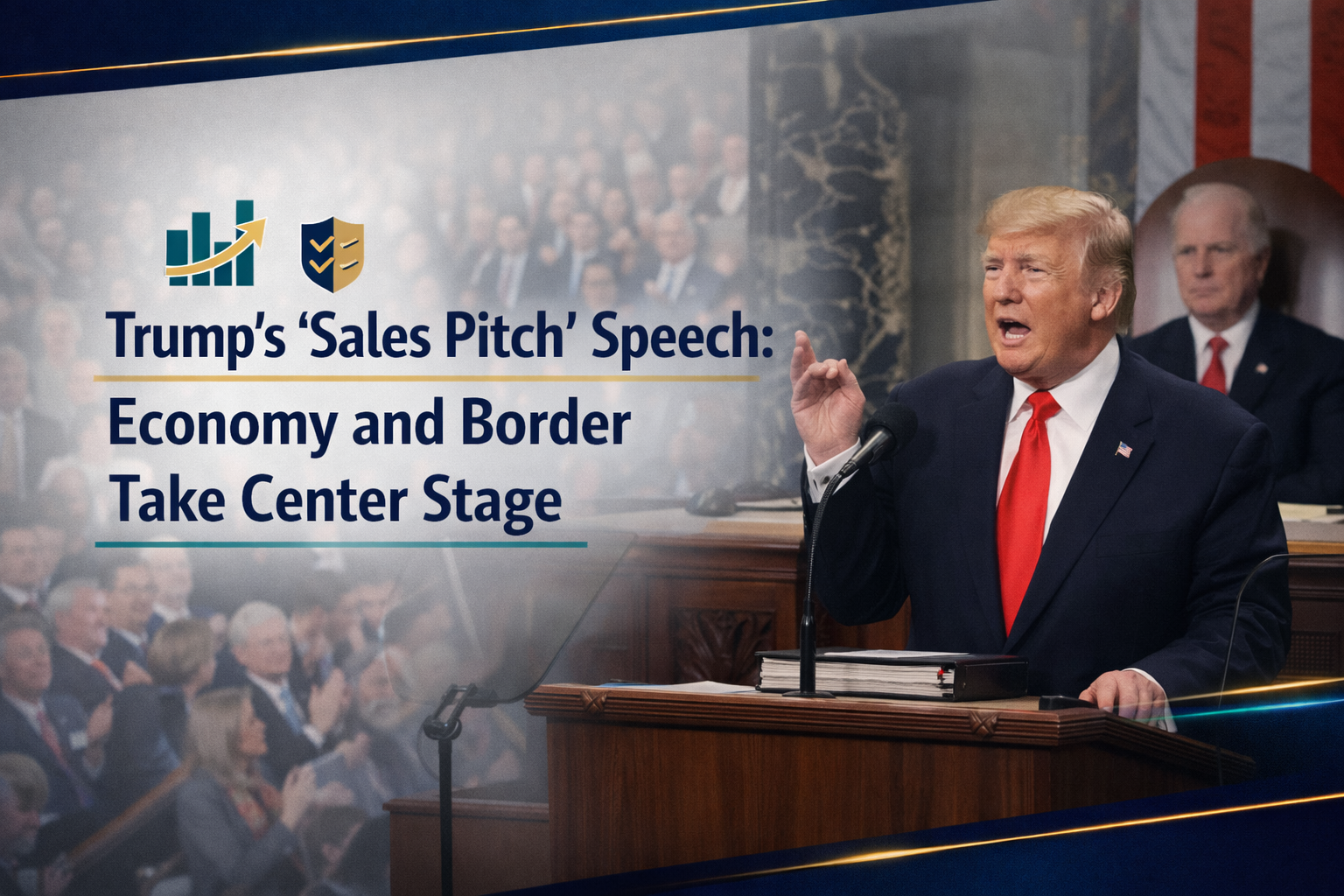
Trump’s “Sales Pitch” Speech: Economy and Border Take Center Stage
Advanced | March 3, 2026
✨ Read the article aloud on your own or repeat each paragraph after your tutor.
Trump’s economy and border speech: A State of the Union in “Sales Mode”
In a widely discussed State of the Union address on February 24, 2026, President Donald Trump leaned into what felt like a confident “sales pitch” — highlighting what he says are his biggest wins on the economy and the southern border. In short, he treated Trump’s economy and border speech like a message-reset: simple, confident, and built for headlines. The tone stayed mostly upbeat, with lots of patriotic imagery and headline-ready moments meant to reassure voters ahead of the November midterms. (Reuters)
The Economy: Big Claims, Kitchen-Table Focus
Trump put “dollars and cents” at the heart of the speech, talking about everyday concerns like housing, healthcare, utility bills, crime, and retirement. He argued that inflation, mortgage rates, and gas prices are falling, while the stock market and oil production are booming — even though polling and some government data still show voters feeling squeezed by the cost of living. (Reuters)
The Border: Tough Talk Without the Messy Details
On immigration, Trump tried to reclaim what has traditionally been a political strength: projecting control, safety, and “law and order.” He highlighted crimes committed by immigrants in graphic terms and attacked Democrats as weak on border security. At the same time, major reporting noted he avoided spotlighting the most controversial elements of enforcement, focusing instead on message discipline and emotional examples. (Reuters)
Made-for-TV Moments and a Clear Strategy
Trump’s address included what reporters called political theater — awards, surprise guests, and patriotic shout-outs — designed to lock in the story he wants people to remember: “America is winning again.” It was the kind of presentation that works like marketing: you repeat a few clear messages, reinforce them with visuals, and keep moving. (AP)
Why This Matters (Even If You’re Not Into Politics)
For professionals, speeches like this can matter because they signal policy priorities. If a president keeps emphasizing tariffs, inflation, and border crackdowns, companies start asking practical questions: Will costs rise? Will labor markets tighten? Will trade rules change? In other words, even a political speech can have business consequences — especially if it shapes what Congress does next.
The Bottom Line
Supporters heard a leader selling progress. Critics heard a leader glossing over real pain points. Either way, Trump’s economy and border speech shows a clear communication lesson: when trust is shaky, leaders often switch to simple, repeatable messages and try to build confidence first — then negotiate details later. (Reuters)
Vocabulary
- Sales pitch (noun) – a persuasive talk designed to convince people.
Example: “The speech felt like a sales pitch aimed at nervous voters.” - Upbeat (adjective) – positive and hopeful.
Example: “He kept an upbeat tone even when discussing serious issues.” - Kitchen-table issues (noun phrase) – everyday problems families talk about at home.
Example: “Housing and utility bills are classic kitchen-table issues.” - Backdrop (noun) – the situation in the background that shapes events.
Example: “The speech happened against a backdrop of voter frustration.” - Reclaim (verb) – to take back something you had before.
Example: “He tried to reclaim the immigration narrative.” - Enforcement (noun) – making sure laws are followed.
Example: “He avoided discussing specific enforcement tactics.” - Controversial (adjective) – causing strong disagreement.
Example: “The policy became controversial after public backlash.” - Theater (noun) – dramatic action meant to create an effect.
Example: “The awards and guests added a sense of political theater.” - Priority (noun) – the most important focus.
Example: “The speech signaled border security as a top priority.” - Consequences (noun) – results or effects of an action.
Example: “Trade policy changes can have consequences for prices.”
Discussion Questions (About the Article)
- Why do you think Trump focused so heavily on the economy and the border?
- Which parts of the speech felt like “marketing” to you, and why?
- Why might a president avoid detailed policy explanations in a big speech?
- How can patriotic or emotional moments change how people remember a message?
- If you were advising a leader, what would you tell them to emphasize in a crisis?
Discussion Questions (About the Topic)
- When is a “sales pitch” communication style useful, and when is it risky?
- How should leaders balance optimism with honesty about problems?
- Do you think big speeches still matter in the age of short videos and social media?
- How can citizens fact-check claims without getting overwhelmed?
- How should businesses prepare when political priorities might change policies?
Related Idiom
“Talk is cheap” — words are easy, but action is what matters.
Example: “After a big speech, voters often feel that talk is cheap unless they see real results.”
📢 Want more advanced English practice with real news? 👉 Sign up for the All About English Mastery Newsletter! Click here to join us!
Want to finally Master English but don’t have the time? Mastering English for Busy Professionals is the course for you! Check it out now!
Follow our YouTube Channel @All_About_English for more great insights and tips.
This article took inspiration from: Yahoo News / USA TODAY Opinion (Ingrid Jacques), Reuters, and AP.


 English
  한국어
한국어