

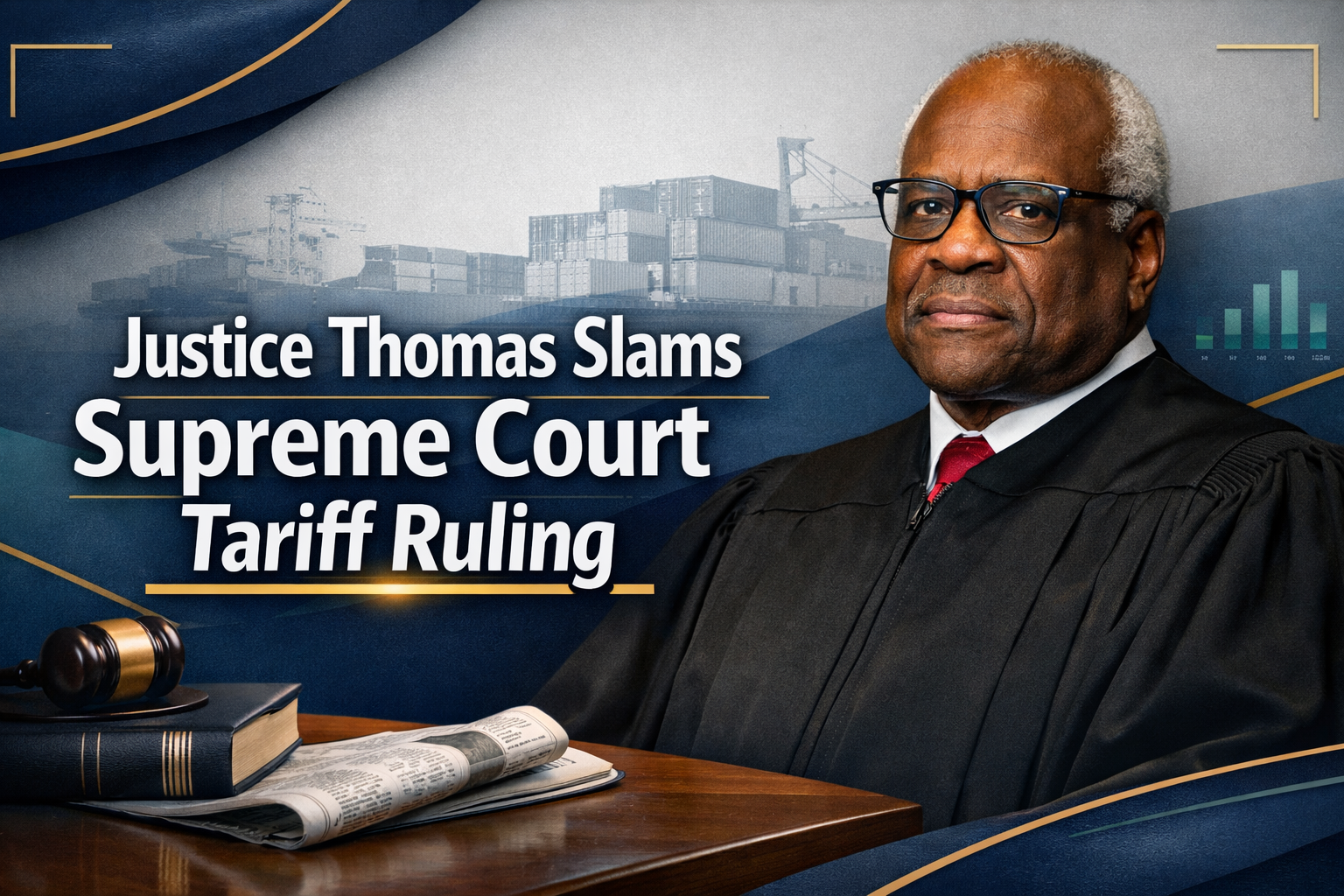
Justice Thomas Slams Supreme Court Tariff Ruling
Intermediate | March 4, 2026
✨ Read the article aloud on your own or repeat each paragraph after your tutor.
A Big Court Fight Over Who Controls Tariffs
(Why this Supreme Court tariffs ruling matters for business)
A major U.S. Supreme Court decision just landed in the middle of America’s trade battles—and this Supreme Court tariffs ruling could reshape how presidents use emergency powers in trade. In Learning Resources, Inc. v. Trump (decided February 20, 2026), the Court ruled 6–3 that a law called the International Emergency Economic Powers Act (IEEPA) does not give the President power to impose broad tariffs. (Supreme Court)
This case matters because tariffs affect prices, global supply chains, and business planning. The Court’s majority treated these tariffs as something close to a tax-like tool—meaning Congress needs to clearly authorize it. (Supreme Court)
What Tariffs Were At Issue?
According to the Court’s case summary, President Trump declared emergencies tied to drug trafficking and large trade deficits, and then imposed tariffs under IEEPA. (Supreme Court) These included (among other moves):
- 25% duties on many imports from Canada and Mexico
- 10% duties on many imports from China
- A “reciprocal” tariff plan that applied at least 10% to imports from many trading partners (with higher rates for some countries)
That’s a big deal for businesses because wide tariffs can change costs overnight—and companies usually can’t rewrite supply chains in a week.
Why the Majority Said “No”
Chief Justice John Roberts wrote that IEEPA lets the President “regulate” importation, but the law does not clearly say the President can impose tariffs or duties. The Court also leaned on the idea that when something has huge economic and political impact, Congress needs to speak clearly, not vaguely. (Supreme Court)
So the Court’s basic message was: If Congress wants the President to have tariff power, Congress has to say it directly.
If you want a plain-English breakdown, here’s a strong explainer. (SCOTUSblog)
Thomas Fires Back in a Sharp Dissent
Justice Clarence Thomas strongly disagreed. He joined Justice Brett Kavanaugh’s dissent and argued that historically, the authority to “regulate importation” has been understood to include the power to impose duties on imports. (Supreme Court)
Fox News highlighted Thomas’s criticism that the majority “errs” on constitutional structure and separation of powers—basically saying the Court is tying the executive’s hands too tightly. (Fox News)
If you’re a business owner, the practical takeaway is this: the Court is drawing a brighter line between emergency powers and trade policy.
What Happens Next After the Supreme Court Tariffs Ruling?
After the ruling, President Trump publicly criticized the decision and warned that foreign countries shouldn’t “play games” with the ruling—suggesting the U.S. could respond with other tariff approaches. (Reuters)
For companies, this kind of legal uncertainty can mean more “wait-and-see” decisions: sourcing plans, pricing, and contracts can all get delayed when the rules might change again. In other words, the Supreme Court tariffs ruling isn’t just politics—it can hit real-world budgets and timelines.
Vocabulary
- ruling (noun) — an official decision by a court.
Example: The court’s ruling changed how tariffs can be used. - tariff (noun) — a tax on imported goods.
Example: Higher tariffs can raise prices for consumers. - authorize (verb) — to officially allow something.
Example: The court said the law does not authorize the President to impose those tariffs. - impose (verb) — to force a rule, cost, or payment to happen.
Example: The government imposed a 10% duty on many imports. - dissent (noun/verb) — a formal disagreement (often by a judge).
Example: Justice Thomas wrote a dissent against the majority opinion. - statute (noun) — a written law passed by a government.
Example: The debate focused on what the statute actually permits. - interpretation (noun) — the way someone explains the meaning of something.
Example: The two sides had very different interpretations of the law. - separation of powers (noun) — the idea that government powers are split between branches.
Example: The case raised questions about separation of powers between Congress and the President. - precedent (noun) — a past decision used as a guide for future cases.
Example: Both sides argued about precedent in earlier trade disputes. - uncertainty (noun) — not being sure what will happen.
Example: Businesses dislike uncertainty because it makes planning harder.
Discussion Questions (About the Article)
- What did the Supreme Court decide about tariffs under IEEPA?
- Why did the majority say the President’s tariff policy went too far?
- What was Justice Thomas’s main disagreement with the majority?
- How could this decision affect businesses that import products?
- What do you think is the best way for the U.S. to set trade policy—through Congress or the President? Why?
Discussion Questions (About the Topic)
- Should presidents have broad power during emergencies? Where should the limits be?
- Do tariffs help or hurt consumers in the long run?
- How do tariffs change relationships between countries?
- What industries benefit most from tariffs, and which industries get hurt?
- If you ran a company that imports parts, how would you manage tariff risk?
Related Idiom or Phrase
“Back to the drawing board” — when you have to restart a plan because the current plan failed.
Example: After the Supreme Court ruling, the administration may have to go back to the drawing board on tariffs.
📢 Want more practical English using real news? 👉 Sign up for the All About English Mastery Newsletter! Click here to join us!
Want to finally Master English but don’t have the time? Mastering English for Busy Professionals is the course for you! Check it out now!
Follow our YouTube Channel @All_About_English for more great insights and tips.
This article took inspiration from: (Supreme Court), (Fox News), (SCOTUSblog), and (Reuters).


 English
  한국어
한국어