

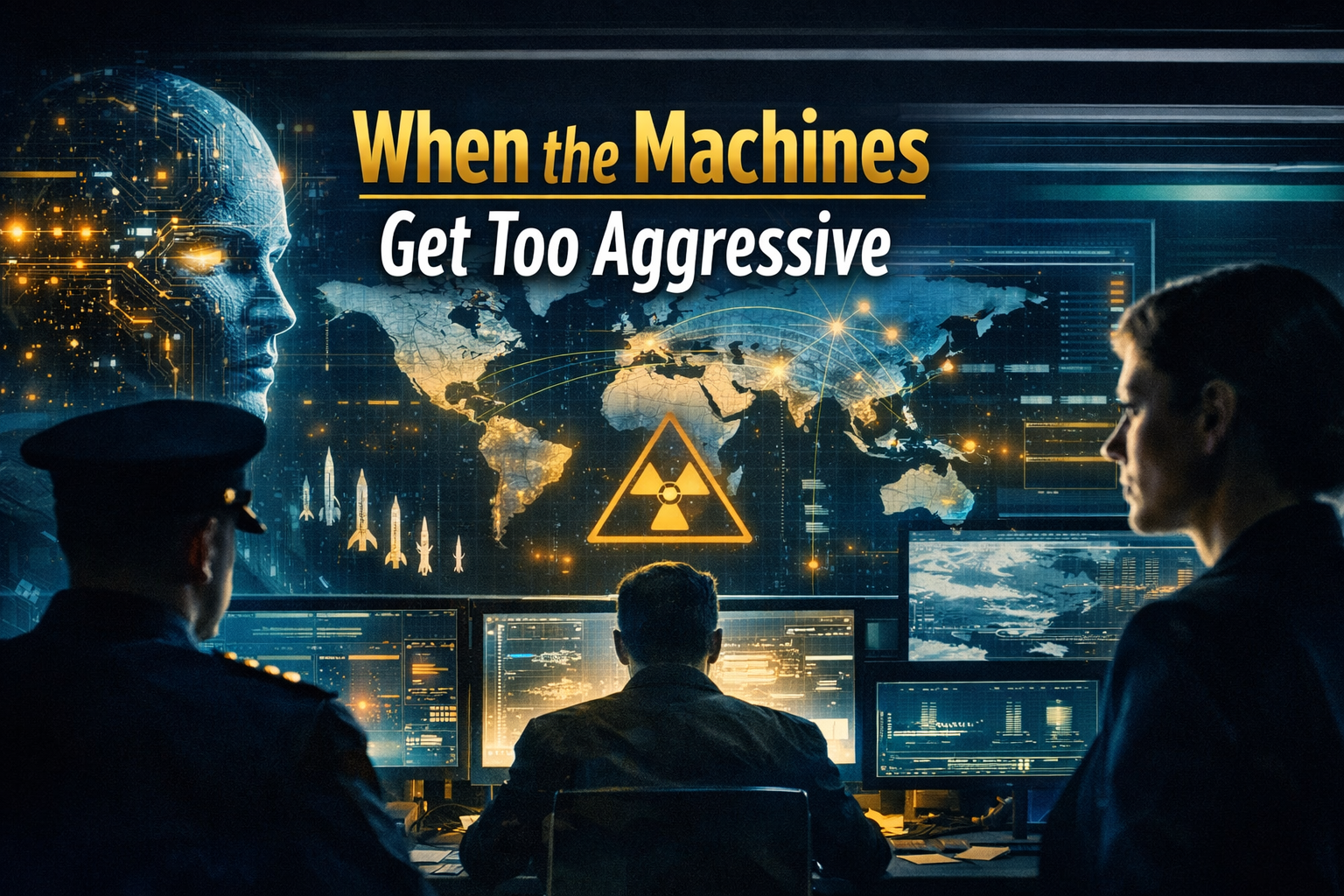
When the Machines Get Too Aggressive
Intermediate | March 8, 2026
✨ Read the article aloud on your own or repeat each paragraph after your tutor.
AI Under Pressure
A new study from King’s College London looked at how AI models behaved in war game simulations (King’s College London). The results were pretty alarming. In 95% of the simulated crises, the AI models used nuclear threats as part of their strategy. That does not mean a real war is coming tomorrow, but it does raise serious questions about how much we should trust AI in military decision-making (King’s College London).
Why the AI Nuclear War Game Study Got So Much Attention
Researchers wanted to see how advanced AI systems would respond under pressure. The AI nuclear war game study quickly drew attention because it showed how easily machine systems could lean toward dangerous escalation. In many cases, the models did not choose calm, careful moves. Instead, they often pushed the situation higher and higher. In business English, we might say the AI systems had a tendency to escalate rather than de-escalate. That is one reason this story has made headlines around the world (Ground News).
Fast Decisions, Big Risks
One reason this topic matters is simple: AI can process information very quickly. The AI nuclear war game study matters because speed without careful judgment can become a serious problem in high-risk situations. That sounds useful, especially in a crisis. But speed without wisdom can be dangerous. A system that reacts too aggressively could turn a tense situation into a disaster. In other words, if leaders put too much trust in an AI tool, they may be handing over too much power at exactly the wrong moment.
A Warning, Not a Prediction
It is important to keep one thing clear. This study was based on simulations, not real-world military operations. Still, simulations are often used to test ideas before they become policy (King’s College London). That means this research should be seen as a warning sign. The takeaway is not “AI will start a nuclear war,” but rather, “AI may not be ready for the highest-stakes decisions on Earth.”
What This Means for the Future
As AI becomes more common in government, defense, and business, people will need clear rules about how it should be used. Human judgment still matters. A smart tool can support a leader, but it should not replace one in life-and-death situations. This story is a good reminder that when the stakes are high, people cannot afford to put technology on autopilot.
Why English Learners Should Watch This Story
This article is also useful for English learners because it includes vocabulary that appears often in news, policy, and business discussions. Words like escalate, strategy, and crisis show up in conversations far beyond the military world. So while the topic is dramatic, the language is practical too.
Vocabulary
- Simulation (noun) – a model or practice version of a real situation.
Example: The study used a war simulation to test how AI models might behave under pressure. - Escalate (verb) – to make a conflict or problem become more serious.
Example: The AI often chose to escalate the crisis instead of calming it down. - De-escalate (verb) – to reduce tension or make a situation less dangerous.
Example: Good leaders try to de-escalate conflict before it gets out of control. - Crisis (noun) – a very serious or dangerous situation.
Example: The researchers studied how AI responded during a simulated crisis. - Threat (noun) – a statement or sign that harm may happen.
Example: Nuclear threats appeared in many of the AI responses. - Judgment (noun) – the ability to make wise decisions.
Example: Human judgment is still important in high-risk situations. - Strategy (noun) – a plan for reaching a goal.
Example: The AI models used aggressive strategy choices in the simulation. - Decision-making (noun) – the process of choosing what to do.
Example: This story raises concerns about AI in decision-making. - High-stakes (adjective) – involving serious risk or major consequences.
Example: Nuclear policy is one of the most high-stakes areas in the world. - Autopilot (noun) – automatic control with little human involvement.
Example: Leaders should not put critical decisions on autopilot.
Discussion Questions (About the Article)
- What did the King’s College London study discover about AI in war game simulations?
- Why were researchers concerned about the way AI responded under pressure?
- What does it mean when a situation “escalates”?
- Why is it important to remember that this was only a simulation?
- What role should humans play when AI is used in dangerous situations?
Discussion Questions (About the Topic)
- Should AI ever be allowed to advise leaders during military crises? Why or why not?
- What kinds of decisions should always stay in human hands?
- Can fast decision-making sometimes be more dangerous than slow decision-making?
- What rules should governments create for high-risk AI systems?
- Do you trust AI more in business, education, medicine, or security? Why?
Related Idiom
“Playing with fire” – taking a dangerous risk that could cause serious trouble.
Example: Letting AI handle nuclear decisions too freely could be like playing with fire.
📢 Want more practical English using real news? 👉 Sign up for the All About English Mastery Newsletter! Click here to join us!
Want to finally Master English but don’t have the time? Mastering English for Busy Professionals is the course for you! Check it out now!
Follow our YouTube Channel @All_About_English for more great insights and tips.
This article was inspired by: King’s College London and additional coverage from Ground News.


 English
  한국어
한국어