

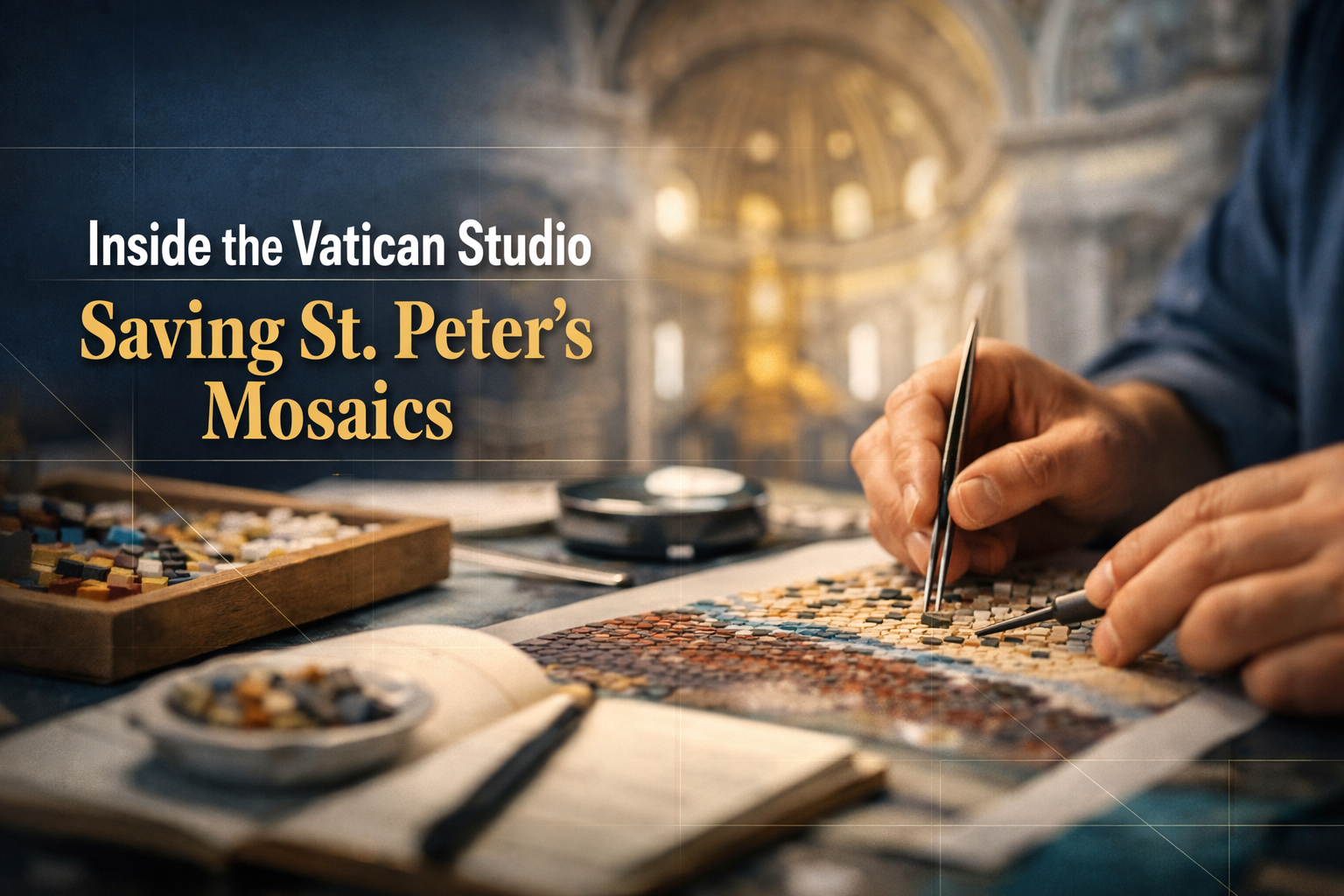
Inside the Vatican Studio Saving St. Peter’s Mosaics
Beginner | March 9, 2026
✨ Read the article aloud on your own or repeat each paragraph after your tutor.
A Tiny Workshop with a Huge Job at the Vatican mosaic studio
When people visit St. Peter’s Basilica in Vatican City, they often look up and say, “Wow.” But behind that “wow” is a small group of specialists at the Vatican mosaic studio. Inside the Vatican, there is a mosaic studio where a team of about 12 artists repairs old mosaics and makes new ones. (Reuters)
Why St. Peter’s Needs Constant Care
St. Peter’s has a sea of color inside—walls, chapels, and even parts of the dome. The mosaics cover about 8,360 square meters. (Reuters) Over time, smoke from candles and incense can darken surfaces, and tiny pieces can loosen. (Reuters) So the studio’s work is not a “one-time project.” It’s more like ongoing maintenance for a world-famous building.
How a Mosaic Is Made
Making a mosaic takes patience. Artists place thousands of tiny tiles one by one to match an original painting or design. Some workers start with a black-and-white blueprint, and others use a colored guide. Either way, the goal is the same: a clean, faithful copy that can last for centuries.
A Tile Library Like No Other
The studio also works like a “materials warehouse.” It holds 27,000 types of tiles, stored in a cabinet with 9,000 drawers. (Reuters) Here’s the catch: about 23,000 colors are old artifacts from past centuries. (Reuters) Some colors can’t be made anymore, and a few were even made using materials that are not used today. When those old supplies are gone, they’re gone.
Today’s Project: Restoring a Chapel
Right now, the Vatican mosaic studio is restoring mosaics in the Clementine Chapel. (Reuters) (Reuters) That kind of restoration is slow and careful. The goal is to protect the artwork without changing the original look. The studio’s director, Paolo Di Buono, describes the work as part of a long tradition that connects today’s artists to the people who started this craft in the late 1500s. (Reuters)
More Than Art: “Mosaic Diplomacy”
The studio is also involved in something interesting: it sometimes creates mosaic gifts for the pope to give to foreign leaders. Reuters described this as “mosaic diplomacy,” including mosaic gifts that have been given to U.S. Presidents like George W. Bush and Barack Obama. (Reuters)
Vocabulary
- Workshop (noun) – a place where skilled work is done.
Example: The workshop inside the Vatican is small, but the work is world-famous. - Preserve (verb) – to protect something so it lasts a long time.
Example: The artists preserve mosaics so visitors can enjoy them for centuries. - Mosaic (noun) – art made from many small pieces (like tiles).
Example: The ceiling has a mosaic made from thousands of tiny tiles. - Restore (verb) – to repair and bring back to a good condition.
Example: The team is restoring mosaics in the Clementine Chapel. - Artifact (noun) – an old object kept because it is valuable or historic.
Example: Some tile colors are artifacts from past centuries. - Irreplaceable (adjective) – impossible to replace.
Example: Many tile colors are irreplaceable because they can’t be produced anymore. - Technique (noun) – a special way of doing something.
Example: Each artist uses a different technique to plan the mosaic. - Faithful (adjective) – accurate and true to the original.
Example: They try to make a faithful copy of the original artwork. - Maintenance (noun) – regular care to keep something working well.
Example: This job is ongoing maintenance, not a one-time repair. - Dignitary (noun) – an important official or leader.
Example: The pope sometimes gives mosaics to visiting dignitaries.
Discussion Questions (About the Article)
- What surprised you most about the Vatican Mosaic Studio?
- Why do the mosaics need regular maintenance?
- Which detail felt most “business-like” to you: the team size, the tile inventory, or the restoration project?
- Why do you think mosaics can last longer than paintings in a building like St. Peter’s?
- What kind of skills do you think these artists need besides creativity?
Discussion Questions (About the Topic)
- Do you think governments and religious organizations should spend money to preserve historic art? Why or why not?
- What important cultural places in your country need constant care?
- Have you ever visited a museum or historic site that felt “well-managed”? What made it feel that way?
- What is one tradition (art, food, craft, etc.) that you think should be protected for the future?
- If you were in charge of preserving a famous building, what would your top priority be?
Related Idiom
“The devil is in the details” – small details matter a lot, especially in careful work.
Example: In mosaic restoration, the devil is in the details—one wrong tile can change the whole picture.
📢 Want more practical English using real news? 👉 Sign up for the All About English Mastery Newsletter! Click here to join us!
Want to finally Master English but don’t have the time? Mastering English for Busy Professionals is the course for you! Check it out now!
Follow our YouTube Channel @All_About_English for more great insights and tips.
This article was inspired by: Reuters, St. Peter’s Basilica (official site)


 English
  한국어
한국어