

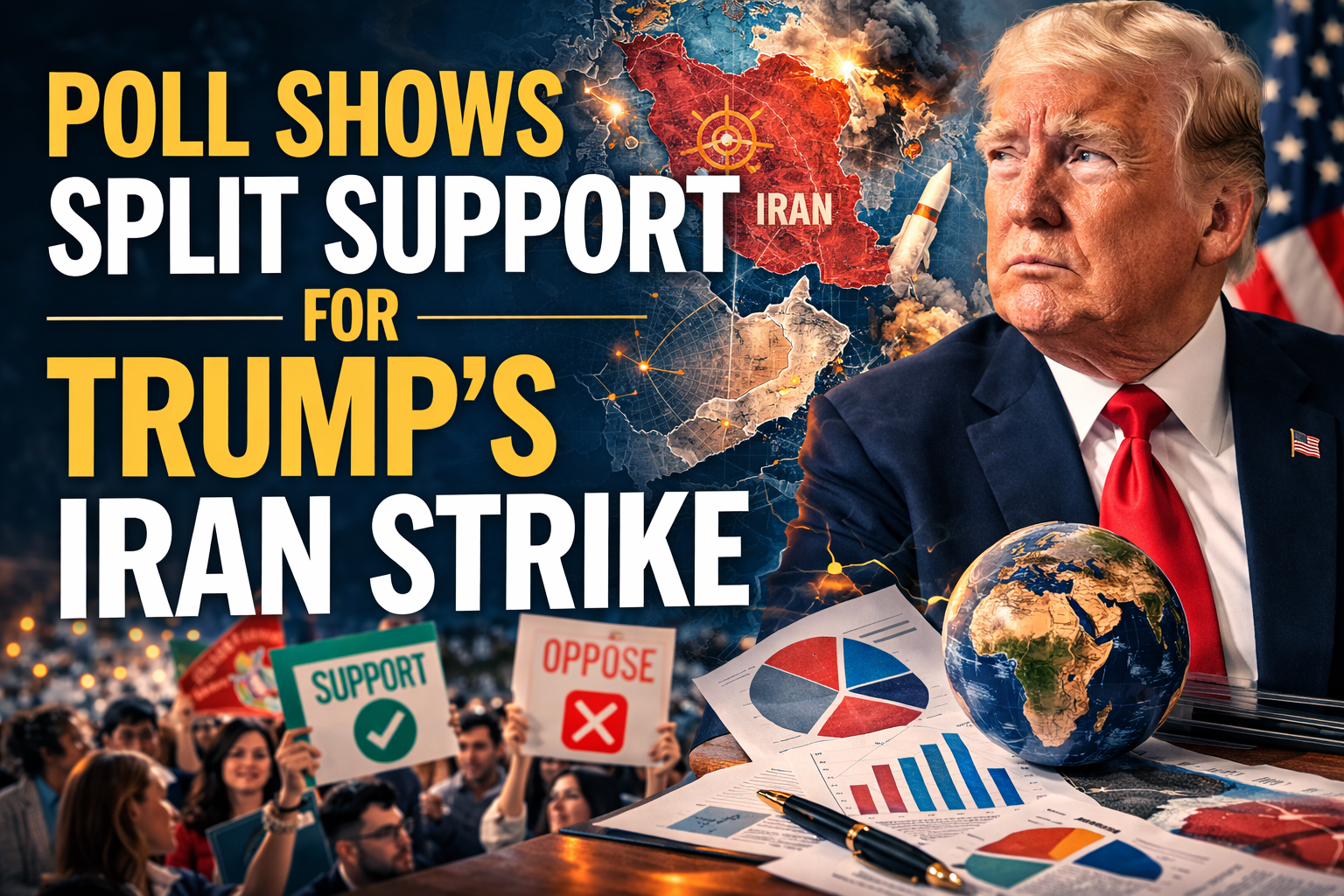
Poll Shows Split Support for Trump’s Iran Strike
Advanced | March 15, 2026
✨ Read the article aloud on your own or repeat each paragraph after your tutor.
A Poll Gives Trump Some Good News
A recent poll highlighted by Just the News reported that 52% of likely U.S. voters approve of President Donald Trump’s decision to strike Iran (Rasmussen Reports). According to Rasmussen, 35% strongly approve, while 42% disapprove overall. For Trump, that headline offers a political boost at a time when the conflict with Iran is creating pressure at home and abroad.
But Other Polls Tell a Different Story
At the same time, other surveys paint a much less friendly picture for the White House. A Reuters/Ipsos poll found that only 27% of Americans supported the strikes, while 43% disapproved and 29% were unsure (Reuters). A Quinnipiac poll also found that 53% of voters opposed the military action, while 40% supported it (PBS NewsHour). So the political picture is far from simple.
Why Are the Numbers So Different?
The answer may come down to who was asked and how the question was framed. Rasmussen surveyed likely voters, while Reuters/Ipsos surveyed U.S. adults, and Quinnipiac surveyed registered voters. Those are not exactly the same groups. Poll wording also matters. A question about “striking Iran” may get a different response from a question about “military action” or “war.” That is one reason Trump Iran strike poll support can look strong in one survey and much weaker in another.
Support Has Clear Limits
Even in surveys that show support for the strikes, many voters do not want a larger war. Reuters reported that some Trump voters backed airstrikes but strongly opposed sending ground troops into Iran (Reuters). The same report said higher gas prices and American casualties could quickly weaken support. In other words, Trump Iran strike poll support may be real, but it also appears fragile.
Politics, Prices, and Public Opinion
The conflict is now testing Trump politically as well as militarily. AP reported that rising oil prices, market stress, and growing questions about the war are starting to create new political problems for the president (AP News). That matters because voters often respond differently once a conflict begins to affect everyday life. If fuel prices rise, if markets fall, or if U.S. casualties increase, public opinion could move fast.
Why Trump Iran Strike Poll Support Matters
This story matters because it shows how polling can shape the way people understand politics. One headline can make it sound like the country is behind the president, while another suggests the public is deeply uneasy. For English learners, this is a good reminder that statistics need context. The biggest lesson is not just whether Trump currently has support, but how quickly public opinion can change when war, inflation, and energy prices all enter the picture.
Vocabulary
- Approve (verb) – to support or agree with something.
Example: “A small majority in one poll approved of the strike.” - Disapprove (verb) – to oppose or not support something.
Example: “Other surveys showed that many voters disapprove of the action.” - Survey (noun) – a study in which people are asked questions.
Example: “The survey measured public opinion about the Iran strike.” - Registered voter (noun) – a person officially signed up to vote.
Example: “Quinnipiac asked registered voters for their views.” - Likely voter (noun) – a person considered likely to vote in an election.
Example: “Rasmussen focused on likely voters rather than all adults.” - Framed (verb) – presented in a particular way.
Example: “How a poll question is framed can affect the answer.” - Fragile (adjective) – easily changed, damaged, or weakened.
Example: “Support for the strike may be fragile if the war expands.” - Casualty (noun) – a person killed or injured in war.
Example: “Public support could fall if U.S. casualties rise.” - Context (noun) – the background information needed to understand something fully.
Example: “Poll numbers are clearer when readers understand the context.” - Public opinion (noun) – the views of the general public.
Example: “Public opinion can shift quickly during a crisis.”
Discussion Questions (About the Article)
- What did the Rasmussen poll say about support for Trump’s strike on Iran?
- How did the Reuters/Ipsos and Quinnipiac polls differ from Rasmussen?
- Why can different polls produce different results?
- What limits on military action did some voters express?
- Why might public opinion change if the conflict continues?
Discussion Questions (About the Topic)
- Do you think polls are a reliable way to understand public opinion? Why or why not?
- How much does wording influence the way people answer survey questions?
- Should presidents consider polling before taking military action?
- Why do gas prices and casualties affect support for war so strongly?
- How should news readers respond when different polls show different results?
Related Idiom
“The jury is still out” – the final answer or outcome is still unclear.
Example: “The jury is still out on whether the public will keep supporting the strike if the conflict gets worse.”
📢 Want more practical English using real news? 👉 Sign up for the All About English Mastery Newsletter! Click here to join us!
Want to finally Master English but don’t have the time? Mastering English for Busy Professionals is the course for you! Check it out now!
Follow our YouTube Channel @All_About_English for more great insights and tips.
This article took inspiration from Rasmussen Reports, Reuters, PBS NewsHour, Reuters, and AP News.


 English
  한국어
한국어