

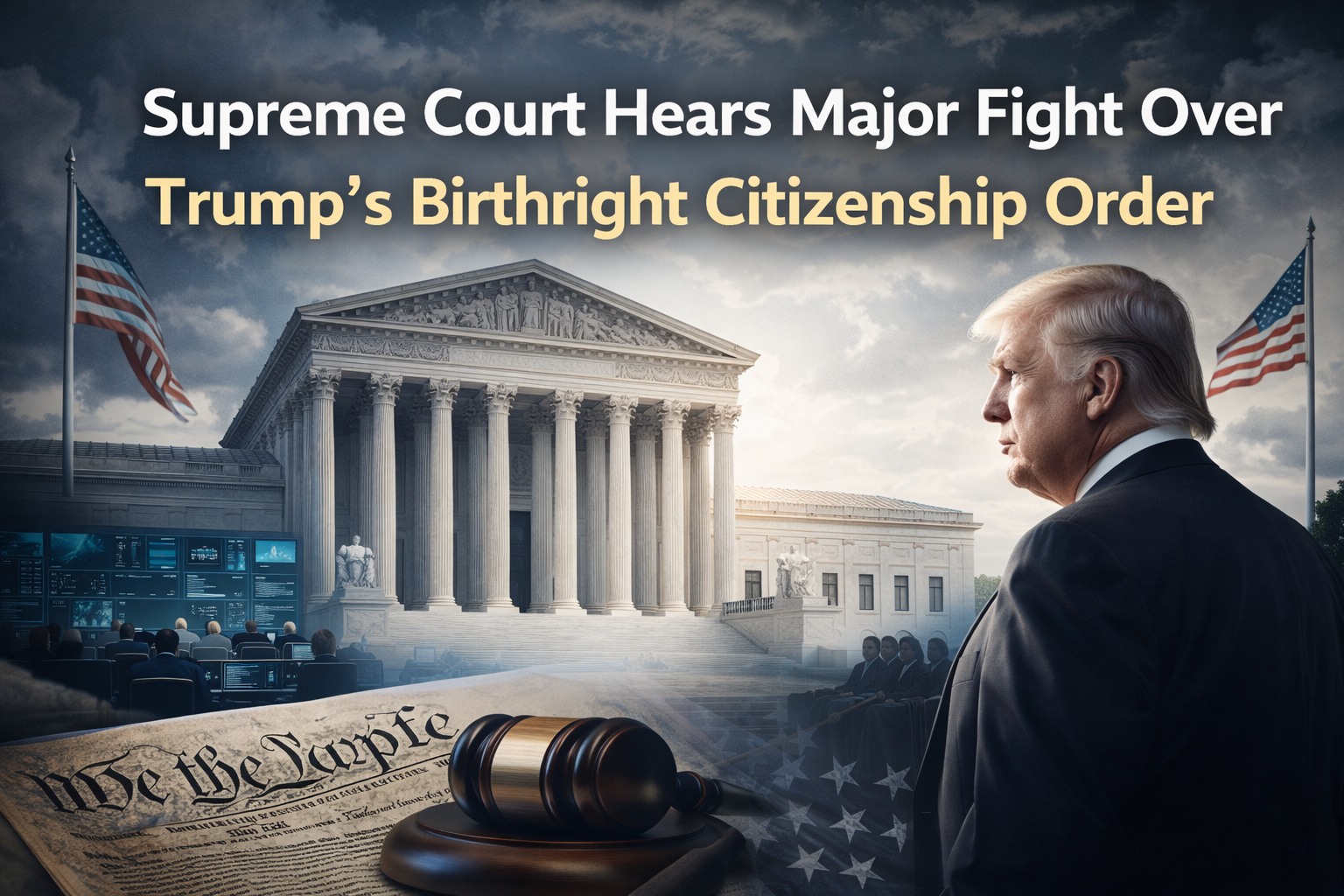
Supreme Court Hears Major Fight Over Trump’s Birthright Citizenship Order
Advanced | April 2, 2026
✨ Read the article aloud on your own or repeat each paragraph after your tutor.
A High-Stakes Day at the Supreme Court
On April 1, 2026, the U.S. Supreme Court heard arguments in a major case over President Donald Trump’s effort to end automatic birthright citizenship for some children born in the United States. This birthright citizenship case quickly became one of the most closely watched legal fights in the country. The case centers on an executive order Trump signed on the first day of his second term in January 2025. That order told federal agencies not to recognize U.S. citizenship for children born in the country if their mother was in the U.S. unlawfully or only temporarily, and if the father was neither a U.S. citizen nor a lawful permanent resident. Lower courts blocked the order before it could take effect, and now the Supreme Court must decide whether the policy can survive. (Reuters, Just the News, SCOTUSblog)
Why the Birthright Citizenship Case Matters So Much
This fight is about the meaning of the 14th Amendment, which says that people born in the United States and “subject to the jurisdiction thereof” are citizens. For well over a century, that language has generally been understood to mean that almost everyone born on U.S. soil gets citizenship, with only narrow exceptions. Trump’s administration argues that children born to undocumented immigrants or to people in the country temporarily should not automatically qualify. Opponents say that argument clashes with the Constitution, long-standing federal law, and the Supreme Court’s 1898 Wong Kim Ark decision, which strongly supports birthright citizenship. In plain English, this case could test whether a president can rewrite a basic rule of American citizenship by executive order. (AP News, AP News, SCOTUSblog)
The Justices Sounded Skeptical
During the arguments, several justices appeared skeptical of the administration’s position. Reuters reported that members of the Court, including some conservatives, questioned whether Trump’s reading of the Constitution could be squared with the text and with long-standing precedent. According to AP and SCOTUSblog, justices pressed the government on the meaning of “jurisdiction,” the reach of the 14th Amendment, and the consequences of breaking so sharply from historical practice. That does not guarantee how the Court will rule, of course. Still, it suggests the administration had a tough day in court. When even a sympathetic bench starts pushing hard, that usually means the legal road ahead is getting rough. (Reuters, Reuters, SCOTUSblog, AP News)
Trump’s Personal Appearance Added Drama
Trump did not leave this one to the lawyers alone. Reuters and AP reported that he personally attended the oral arguments, becoming the first sitting U.S. president to attend a Supreme Court oral argument. He sat in the front row during the government’s presentation, then left before the opposing arguments were finished. His appearance added a dramatic political layer to an already important legal case. Critics saw it as an attempt to project strength or influence the moment, while supporters saw it as proof that he views the issue as central to his immigration agenda. Either way, it turned an already high-profile hearing into an even bigger spectacle. (Reuters, AP News, Reuters)
The Real-World Impact Could Be Huge
This case is not just a legal debate for scholars and judges. AP reported that a ruling in favor of Trump could affect more than 250,000 births annually. That means the outcome could change the legal status of a very large number of children born in the United States. It could also create confusion for families, hospitals, government agencies, and state officials. If the Court rejects Trump’s order, it would be a major setback for one of the administration’s most ambitious immigration policies. If it sides with him, the decision could trigger a legal and political earthquake. Either way, the ruling expected by June 2026 will matter far beyond the courtroom. (AP News, Reuters)
What English Learners Can Learn From This Story
This article is useful for English learners because it brings together law, politics, immigration, and constitutional language in one story. The birthright citizenship case also shows how one constitutional phrase can shape a huge national debate. It also gives you useful current-events vocabulary like precedent, jurisdiction, executive order, skeptical, and constitutional. More importantly, it shows how public policy battles often turn on the meaning of a few key words. In this case, one short constitutional phrase is at the center of a national fight. That is a good reminder that in law, as in business, a few words can carry a ton of weight.
Vocabulary
- Birthright citizenship (noun) – citizenship a person receives automatically by being born in a country.
Example: The case focuses on whether birthright citizenship can be limited by executive order. - Executive order (noun) – an official order issued by the president.
Example: Trump signed an executive order targeting automatic citizenship rules. - Jurisdiction (noun) – legal authority or power over a person or area.
Example: The case turns partly on the meaning of jurisdiction in the 14th Amendment. - Precedent (noun) – an earlier legal decision that guides later cases.
Example: The justices discussed whether past precedent supports birthright citizenship. - Constitutional (adjective) – connected to the Constitution.
Example: Lower courts said the order was likely unconstitutional. - Skeptical (adjective) – doubtful or not easily convinced.
Example: Several justices sounded skeptical during the arguments. - Oral arguments (noun) – spoken legal presentations made before a court.
Example: The oral arguments lasted more than two hours. - Interpretation (noun) – a particular way of explaining the meaning of something.
Example: The administration offered a different interpretation of the 14th Amendment. - Blocked (verb) – stopped by legal action or authority.
Example: Lower courts blocked the order before it could take effect. - Ruling (noun) – an official court decision.
Example: A ruling from the Supreme Court is expected by June.
Discussion Questions (About the Article)
- What exactly did Trump’s executive order try to change?
- Why is the 14th Amendment so important in this case?
- Why did the justices appear skeptical of the administration’s argument?
- How did Trump’s personal appearance change the tone of the hearing?
- What could be the real-world effects of the final ruling?
Discussion Questions (About the Topic)
- Should birthright citizenship remain automatic in the United States? Why or why not?
- How much power should a president have to reinterpret long-standing constitutional rules?
- Why do legal definitions matter so much in political fights?
- What are the risks when major policy changes are made by executive order instead of legislation?
- How should courts balance constitutional text, history, and modern political pressure?
Related Idiom
“Open a can of worms” – to create a situation that causes many new problems.
Example:
If the Court accepts Trump’s argument, it could open a can of worms for citizenship law in the United States.
📢 Want more practical English using real news? 👉 Sign up for the All About English Mastery Newsletter! Click here to join us!
Want to finally Master English but don’t have the time? Mastering English for Busy Professionals is the course for you! Check it out now!
Follow our YouTube Channel @All_About_English for more great insights and tips.
This article was inspired by: Reuters, Reuters, Reuters, AP News, AP News, AP News, Just the News, and SCOTUSblog


 English
  한국어
한국어