

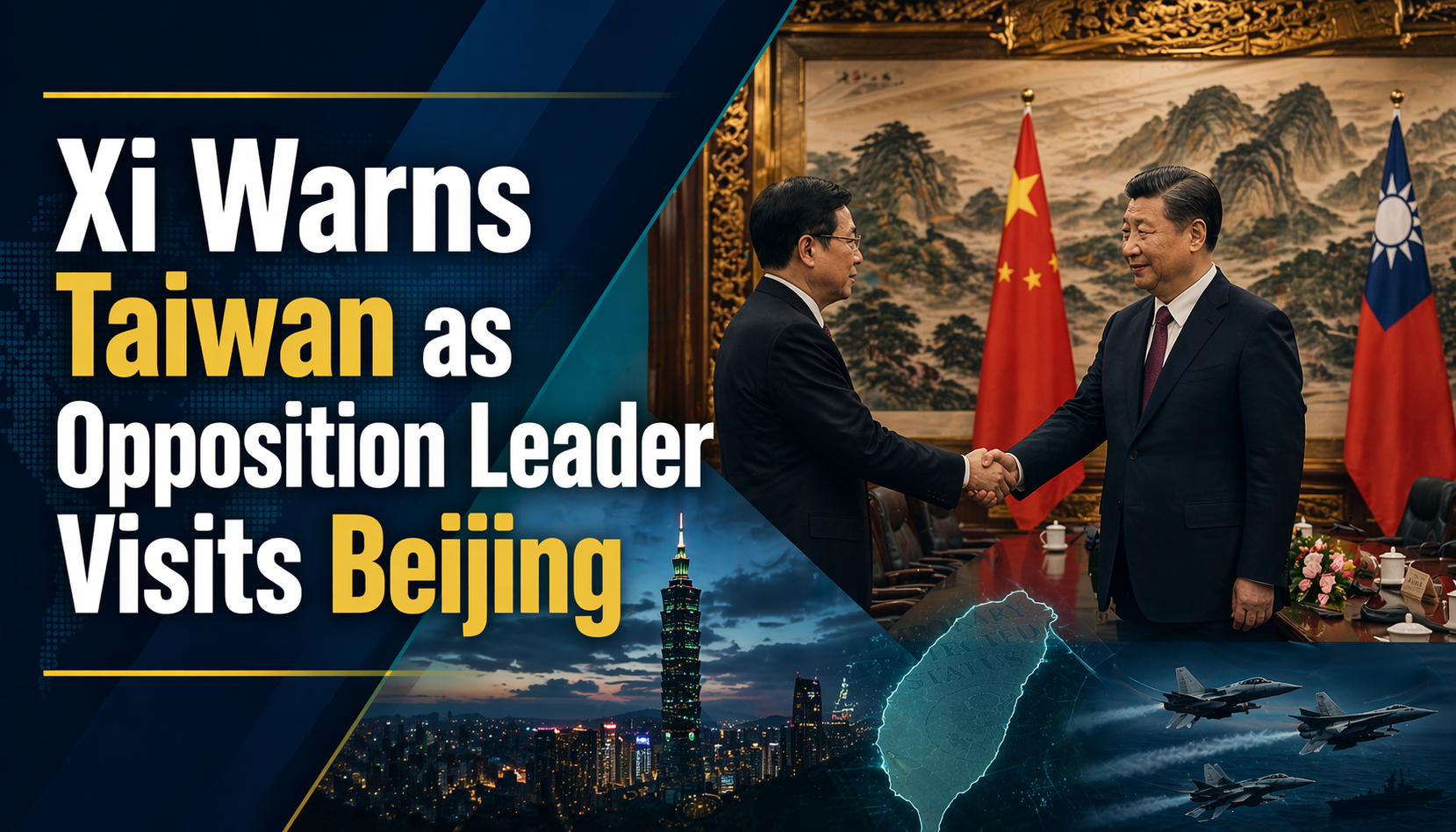
Xi Warns Taiwan as Opposition Leader Visits Beijing
Advanced | April 20, 2026
✨ Read the article aloud on your own or repeat each paragraph after your tutor.
A High-Stakes Meeting Over Taiwan’s Future
Chinese President Xi Jinping told Taiwan opposition leader Cheng Li-wun that China would “absolutely not tolerate” independence for Taiwan during their meeting in Beijing. The talks took place at the Great Hall of the People and quickly drew attention across the region because Taiwan remains one of the most sensitive issues in East Asia. (Reuters)
Why This Taiwan Opposition Leader Meeting Matters
Cheng is the chairwoman of Taiwan’s main opposition party, the Kuomintang (KMT), which generally supports more engagement with Beijing than Taiwan’s ruling Democratic Progressive Party (DPP). Her trip to China was described as a “peace” mission, and Reuters noted it was happening at a time when Beijing had already increased both military and political pressure on the island. (Reuters)
This was also the first such meeting in more than a decade between a Chinese president and a Taiwanese opposition leader at that level, which gave the visit extra political weight. That made the Taiwan opposition leader meeting much more than a symbolic handshake. Both sides talked about peace, but they clearly did not mean exactly the same thing. (AP News)
Beijing Pushes Its Message While Taiwan Pushes Back
Xi repeated Beijing’s long-running position that Taiwan is part of China and said independence is the main threat to peace in the Taiwan Strait. He also called for both sides to uphold the “One China” principle and work together on what Beijing calls national reunification. (Reuters)
Taiwan’s government pushed back right away. Reuters reported that Taiwan’s Mainland Affairs Council said only the Taiwanese people can decide their future. Taipei also warned that meetings like this can create a misleading picture, especially because Beijing still refuses to talk with President Lai Ching-te, whom China labels a separatist. (Reuters)
Peace Talk on the Surface, Pressure in the Background
Here is where the story gets more complicated. While Cheng spoke about peace and mutual benefit, the pressure around Taiwan did not magically disappear. Reuters later reported that Taiwan spotted 16 Chinese warplanes operating near the island around the same time Xi was meeting Cheng in Beijing. (Reuters)
A few days later, Beijing also defended its military activity as “reasonable” and “justified,” while accusing Taiwan’s ruling party of stirring up fear. So, on paper, there was talk of easing tensions. In reality, the military pressure was still very much part of the picture. (Reuters)
Could This Change Cross-Strait Relations?
After Cheng’s visit, China announced it would resume some suspended ties with Taiwan, including direct flights to more cities in China and imports of some Taiwanese aquaculture products. That sounded like a goodwill gesture, but there was a catch: Beijing continues to tie warmer relations to opposition to Taiwanese independence. (AP News)
So where does that leave things? The meeting may have opened the door to a little more communication, but it did not solve the core problem. Beijing wants progress toward unification. Taiwan’s government says its future must be chosen democratically by its own people. That gap is still wide, and nobody should kid themselves about that.
Vocabulary
- Opposition leader (noun) – the head of a political party that is not currently in power.
Example: The opposition leader traveled to Beijing for talks with Xi. - Independence (noun) – freedom from control by another country or authority.
Example: China says it will not tolerate independence for Taiwan. - Reunification (noun) – the act of bringing separate areas back under one government.
Example: Beijing says reunification is its long-term goal. - Sensitive (adjective) – likely to cause strong feelings or political tension.
Example: Taiwan is one of the most sensitive issues in the region. - Engagement (noun) – active communication or contact between sides.
Example: The KMT usually supports more engagement with Beijing. - Pressure (noun) – political, military, or economic force used to influence someone.
Example: Taiwan has faced growing pressure from China. - Misleading (adjective) – giving the wrong idea or a false impression.
Example: Taiwan warned the meeting could create a misleading picture. - Strait (noun) – a narrow stretch of water between two land areas.
Example: Peace in the Taiwan Strait remains a major concern. - Aquaculture (noun) – the farming of fish or seafood.
Example: China said it would resume imports of some Taiwanese aquaculture products. - Sovereignty (noun) – the authority of a state to govern itself.
Example: Taiwan rejects Beijing’s claims over its sovereignty.
Discussion Questions (About the Article)
- What did Xi say to Cheng Li-wun during their meeting in Beijing?
- Why did this visit attract so much attention in Taiwan and abroad?
- How did Taiwan’s government respond to the meeting?
- Why do the warplane reports make the peace message harder to believe?
- What small changes did China announce after the visit?
Discussion Questions (About the Topic)
- Can political dialogue still matter when military pressure continues in the background?
- Should opposition parties handle sensitive diplomacy, or should only governments do that?
- Why is Taiwan such an important issue for China, the U.S., and the wider region?
- What does real peace look like in cross-strait relations?
- How should democracies respond when a larger neighbor tries to influence their future?
Related Idiom or Phrase
“Walk a tightrope” – to deal with a very difficult situation where one wrong move could cause serious problems.
Example: Taiwan’s leaders often have to walk a tightrope between dialogue, democracy, and security.
📢 Want more practical English through real news stories? Sign up for the All About English Mastery Newsletter here: allaboutenglishmastery.com/newsletter
Want to build stronger English in less time? Check out Mastering English for Busy Professionals.
Follow our YouTube channel @All_About_English for more English tips and practice.
This article was inspired by: Reuters, Reuters on military activity, Reuters on Beijing’s follow-up message, and AP News.


 English
  한국어
한국어