

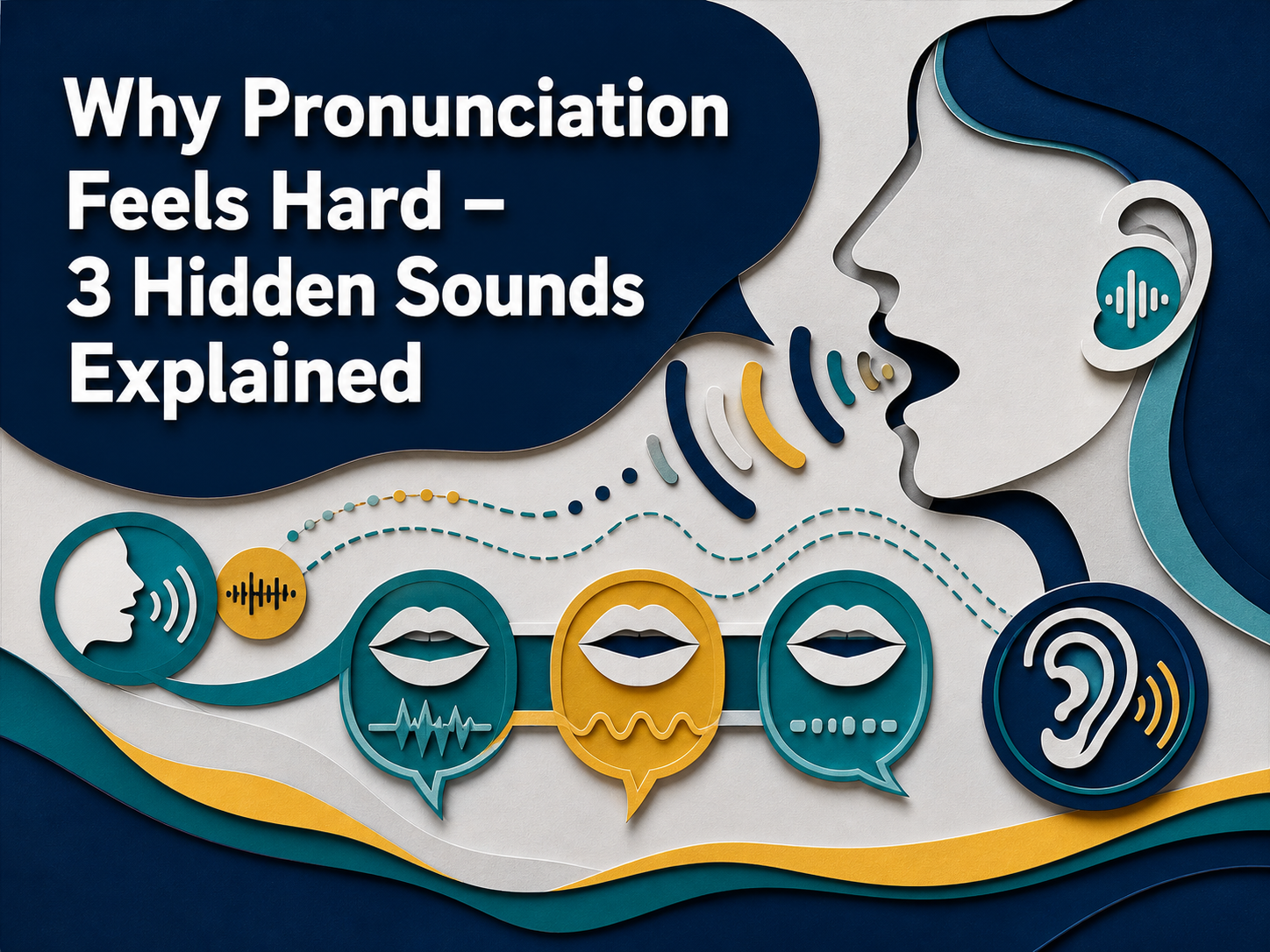
Why Pronunciation Feels Hard: 3 Hidden Sounds Explained 🎙️
Intermediate Level | May 2, 2026
Read the article aloud on your own or repeat each paragraph after your tutor.
Have you ever known a word in English, understood the meaning, and still felt strange when you tried to say it out loud? You are not alone. Many busy professionals can read English well, write good emails, and follow meetings, but pronunciation still feels hard when they need to speak quickly.
The Real Problem Is Not Always Grammar
The problem is not always vocabulary or grammar. Sometimes, the problem is hidden sounds.
English pronunciation feels hard because English often hides important sounds inside normal speech. Native speakers connect words, reduce sounds, and stress certain parts of a sentence. These small sound changes can make English feel faster, messier, and harder to copy.
What Changes When You Know What to Hear
Once you learn what to listen for, the whole thing becomes much less mysterious. These hidden sounds in English are not random mistakes; they are normal patterns. You begin to hear patterns instead of noise. That makes pronunciation easier to practice and easier to improve.
Why Pronunciation Feels Hard for Professionals
In business English, pronunciation matters because people often judge confidence by sound. That may not be fair, but it happens.
Clear Speech Builds Confidence
If you speak too carefully, you may sound nervous. If you speak too quickly, your message may become unclear. And if you miss the hidden sounds, you may feel like everyone else is speaking a secret version of English. Very rude of English, honestly.
Your Goal Is Not Native Pronunciation
The good news is that you do not need to sound like a native speaker. Your goal is clear communication. You want people to understand your ideas without struggling.
Today, let’s look at three hidden sounds that make English pronunciation feel hard—and how to practice them in a simple, practical way.
Hidden Sound 1: The Schwa Sound
The first hidden sound is the schwa. It sounds like a soft, relaxed “uh.” In English, many unstressed syllables become this sound.
Listen for the Weak Syllable
For example, the word about often sounds like “uh-BOUT.” The first syllable is weak, fast, and relaxed. In the word support, the first syllable often sounds like “suh-PORT.”
This is important because English is a stress-timed language. That means strong syllables get more attention, while weak syllables often shrink.
Do Not Punch Every Word
If you pronounce every syllable strongly, your English may sound stiff or unnatural. Try saying this sentence aloud: I need to prepare for the meeting. The words to and for the may become softer and faster.
You do not need to punch every word like you are arguing with a printer.
Hidden Sound 2: Connected Speech
The second hidden sound is not really one sound. It is the way words connect together. Native speakers often link the end of one word to the beginning of the next.
Words Often Blend Together
For example, turn off may sound like “tur-noff.” Pick it up may sound like “pi-ki-tup.” This is why listening can feel harder than reading.
Connected speech helps English flow smoothly. In professional conversations, you will hear it all the time: send it over, look at it, follow up, check in, figure out. These phrases may sound like one long word when people speak naturally.
Practice One Phrase at a Time
To practice, choose one short phrase and repeat it slowly first. Then speed up a little: follow up, follow up, follow up. Your mouth needs training, not punishment. Captain’s orders.
Hidden Sound 3: Word Stress
The third hidden sound is word stress. English words often have one syllable that is stronger than the others.
Stress Can Change Meaning
For example, we say PRE-sent as a noun, but pre-SENT as a verb. A RE-cord is a thing, but to re-CORD means to make audio or video. Stress can even change meaning.
This matters in business English because many professional words have stress patterns: DEAD-line, pro-PO-sal, pre-SEN-ta-tion, com-MU-ni-cate.
Small Stress Changes Make Speech Clearer
If the stress is in the wrong place, people may still understand you, but they may need extra effort. A small stress change can make your speech sound much clearer.
How to Practice Hidden Sounds in English
The best way to practice hidden sounds in English is to use short, focused speaking practice. Pick one sentence from an article, meeting note, or email.
Step 1: Find the Strong Words
Listen to how a native speaker might say the sentence, then read it aloud several times. First, focus on the strong words.
Step 2: Notice the Weak Sounds
Next, listen for the small words and weak syllables. These are the sounds that often become softer, faster, or less clear in natural English.
Step 3: Connect the Words Naturally
Finally, try to connect the words naturally. Do not rush. Your goal is smooth speech, not speed.
Record Yourself Like a Coach
You can also record yourself for 30 seconds. Do not listen like a judge. Listen like a coach. Ask: Which words sound clear? Which sounds feel too strong? Where can I relax? This simple habit helps you hear your own progress and build confidence over time.
One Sentence a Day Is Enough
Pronunciation feels hard because English hides sounds in plain sight. But once you understand schwa, connected speech, and word stress, you can start hearing English differently.
You do not need perfect pronunciation. You need clear, confident pronunciation that helps your ideas land. Practice one sentence a day, and those hidden sounds will slowly become familiar friends instead of little pronunciation gremlins.
Vocabulary List
- Pronunciation (noun) — The way a word or language is spoken.
Example: Her pronunciation became clearer after daily speaking practice. - Hidden (adjective) — Not easy to see, hear, or notice.
Example: English has many hidden sounds in natural speech. - Schwa (noun) — A weak “uh” sound often used in unstressed syllables.
Example: The first sound in “about” is often a schwa. - Unstressed (adjective) — Spoken with less force or emphasis.
Example: Unstressed syllables are usually shorter and softer. - Syllable (noun) — A part of a word that has one vowel sound.
Example: The word “meeting” has two syllables. - Connect (verb) — To join two or more things together.
Example: Native speakers often connect words when they speak. - Reduce (verb) — To make something smaller, weaker, or shorter.
Example: English speakers often reduce small words like “to” and “for.” - Stress (noun) — Extra force or emphasis placed on a syllable or word.
Example: Word stress can change the meaning of some English words. - Stiff (adjective) — Not relaxed or natural.
Example: Speaking every syllable strongly can make your English sound stiff. - Clear (adjective) — Easy to understand.
Example: Clear pronunciation helps people understand your ideas quickly.
5 Questions About the Article
- Why does English pronunciation often feel hard for busy professionals?
- What is the schwa sound?
- How does connected speech change the way English sounds?
- Why is word stress important in business English?
- What is one simple way to practice hidden sounds in English?
5 Open-Ended Discussion Questions
- Which English sounds are hardest for you to pronounce clearly?
- Do you think clear pronunciation is more important than perfect pronunciation? Why?
- When do you feel most nervous about your pronunciation at work?
- How could recording yourself help you improve your speaking confidence?
- What short English phrase could you practice this week?
📢 Want more tips like this? 👉 Sign up for the All About English Mastery Newsletter! Click here to join us!
Want to finally Master English but don’t have the time? Mastering English for Busy Professionals is the course for you! Check it out now!
Follow our YouTube Channel @All_About_English for more great insights and tips.

 English
  한국어
한국어