

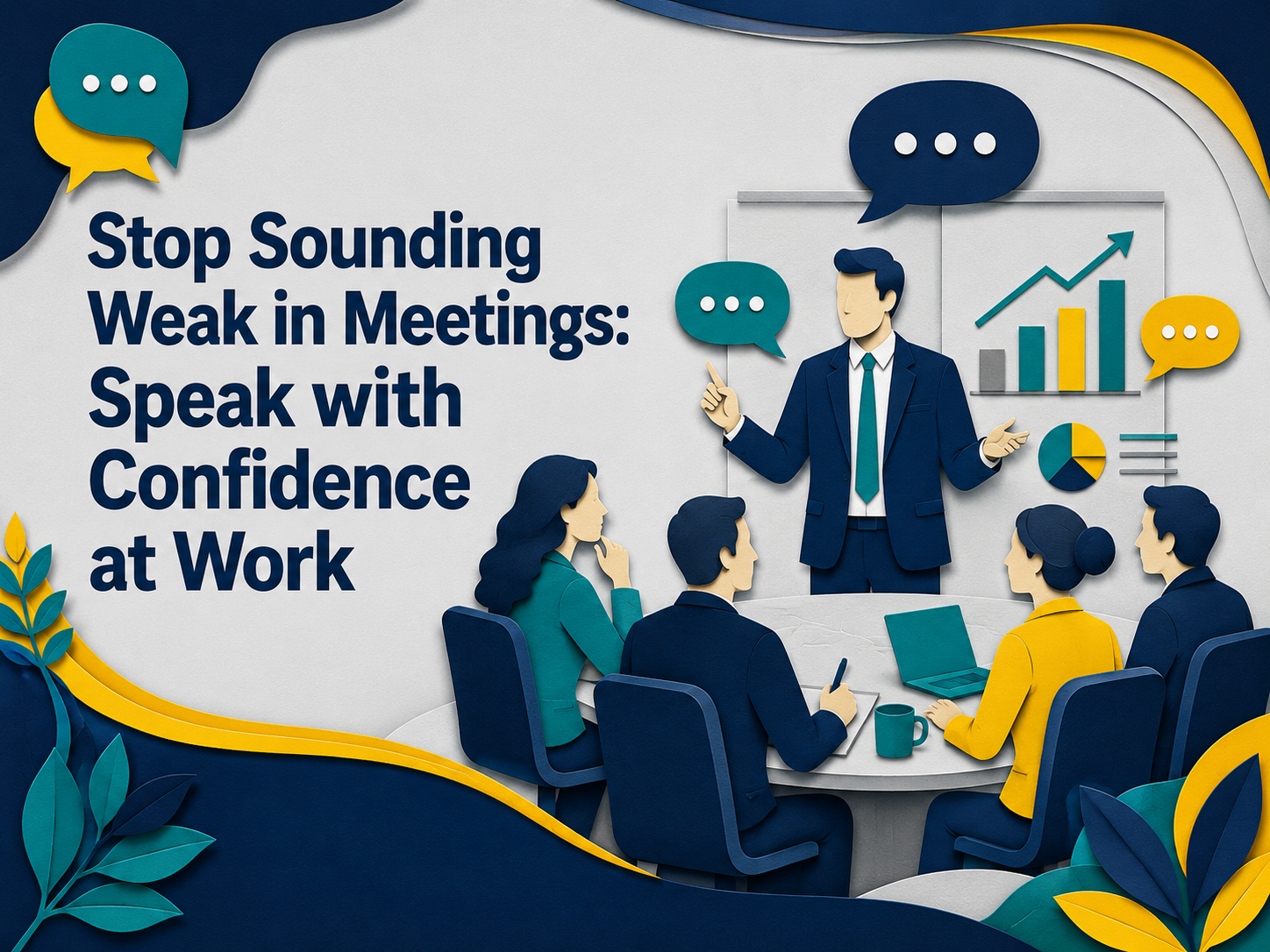
Stop Sounding Weak in Meetings: Speak with Confidence at Work 💼
Intermediate Level | June 1, 2026
Read the article aloud on your own or repeat each paragraph after your tutor.
Have you ever shared an idea in a meeting and felt like nobody really listened? Maybe your idea was good, but your words sounded too uncertain. Many English learners use soft phrases like “maybe,” “I think,” “just,” or “sorry, but…” because they want to sound polite. Politeness is good, of course. But if every sentence sounds too careful, people may think you are not confident.
In professional English, confidence does not mean being rude, loud, or aggressive. It means speaking clearly, directly, and calmly. When you learn how to stop sounding weak in meetings, you can share your ideas with more authority and help others understand your point faster.
Why Weak Language Hurts Your Message
Weak language can make strong ideas sound small. Imagine a team member saying, “I just think maybe we could possibly change the schedule.” The idea might be useful, but the sentence sounds nervous. Now compare that with: “I recommend changing the schedule so we can finish the project on time.” Same basic idea. Much stronger delivery.
When you speak in meetings, people are often busy, tired, or thinking about the next item on the agenda. They need clear signals. If your words sound unsure, your message can disappear into the corporate fog machine. And nobody wants their best idea to vanish like office coffee on Monday morning.
Replace “I Think” with Stronger Phrases
“I think” is not always wrong. Native speakers use it all the time. The problem comes when you use it before every idea. “I think we should update the report.” “I think the client needs more detail.” “I think this is a good option.” After a while, it sounds like you are asking for permission to have an opinion.
Try stronger phrases instead. Say, “I recommend…” “My suggestion is…” “The best option is…” or “Based on the data, we should…” These phrases show that you have thought about your idea. They also help you stop sounding weak in meetings without sounding pushy.
Remove Small Apology Words
Many professionals say, “Sorry, can I ask something?” or “Sorry, I just wanted to add…” This sounds polite, but it also makes your contribution feel like an interruption. Unless you actually did something wrong, you do not need to apologize for speaking.
Instead of saying, “Sorry, I just wanted to ask a quick question,” try, “I have one question about the timeline.” Instead of “Sorry, but I disagree,” say, “I see it differently.” These small changes make your English cleaner, stronger, and more professional.
Be Direct, But Still Respectful
Some English learners worry that direct language sounds rude. That is a fair concern, especially if your culture values indirect communication. But in many international business settings, direct language is not rude when your tone is calm and respectful.
For example, “This plan will not work” may sound too harsh. But “I have concerns about this plan because the timeline is too short” sounds professional. You are direct, but you also explain why. Respectful confidence is the goal. You are not throwing a chair across the boardroom; you are simply making your point like a grown-up with coffee and deadlines.
Use Clear Action Verbs
Action verbs make your meeting language stronger. Instead of saying, “We need to do something about this issue,” say, “We need to fix this issue before Friday.” Instead of “Maybe we can make the process better,” say, “We can improve the process by removing one approval step.”
Words like recommend, improve, solve, reduce, increase, prepare, confirm, and deliver help your speech sound active. They show movement. They make people feel that you are not only talking about the problem—you are ready to help solve it.
Practice One Strong Sentence Before Each Meeting
Here is a simple habit: before your next meeting, prepare one strong sentence you may need to say. It could be an update, an opinion, a question, or a recommendation. Say it out loud three times before the meeting starts.
For example: “I recommend moving the deadline to Friday so the team has time to review the final version.” This sentence is clear, specific, and professional. When you practice before the meeting, your mouth and brain are already warmed up. That makes it easier to speak when the moment comes.
Stop Sounding Weak in Meetings and Build Professional Trust
When you speak with confidence, people trust your ideas more easily. You do not need perfect grammar. You do not need a giant vocabulary. You need clear sentences, strong verbs, and the courage to stop apologizing for having something useful to say.
This week, choose one weak phrase you often use and replace it with a stronger one. Start small. Maybe remove “just” from your meeting language. Maybe replace “I think” with “I recommend.” Over time, these small changes will help you sound more confident, more professional, and more ready to lead.
Vocabulary List
- Confident (adjective) — Feeling sure about your ability or idea.
Example: She sounded confident when she explained the new plan. - Uncertain (adjective) — Not completely sure about something.
Example: His uncertain answer made the team ask more questions. - Authority (noun) — The quality of sounding knowledgeable and in control.
Example: He spoke with authority during the client meeting. - Recommend (verb) — To suggest the best action or choice.
Example: I recommend changing the schedule before Friday. - Contribution (noun) — Something useful that you add to a discussion or project.
Example: Her contribution helped the team solve the problem. - Interrupt (verb) — To speak while someone else is talking.
Example: Try not to interrupt, but do ask your question when there is a pause. - Direct (adjective) — Clear and honest, without too many extra words.
Example: A direct answer is often easier to understand in meetings. - Respectful (adjective) — Showing care and politeness toward others.
Example: You can disagree in a respectful way. - Action verb (noun) — A verb that shows movement, activity, or clear action.
Example: “Improve” is a stronger action verb than “do something about.” - Deadline (noun) — The final time or date when something must be finished.
Example: We need to confirm the deadline by the end of the meeting.
5 Questions About the Article
- Why can weak language hurt your message in meetings?
- What is one stronger phrase you can use instead of “I think”?
- Why should you avoid saying “sorry” when you have done nothing wrong?
- How can direct language still sound respectful?
- What is one strong sentence you could prepare before a meeting?
5 Open-Ended Discussion Questions
- What weak phrases do you sometimes use in meetings?
- How do you feel when you need to disagree with someone in English?
- What makes a speaker sound confident but not rude?
- Which action verbs could you use more often at work?
- What is one meeting situation where stronger English would help you?
📢 Want more tips like this? 👉 Sign up for the All About English Mastery Newsletter! Click here to join us!
Want to finally Master English but don’t have the time? Mastering English for Busy Professionals is the course for you! Check it out now!
Follow our YouTube Channel @All_About_English for more great insights and tips.

 English
  한국어
한국어