

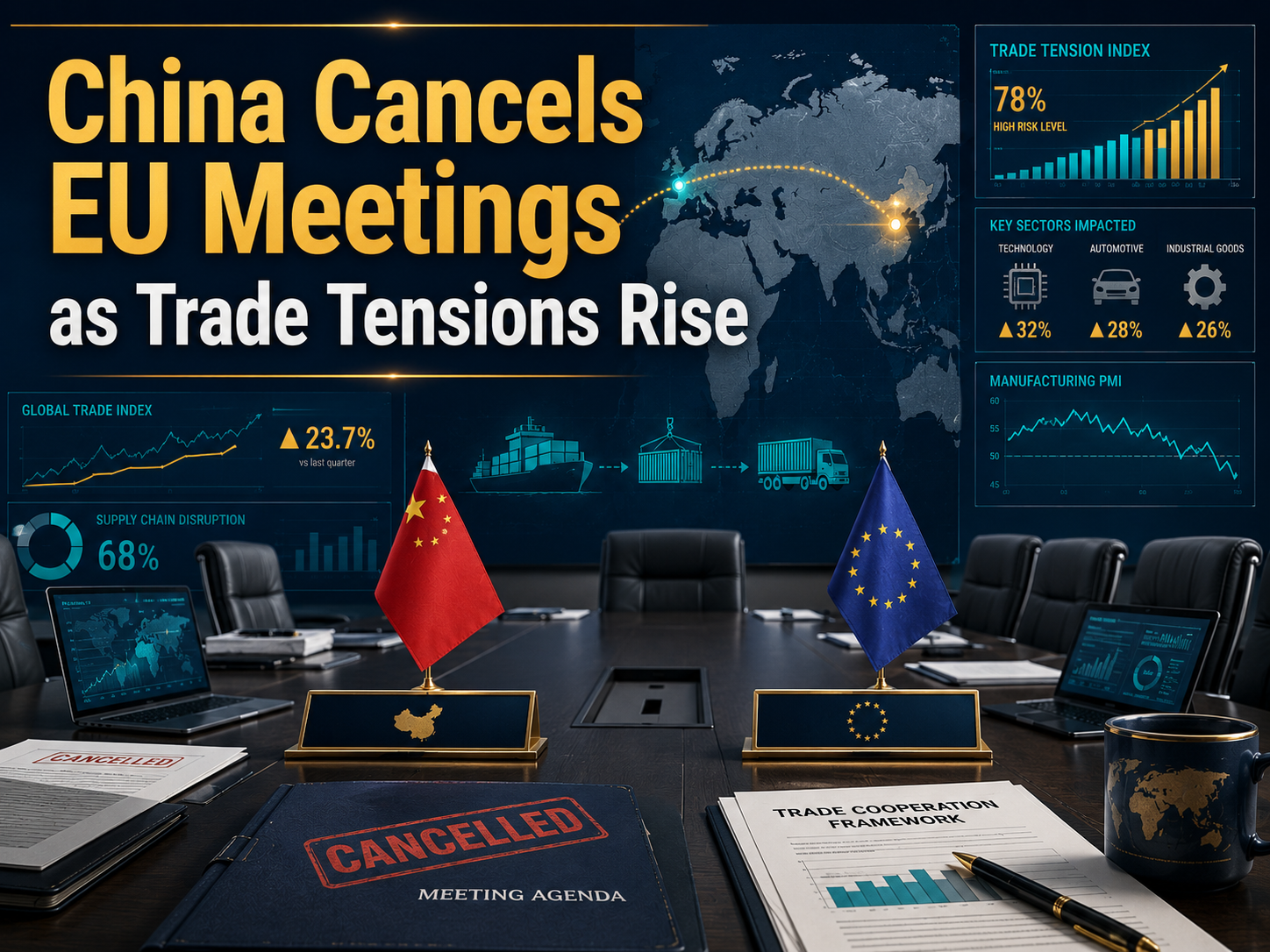
China Cancels EU Meetings as Trade Tensions Rise
Advanced | June 13, 2026
✨ Read the article aloud on your own or repeat each paragraph after your tutor.
China Cancels EU Meetings at Short Notice
On June 11, 2026, Reuters reported that China had cancelled two planned high-level diplomatic meetings with the European Union in Beijing, according to the Financial Times. The cancelled meetings reportedly included a ministerial-level dialogue on digital issues and a meeting involving Olof Skoog, the deputy secretary-general of the EU’s diplomatic service. Reuters said it could not independently verify the FT report, which is an important detail for careful readers.
Why the China EU Meetings Cancelled Story Matters
The China EU meetings cancelled story matters because it shows how quickly diplomacy can change when trade tensions are rising. Meetings like these are not just polite handshakes and photos. They are where governments discuss rules, technology, market access, security concerns, and future cooperation. When a major power cancels talks at short notice, it sends a message — even if the official explanation is vague. In business English, we might say this is a sign that the relationship has “hit a rough patch.”
Trade Pressure Is Building Between China and Europe
The tension comes as the EU becomes more concerned about Chinese exports and competition. The Financial Times reported that Brussels has been looking at ways to respond to China’s growing industrial strength, especially in areas such as technology, energy, and manufacturing. Reuters also reported in late May that the European Commission called the EU-China trade and investment relationship “not sustainable.” That is diplomatic language, but it is not exactly a love letter.
The EU Is Looking at Tougher Trade Tools
European officials have discussed stronger measures to protect European industries from what they see as unfair competition, overcapacity, and subsidized Chinese exports. Reports have mentioned possible restrictions linked to technology, critical infrastructure, and energy-related products. The EU has also opened anti-dumping investigations into some Chinese goods. These actions do not mean Europe wants to stop trading with China. Instead, the EU appears to be trying to reset the terms of the relationship and create what it sees as a fairer playing field.
China Says Communication Is Still Happening
China did not give a detailed public explanation for the reported cancellations. When asked about the issue, Chinese Foreign Ministry spokesman Lin Jian said China and the EU were maintaining communication about the relevant dialogues, according to Reuters. That kind of statement leaves room for future talks, but it does not remove the tension. For English learners, this is a useful example of diplomatic language: officials often say something calm in public while serious disagreement continues behind the scenes.
What Happens Next?
The next question is whether the EU and China will return to serious talks or continue moving toward a tougher trade relationship. Europe depends on China for many products and supply chains, while China depends on Europe as a major market. That means neither side can simply walk away without consequences. For learners, this story is useful because it includes strong real-world vocabulary: diplomacy, trade deficit, anti-dumping, market access, critical infrastructure, and negotiation. It also teaches a practical business lesson: when an important meeting is cancelled, the real message is often bigger than the calendar change.
Vocabulary
- Diplomatic meeting (noun) – an official meeting between governments.
Example: “China cancelled two diplomatic meetings with the EU.” - High-level (adjective) – involving senior or important officials.
Example: “The cancelled meetings were high-level discussions.” - Ministerial-level (adjective) – involving government ministers or senior officials.
Example: “The digital issues meeting was ministerial-level.” - Trade tension (noun) – disagreement or pressure between countries over trade.
Example: “Trade tension between China and the EU has increased.” - Market access (noun) – the ability to sell goods or services in another market.
Example: “European companies want better market access in China.” - Anti-dumping investigation (noun) – an investigation into whether products are being sold too cheaply and unfairly.
Example: “The EU opened anti-dumping investigations into some Chinese goods.” - Overcapacity (noun) – when a country or company produces more than the market needs.
Example: “European officials worry about Chinese industrial overcapacity.” - Critical infrastructure (noun) – systems important for a country’s safety and economy, such as energy, telecom, or transport.
Example: “The EU is concerned about foreign involvement in critical infrastructure.” - Trade deficit (noun) – when a country imports more than it exports.
Example: “The EU has a large trade deficit with China.” - Fair playing field (noun phrase) – a situation where everyone competes under fair rules.
Example: “The EU wants a fair playing field for European companies.”
Discussion Questions (About the Article)
- What two kinds of meetings did China reportedly cancel?
- Why is it important that Reuters could not independently verify the FT report?
- What trade concerns are creating tension between China and the EU?
- How did China’s foreign ministry respond to questions about the cancelled meetings?
- Why might a cancelled meeting send a stronger message than an official statement?
Discussion Questions (About the Topic)
- Should countries cancel diplomatic meetings when trade tensions rise? Why or why not?
- How can governments protect local industries without damaging trade relationships?
- What does a “fair playing field” mean in international business?
- Why are technology and critical infrastructure sensitive topics in trade?
- How should companies prepare when political tensions affect global supply chains?
Related Idiom
“A shot across the bow” – a warning action that signals stronger action may come later.
Example: “China cancelling the EU meetings may be seen as a shot across the bow during a tense trade dispute.”
📢 Want more practical English through real news stories? Sign up for the All About English Mastery Newsletter here: allaboutenglishmastery.com/newsletter
Want to build stronger English in less time? Check out Mastering English for Busy Professionals.
Follow our YouTube channel @All_About_English for more English tips and practice.
This article was inspired by: Reuters, Financial Times, The Straits Times, and Reuters


 English
  한국어
한국어