

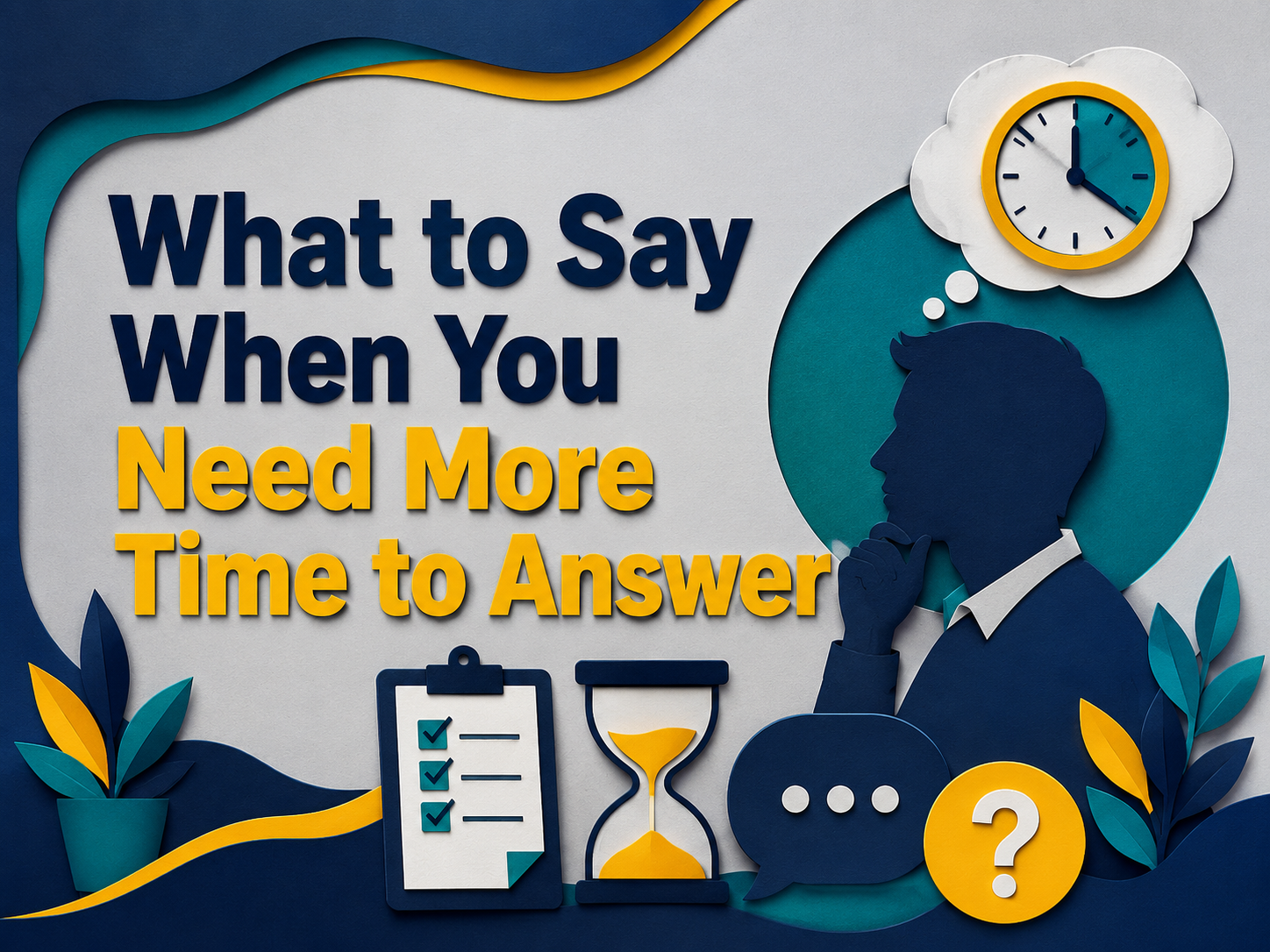
What to Say When You Need More Time to Answer ⏳
Intermediate Level | June 18, 2026
Read the article aloud on your own or repeat each paragraph after your tutor.
Have you ever been in a meeting when someone asked you a question, and your brain suddenly said, “Nope. We’re closed today”? You know the answer is somewhere in your head, but it refuses to come out. For English learners, this moment can feel stressful. You may worry that people will think you are unprepared, slow, or not confident. But here is the good news: needing more time is normal. Even native speakers pause, think, and ask for a moment before answering.
The real skill is not answering every question immediately. The real skill is knowing what to say when you need more time to answer. In professional English, silence can feel awkward if it lasts too long. But a short, confident phrase can protect your image and give your brain the space it needs. Instead of panicking, you can use simple expressions that sound calm, natural, and professional.
Why It’s Okay When You Need More Time to Answer
Many learners think they must answer quickly to sound fluent. That is not true. Fast English is not always good English. In business, clear thinking is more important than fast speaking. If someone asks you a serious question about a project, deadline, client issue, or decision, it is perfectly acceptable to pause before answering. In fact, thoughtful pauses can make you sound more professional.
Imagine two employees in a meeting. One answers quickly but gives a confusing response. The other says, “That’s a good question. Let me think about that for a moment.” Then she gives a clear answer. Who sounds more professional? Usually, the second person. She does not sound weak. She sounds careful, thoughtful, and in control.
Phrase 1: “That’s a good question.”
This is one of the easiest phrases to use when you need a little thinking time. It sounds natural, polite, and professional. It also gives you a few extra seconds to organize your thoughts. For example, if your manager asks, “Why did the schedule change?” you can begin with, “That’s a good question.” Then pause briefly and continue.
This phrase works because it shows respect for the question. It tells the listener, “I am taking this seriously.” Be careful not to overuse it, though. If every question is “a good question,” people may notice. Use it when the question is important, difficult, or worth thinking about.
Phrase 2: “Let me think about that for a moment.”
This phrase is direct and useful. It clearly tells the listener that you need a short pause. It is much better than freezing in silence. You can say, “Let me think about that for a moment,” then take two or three seconds to prepare your answer. No drama. No panic. No need to stare at the ceiling like you’re trying to receive a message from space.
This phrase is especially useful in meetings, interviews, and client calls. It helps you slow down without sounding unsure. You are not avoiding the question. You are simply giving yourself time to answer well.
Phrase 3: “I want to make sure I answer that clearly.”
This phrase is excellent for professional situations. It shows that you care about accuracy and communication. For example, you could say, “I want to make sure I answer that clearly. The main issue is the timeline.” This gives you a smooth bridge from thinking to answering.
Use this phrase when the topic is complicated or sensitive. Maybe you are explaining a budget problem, a customer complaint, or a technical issue. Instead of rushing, you show that you want to be clear. That sounds responsible and mature.
Phrase 4: “Can I come back to that after I check the details?”
Sometimes you really do not know the answer. That is okay. Professionals do not need to pretend they know everything. Actually, pretending can create bigger problems. If you are not sure, say so politely and explain what you will do next.
For example: “Can I come back to that after I check the details?” This is much better than guessing. It shows honesty and responsibility. You can also say, “I don’t want to give you the wrong information, so I’ll confirm and follow up.” That phrase is gold in business English. Use it wisely, like a responsible adult with a calendar.
Phrase 5: “My first thought is…”
Sometimes you have an idea, but you are not 100% sure yet. In that case, you can start with, “My first thought is…” This phrase helps you share an early opinion without making it sound final. For example, “My first thought is that we should contact the client before changing the schedule.”
This phrase is useful in brainstorming meetings or team discussions. It lets you participate even when your idea is still forming. You do not need a perfect answer before you speak. You can show that you are thinking actively and contributing to the discussion.
What to Say When You Need More Time to Answer in Real Meetings
Let’s put these phrases together. Imagine someone asks, “How should we handle the client’s complaint?” You could answer, “That’s a good question. I want to make sure I answer that clearly. My first thought is that we should apologize first, then offer a clear next step.” That response sounds calm, structured, and professional.
The next time you need more time to answer, do not panic. Use one of these phrases, breathe, and give yourself a moment. Clear communication is not about speed. It is about control, confidence, and connection. The person listening usually does not expect perfection. They just want a thoughtful answer. And now, you have the language to give one.
Vocabulary List
- Pause (verb/noun) — To stop briefly before continuing.
Example: She paused before answering the difficult question. - Thoughtful (adjective) — Showing careful thinking.
Example: His thoughtful answer helped the team understand the issue. - Professional (adjective) — Suitable for work or business situations.
Example: She gave a professional response during the meeting. - Organize (verb) — To arrange ideas clearly.
Example: Take a moment to organize your thoughts before speaking. - Response (noun) — An answer or reply.
Example: His response was clear and helpful. - Accuracy (noun) — Being correct or exact.
Example: Accuracy is important when discussing financial details. - Sensitive (adjective) — Needing careful handling.
Example: The manager spoke carefully about the sensitive issue. - Confirm (verb) — To check and make sure something is correct.
Example: I will confirm the schedule and email you later. - Follow up (phrasal verb) — To contact someone again with more information.
Example: I’ll follow up after I check the report. - Contribute (verb) — To give ideas, help, or support.
Example: Everyone contributed ideas during the meeting.
5 Questions About the Article
- Why is it okay to pause before answering a question?
- What phrase can you use when someone asks a difficult question?
- Why is “I want to make sure I answer that clearly” useful?
- What should you say if you do not know the answer yet?
- How does “My first thought is…” help you join a discussion?
5 Open-Ended Discussion Questions
- When do you usually feel pressure to answer quickly in English?
- Which phrase from this article would be most useful for your job?
- How do people in your workplace usually respond when they do not know an answer?
- What is better in business: a fast answer or a clear answer? Why?
- How can you practice staying calm when someone asks you a difficult question?
📢 Want more tips like this? 👉 Sign up for the All About English Mastery Newsletter! Click here to join us!
Want to finally Master English but don’t have the time? Mastering English for Busy Professionals is the course for you! Check it out now!
Follow our YouTube Channel @All_About_English for more great insights and tips.

 English
  한국어
한국어