

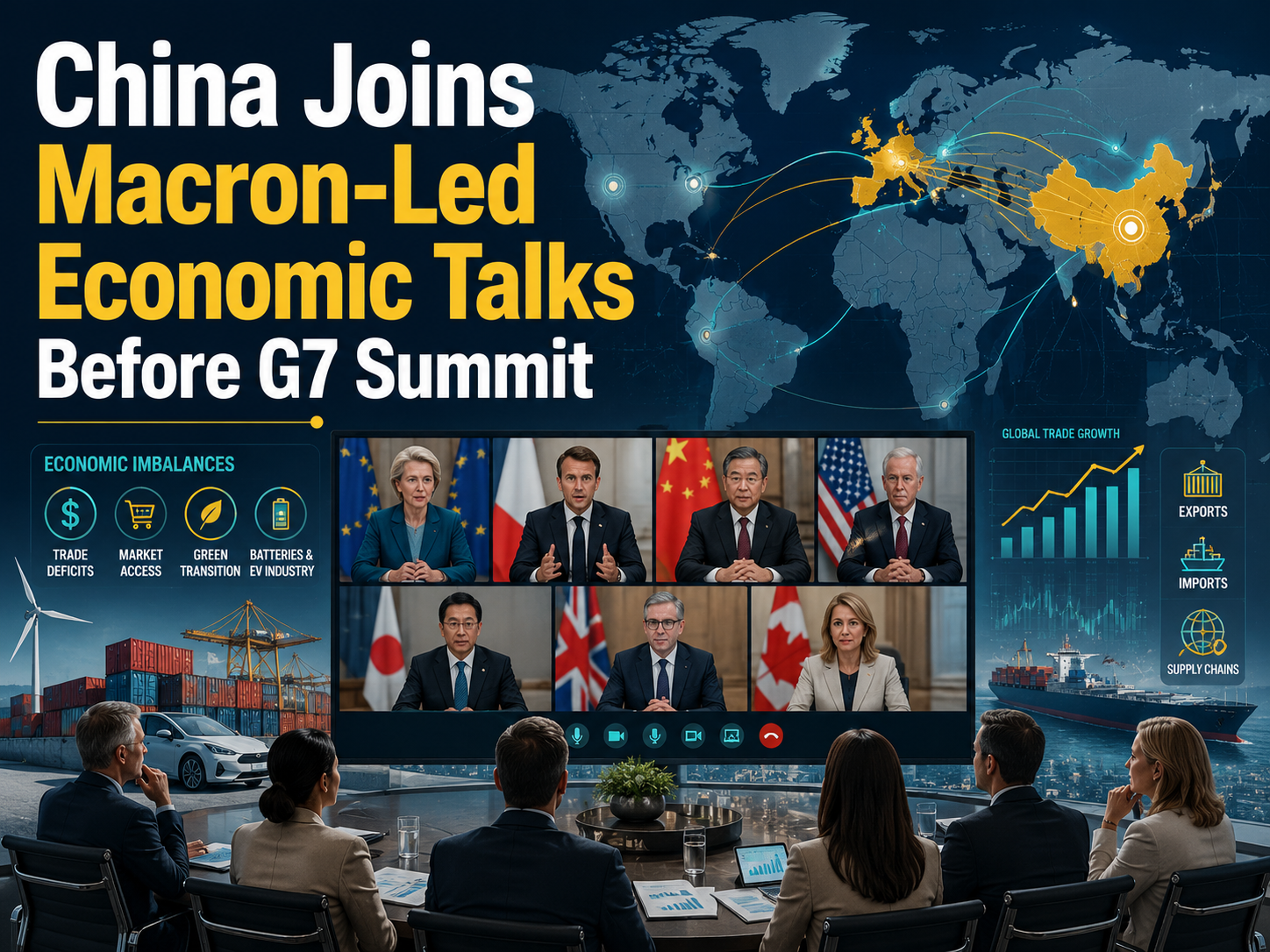
China Joins Macron-Led Economic Talks Before G7 Summit
Advanced | June 21, 2026
✨ Read the article aloud on your own or repeat each paragraph after your tutor.
A Rare Call Before the G7 Summit
A few days before the G7 summit in Evian-les-Bains, France, Chinese Vice Premier Zhang Guoqing joined a video call hosted by French President Emmanuel Macron. The call focused on global economic imbalances, especially the growing tension over trade, exports, and industrial competition. According to Reuters, Zhang urged countries to support economic cooperation, inclusive growth, and a free, convenient trade environment.
Why China G7 Economic Cooperation Is in the Spotlight
The story matters because China G7 economic cooperation is not just a polite diplomatic phrase. It is connected to real business pressure. Many Western countries are worried about low-priced Chinese exports entering their markets, especially electric vehicles, lithium-ion batteries, and other high-tech products. Reuters reported that France wanted the discussion to include G7 countries, China, invited partners, and the IMF because these trade tensions affect more than one region. European manufacturers fear they could lose market share if Chinese companies keep moving up the value chain while selling at very competitive prices.
Macron’s Goal: Keep the Conversation Open
Macron has tried to engage Beijing before the European Union decides whether to take a tougher trade position toward China. Reuters reported that France sees global imbalance in a simple but sharp way: China produces too much, the United States consumes too much, and Europe invests too little. That is a big statement, but it helps explain why the call was important. Macron’s message was basically this: if major economies do not coordinate, the global economy could face sudden and painful adjustments.
China’s Message: Don’t Blame Our Success
China pushed back against the idea that its exports are unfair. Zhang said China is expanding high-level opening-up and wants to share development opportunities with other countries. Beijing has also rejected accusations that Chinese exporters benefit unfairly from state subsidies. Instead, China argues that other countries are hurting global trade rules by using unilateral tariffs. As Reuters noted, Zhang called for an international economic and trade environment that is “free, open and convenient.” In plain English: China is saying, “Don’t punish us just because we are competitive.”
A Difficult Balance for Europe
Europe is not fully united on how to respond. Some leaders want tougher trade measures, especially as Chinese electric vehicle companies compete more directly with European carmakers. But Germany, Europe’s largest trading economy, has been more cautious because China is a major export market for German companies. Reuters’ G7 background report said the 2026 summit agenda included global economic imbalances, China’s trade surplus, AI, Ukraine, Iran, and developing-country debt. That puts Europe in a tricky position: it wants to protect its industries without starting a trade fight that could hurt its own businesses.
What This Means for Global Business
This story shows how connected the global economy has become. A policy decision in Beijing can affect factories in Germany, consumers in France, investors in the United States, and supply chains across Asia. The G7 may not solve the problem overnight, but the call shows that major economies are at least trying to keep the conversation going. In business, that matters. When the stakes are high, silence usually makes things worse.
Vocabulary
- Economic imbalance (noun) – a situation where parts of the economy are uneven or unstable.
Example: “The G7 discussed economic imbalance between major countries.” - Cooperation (noun) – working together toward a shared goal.
Example: “China called for more cooperation with other economies.” - Inclusive growth (noun) – economic growth that benefits many people or countries, not just a few.
Example: “Leaders said inclusive growth should be part of trade discussions.” - Export (noun/verb) – a product sold to another country; to sell products abroad.
Example: “Chinese exports have become a major topic in Europe.” - Tariff (noun) – a tax on imported goods.
Example: “Some countries use tariffs to protect local industries.” - Subsidy (noun) – money or support given by a government to help a business or industry.
Example: “China rejected claims that its exporters benefit unfairly from subsidies.” - Manufacturer (noun) – a company that makes products.
Example: “European manufacturers worry about low-priced imports.” - Competitive (adjective) – able to succeed against others in the same market.
Example: “Chinese companies have become more competitive in electric vehicles.” - Coordinate (verb) – to organize actions together.
Example: “Macron said major economies need to coordinate their policies.” - Trade policy (noun) – a government’s rules about imports, exports, tariffs, and trade relationships.
Example: “The EU may consider a tougher trade policy toward China.”
Discussion Questions About the Article
- Why did China’s participation in the video call stand out?
- What did Zhang Guoqing ask countries to support?
- Why are European leaders worried about low-priced Chinese exports?
- How does France describe the global economic imbalance between China, the U.S., and Europe?
- Why is Germany cautious about taking a tougher trade position toward China?
Discussion Questions About the Topic
- Should countries protect local industries from cheaper foreign products? Why or why not?
- When do tariffs help an economy, and when can they hurt it?
- How should businesses prepare for trade tensions between major countries?
- Is China’s export strength a problem, or is it simply competition?
- What should Europe do if it wants to stay competitive in high-tech industries?
Related Idiom
“Walk a tightrope” – to deal with a difficult situation where one wrong move could cause problems.
Example: “Europe is walking a tightrope between protecting its industries and avoiding a bigger trade fight with China.”
📢 Want more practical English through real news stories? Sign up for the All About English Mastery Newsletter here: allaboutenglishmastery.com/newsletter
Want to build stronger English in less time? Check out Mastering English for Busy Professionals.
Follow our YouTube channel @All_About_English for more English tips and practice.
This article was inspired by: Reuters – China urges economic cooperation on Macron-led video call ahead of G7 summit, Reuters – Macron to chair video call involving G7 and China over economic imbalances, and Reuters – What is the G7 and what’s on the agenda at the Evian-les-Bains summit?


 English
  한국어
한국어