

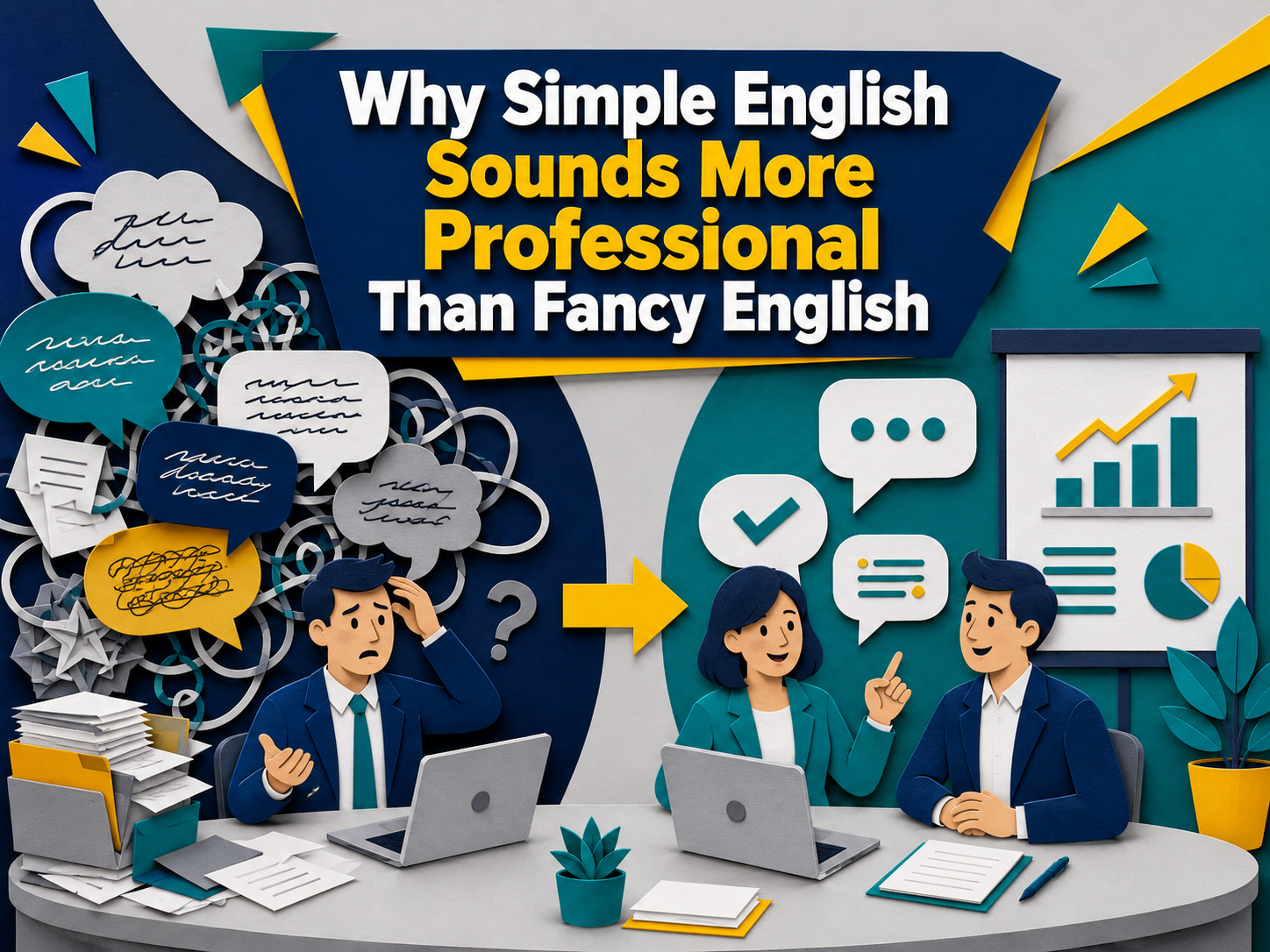
Why Simple English Sounds More Professional Than Fancy English 💼
Intermediate Level | June 26, 2026
Read the article aloud on your own or repeat each paragraph after your tutor.
Many English learners believe they need big words to sound smart at work. They try to use long sentences, difficult vocabulary, and formal expressions because they want to sound professional. But here’s the truth: simple English sounds professional because it is clear, direct, and easy to understand.
In business, people are busy. They don’t want to decode your message like it’s a secret government document. They want to know what you mean, what you need, and what should happen next. When your English is simple, your message travels faster. That makes you sound confident, prepared, and respectful of other people’s time.
Why Simple English Sounds Professional at Work
Simple English does not mean childish English. It means clear English. For example, instead of saying, “We need to facilitate the implementation of this strategic initiative,” you can say, “We need to start this plan.” The second sentence is shorter, stronger, and much easier to follow. No one needs a dictionary. No one needs coffee. Well, maybe coffee—but not because of your sentence.
Fancy English can sometimes make you sound nervous. Many learners use difficult words because they are trying to prove themselves. But when a sentence becomes too heavy, the listener may get confused. Worse, they may stop listening. Professional communication is not about showing every word you know. It is about helping people understand your idea quickly.
Clear Language Builds Better Connection
Connection is one of the most important parts of professional English. When people understand you easily, they feel more comfortable speaking with you. They are more likely to ask questions, share ideas, and continue the conversation. This is why simple English sounds professional in meetings, emails, presentations, and small talk.
Think about two managers giving the same update. One says, “The timeline requires further optimization due to operational limitations.” The other says, “We need more time because our team is short-staffed.” Which manager sounds clearer? Which one sounds more honest? In most situations, the simple sentence wins because it feels real.
Simple English Helps You Sound Confident
Confident speakers do not hide behind complicated words. They speak with control, they choose words that fit the situation, and they make the listener’s job easy. That is a quiet kind of leadership. You are not shouting, “Look how smart I am!” You are saying, “Here is the point. Let’s move forward.”
Simple English also helps you avoid common mistakes. Long sentences create more chances for grammar problems. Shorter sentences are easier to manage. Instead of trying to build one giant sentence with five ideas, break it into two or three smaller sentences. Your message will sound cleaner and more natural.
Use Simple Words, Not Weak Words
Some learners worry that simple words sound weak. But simple does not mean weak. Words like start, fix, build, improve, solve, explain, and finish are simple—but they are also powerful. They show action. They help people see exactly what you mean.
Here are a few examples:
- “We need to utilize this tool.” → “We need to use this tool.”
- “Can you elaborate on your opinion?” → “Can you tell me more about what you think?”
- “We will commence the next phase.” → “We’ll start the next step.”
- “There are numerous issues.” → “There are many problems.”
- “I am currently reviewing the document.” → “I’m reviewing the document now.”
If you want to sound more professional, try this simple habit: after you write or say a sentence, ask yourself, “Can I say this more clearly?” If the answer is yes, simplify it. Your goal is not to impress people with fancy English. Your goal is to connect, explain, and get results.
Vocabulary List
- Professional (adjective) — Suitable for work or business situations.
Example: Her professional tone made the meeting feel calm and organized. - Fancy (adjective) — Complicated, stylish, or impressive-looking, sometimes too much.
Example: He used fancy words, but his meaning was not clear. - Clear (adjective) — Easy to understand.
Example: Please give me a clear explanation of the problem. - Direct (adjective) — Simple and straight to the point.
Example: A direct answer saves time in a meeting. - Decode (verb) — To figure out the meaning of something difficult.
Example: I had to decode his long email before I understood the request. - Respectful (adjective) — Showing care for others.
Example: Clear communication is respectful because it saves people time. - Complicated (adjective) — Difficult to understand or use.
Example: The instructions were too complicated for a quick meeting. - Connection (noun) — A relationship or feeling of understanding between people.
Example: Simple English helps build connection with coworkers. - Confident (adjective) — Feeling sure and comfortable.
Example: She sounded confident because her message was simple and clear. - Simplify (verb) — To make something easier to understand.
Example: Try to simplify your answer before the presentation.
5 Questions About the Article
- Why do many English learners try to use fancy English at work?
- Why does simple English sound professional in business situations?
- What can happen when a sentence becomes too complicated?
- How does simple English help build connection?
- Give two examples of simple words that can sound powerful.
5 Open-Ended Discussion Questions
- Have you ever used a fancy English word when a simple word would have been better?
- Why do you think people sometimes connect simple English with low ability?
- What is one work sentence you often say that you could simplify?
- How can simple English help you in meetings or presentations?
- Who do you know that communicates clearly and professionally? What do they do well?
📢 Want more tips like this? 👉 Sign up for the All About English Mastery Newsletter! Click here to join us!
Want to finally Master English but don’t have the time? Mastering English for Busy Professionals is the course for you! Check it out now!
Follow our YouTube Channel @All_About_English for more great insights and tips.

 English
  한국어
한국어