

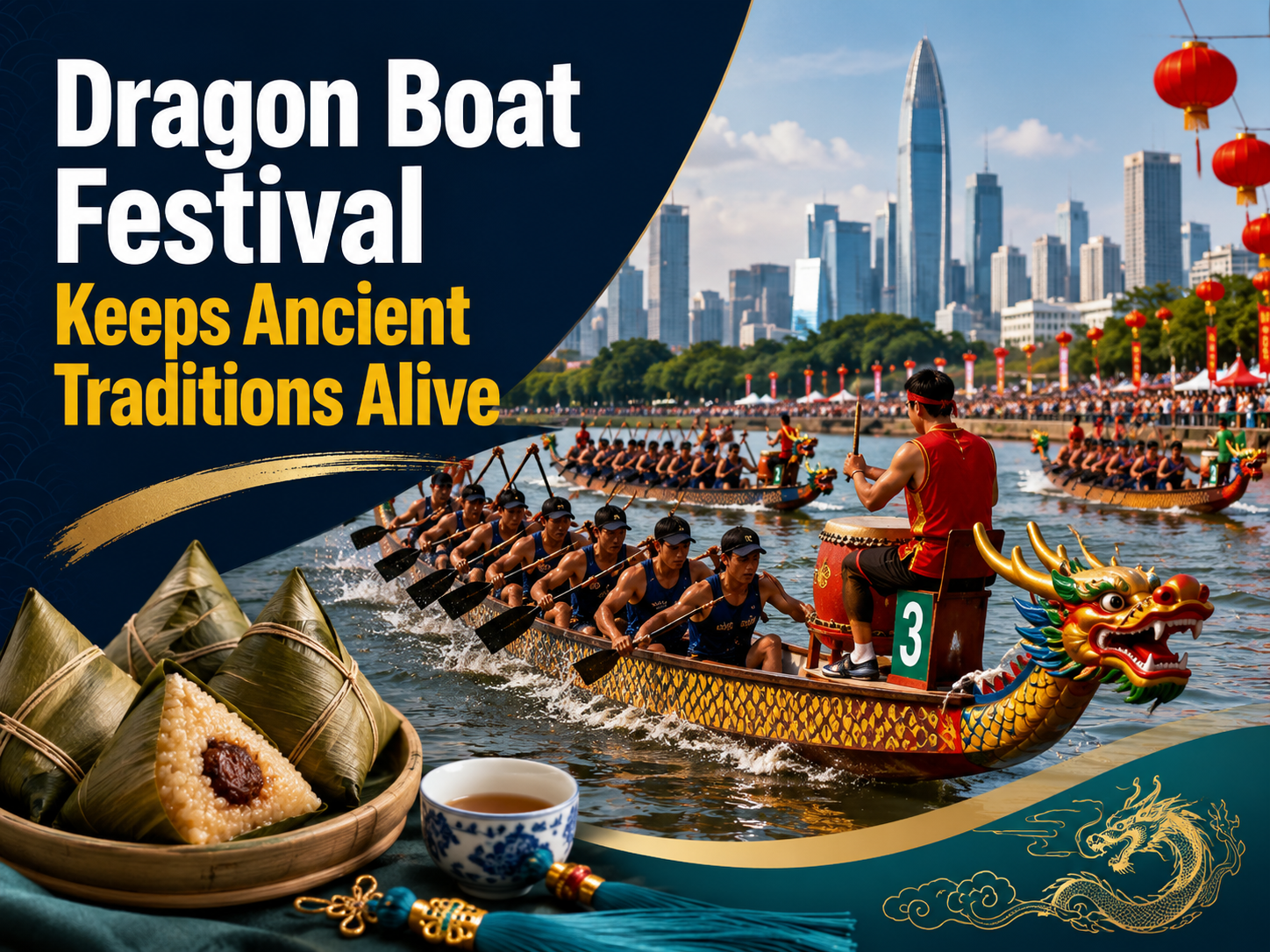
Dragon Boat Festival Keeps Ancient Traditions Alive
Beginner | June 27, 2026
✨ Read the article aloud on your own or repeat each paragraph after your tutor.
Dragon Boat Festival Traditions Still Matter Today
The Dragon Boat Festival traditions are more than 2,000 years old, but they are still alive in modern China. On June 19, 2026, people across mainland China, Hong Kong, and Taiwan celebrated with colorful dragon boat races, lion dances, family meals, and traditional foods. The festival is also known as Duanwu Festival in Mandarin and Tuen Ng Festival in Cantonese. It falls on the fifth day of the fifth month of the traditional Chinese lunar calendar. (AP News, UNESCO)
A Festival With Fast Boats and Family Food
For many people, the most exciting part of the festival is the dragon boat race. Teams paddle long boats together while a drummer keeps the rhythm. In Hong Kong, competitors took part in the famous Aberdeen Dragon Boat Race, and some even wore colorful costumes. In Beijing, celebrations continued at the Grand Canal, where men’s, women’s, and mixed teams raced over 100, 200, and 500 meters. Organizers expected more than 1,000 athletes and about 200,000 spectators during the holiday weekend. (AP News, AP Photos)
Why People Eat Zongzi
The festival is also famous for zongzi, a sticky rice dumpling usually wrapped in leaves. Many families make or eat zongzi together during the holiday. According to tradition, the food is connected to the story of Qu Yuan, an ancient Chinese poet. Legend says that after Qu Yuan drowned himself more than 2,000 years ago, people raced out in boats to search for him and threw rice into the river so fish would not eat his body. Today, the boat races and zongzi help people remember that old story. (AP News)
Health, Protection, and Old Beliefs
The Dragon Boat Festival traditions are not only about sports. They are also connected to health and protection. In the past, people believed the fifth lunar month was a dangerous time because insects, disease, and bad luck were more common. Some families still wear five-colored bracelets, use herbal sachets, or prepare special foods and drinks. One Beijing resident told AP that her family made zongzi and learned about a recipe using mugwort leaves, red dates, brown sugar, and ginger to boil eggs. The goal was simple: protect the family and hope for good health. (AP News)
Modern Cities, Old Customs
China has changed a lot. Today, more than 64% of China’s population lives in urban areas, so many people do not celebrate the festival the same way their grandparents did in villages. But traditions can change without disappearing. In Beijing, the festival included Wing Chun martial arts, a traditional handicraft market, and lion dance performances from Guangdong province. Reuters also reported that China had 124 million domestic trips during the three-day holiday from June 19 to 21, with tourism spending reaching 44.5 billion yuan, or about $6.57 billion. So yes, tradition is alive—and apparently, it also knows how to boost the holiday economy. (AP News, Reuters)
What English Learners Can Learn From This Story
This story is useful for English learners because it gives us great words for talking about culture, family, teamwork, and tradition. A dragon boat team must paddle together. If one person goes too fast or too slow, the team loses rhythm. That is also true in many workplaces. Good teams need timing, trust, and clear communication. The Dragon Boat Festival shows how old traditions can still bring people together in a modern world.
Vocabulary
- Festival (noun) – a special event or celebration.
Example: “The Dragon Boat Festival is celebrated in many Chinese communities.” - Tradition (noun) – a custom or belief passed down over time.
Example: “Eating zongzi is an important tradition during the festival.” - Spectator (noun) – a person who watches an event.
Example: “Thousands of spectators watched the dragon boat races.” - Athlete (noun) – a person who plays a sport or competes in physical events.
Example: “More than 1,000 athletes joined the races in Beijing.” - Paddle (verb) – to move a boat using a paddle.
Example: “The team paddled together to reach the finish line.” - Rhythm (noun) – a regular beat or pattern.
Example: “The drummer helped the rowers keep their rhythm.” - Herbal (adjective) – made from plants used for medicine or flavor.
Example: “Some families use herbal sachets during the festival.” - Protection (noun) – keeping someone or something safe.
Example: “Many old customs were connected to health and protection.” - Urban (adjective) – related to cities.
Example: “Urban families may celebrate differently from rural families.” - Heritage (noun) – traditions, history, and culture passed down from the past.
Example: “The festival is part of China’s cultural heritage.”
Discussion Questions About the Article
- Where was the Dragon Boat Festival celebrated in 2026?
- What are two activities people enjoyed during the festival?
- What is zongzi, and why is it important?
- Why did some old festival customs focus on health and protection?
- How has modern city life changed the way people celebrate the festival?
Discussion Questions About the Topic
- What traditional holiday is important in your country?
- Do young people in your country still care about old traditions? Why or why not?
- What food do people usually eat during an important holiday in your culture?
- How can festivals help families or communities stay connected?
- Should old traditions change with modern life, or should they stay the same?
Related Idiom
“Pull together” – to work as a team, especially during a challenge.
Example: “Dragon boat teams must pull together to win the race, just like coworkers must pull together to finish an important project.”
📢 Want more practical English through real news stories? Sign up for the All About English Mastery Newsletter here: allaboutenglishmastery.com/newsletter
Want to build stronger English in less time? Check out Mastering English for Busy Professionals.
Follow our YouTube channel @All_About_English for more English tips and practice.
This article was inspired by: AP News, with additional details from Reuters, AP Photos, and UNESCO.


 English
  한국어
한국어