

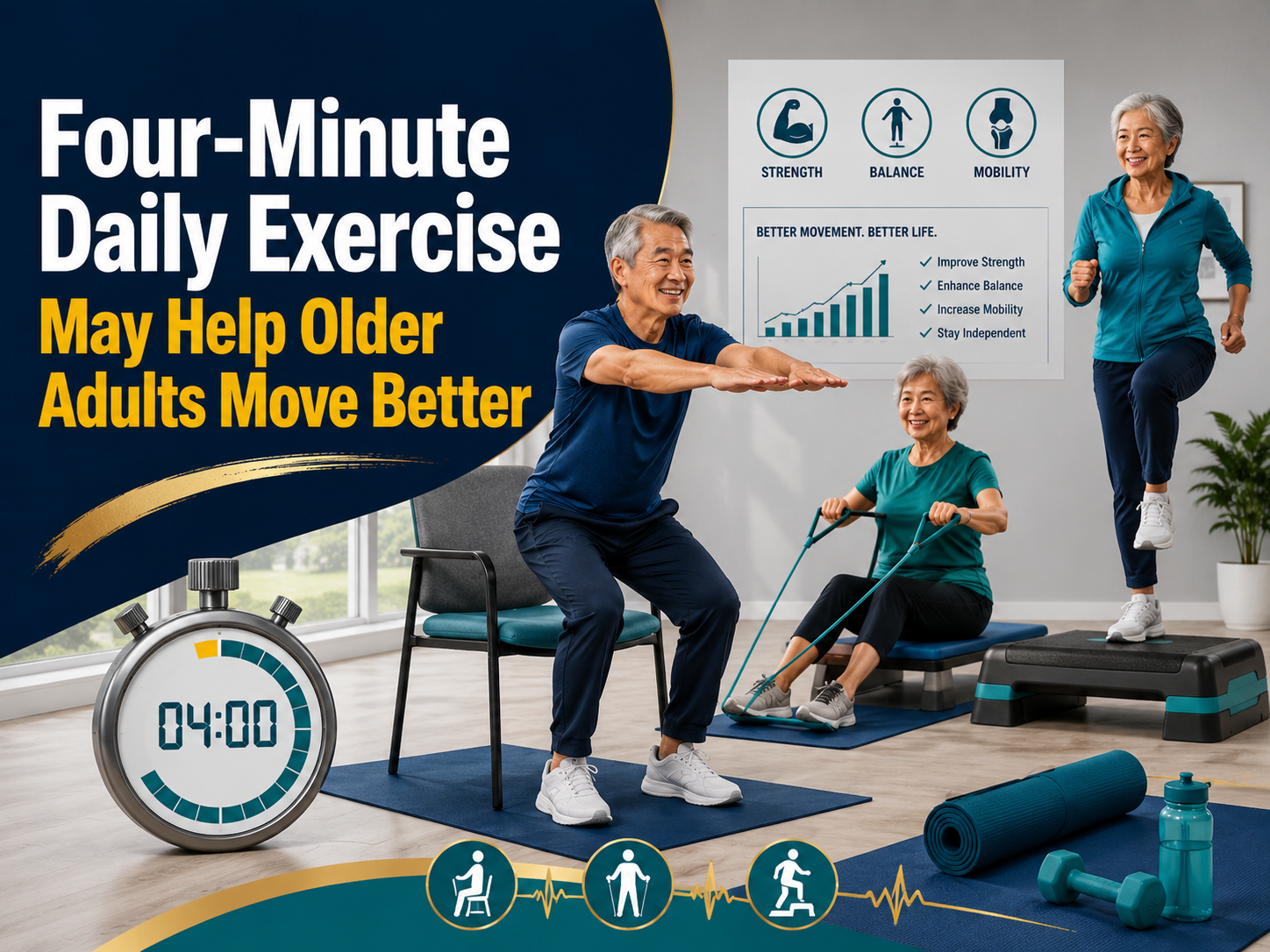
Four-Minute Daily Exercise May Help Older Adults Move Better
Beginner | June 27, 2026
✨ Read the article aloud on your own or repeat each paragraph after your tutor.
Four-Minute Daily Exercise May Improve Mobility
A new Penn State study suggests that a very short workout may help older adults move better. According to Fox News, researchers studied whether four-minute daily exercise could improve strength, balance, and mobility in adults over 65. The study focused on people who already had some difficulty walking. That detail matters. This was not a “four minutes and become Superman” study. It was about helping older adults improve important daily movements, such as standing up from a chair, climbing stairs, and staying balanced. (Fox News, Penn State)
What the FAST-2 Program Included
The program was called FAST-2, which stands for Functional Activity Strength Training. Researchers tested the program with 97 participants who were older than 65. Their average age was about 74 years old. The workout included four simple exercises: push-ups, chair stands, two-arm rows, and stair stepping. Each exercise lasted 30 seconds, followed by a 30-second rest. Participants also received resistance bands and an adjustable stepper, and the exercises could be modified. For example, people could do push-ups against a wall or chair stands with their hands on their knees. (Penn State, Penn State Health News)
Small Exercise, Real Improvements
After 12 weeks, the results were encouraging. Compared with the control group, the exercise group improved by about 4.2 more chair stands in 30 seconds. They also improved their one-leg standing time by about 3.6 seconds and became faster on a sit-to-stand test by about 2.3 seconds. These may sound like small numbers, but they matter in real life. For an older adult, standing up more easily or balancing longer can mean more independence and less fear of falling. (Penn State, PLOS One via NIH/PubMed Central)
Why Mobility Matters So Much
Mobility means the ability to move your body well enough to do normal daily activities. This includes walking, standing, climbing stairs, and getting out of a chair. The CDC says falls are the leading cause of injury for adults aged 65 and older, and more than 14 million older adults, or about 1 in 4, report falling every year. That is why strength and balance are not just “fitness goals.” They are part of daily freedom. If you can move safely, you can keep doing more things for yourself. (CDC, CDC Fall Prevention)
Why Short Workouts May Be Easier to Keep
One important part of the study was consistency. Penn State reported that participants completed the exercise program on 81% of days during the study. That is a strong number, especially because many people find long workouts hard to continue. Dr. Christopher Sciamanna, a Penn State professor of medicine and public health, said short exercise routines may help people who would never consider a 45-minute workout. In other words, a small routine is better than a perfect plan that never happens. Fitness, like email, only works if you actually do it. (Penn State, Business Insider)
A Helpful Study, But Not a Magic Cure
The researchers were careful about what the study does and does not show. The original study says the results do not prove that four minutes of daily exercise is enough to improve body composition or heart health for the general population. Instead, the study suggests that four-minute daily exercise may improve functional performance in older adults who already have walking difficulties. That is still important. For many older adults, better strength and balance can help them stay active, independent, and confident. (PLOS One via NIH/PubMed Central)
What English Learners Can Learn From This Story
This story is useful for English learners because it gives us practical words for health, aging, and daily routines. You can practice phrases like “build strength,” “improve balance,” “stay active,” “reduce fall risk,” and “keep a routine.” These are helpful expressions for talking with doctors, family members, coworkers, or friends. You can also use this story to practice giving gentle advice: “You could start small,” “You should check with your doctor first,” or “A short routine may be easier to keep.”
Vocabulary
- Mobility (noun) – the ability to move easily.
Example: “The study looked at mobility in older adults.” - Strength (noun) – physical power in the body or muscles.
Example: “Strength helps people stand and climb stairs.” - Balance (noun) – the ability to stay steady and not fall.
Example: “Good balance can reduce the risk of falling.” - Participant (noun) – a person who takes part in a study or activity.
Example: “The study included 97 participants.” - Resistance band (noun) – a stretchy band used for exercise.
Example: “Participants used resistance bands for two-arm rows.” - Chair stand (noun) – an exercise where a person stands up from a chair and sits down again.
Example: “Chair stands can help build leg strength.” - Control group (noun) – a group in a study that does not receive the treatment being tested.
Example: “Researchers compared the exercise group with the control group.” - Independence (noun) – the ability to do things by yourself.
Example: “Better mobility can help older adults keep their independence.” - Routine (noun) – something you do regularly.
Example: “A short exercise routine may be easier to continue.” - Functional performance (noun) – how well a person can do everyday physical tasks.
Example: “The study measured functional performance, such as standing from a chair.”
Discussion Questions About the Article
- What did the Penn State study test?
- What four exercises were included in the FAST-2 program?
- How many participants were in the study?
- What improvements did researchers see after 12 weeks?
- Why is mobility important for older adults?
Discussion Questions About the Topic
- Do you think short workouts are easier to keep than long workouts? Why?
- What kind of exercise do older adults in your family usually do?
- Why do many people stop exercising after a short time?
- What is one small health habit you could do every day?
- How can families help older adults stay active and safe?
Related Idiom
“A little goes a long way” – a small amount can have a big effect.
Example: “This study shows that a little goes a long way because even four minutes of exercise helped some older adults improve their mobility.”
📢 Want more practical English through real news stories? Sign up for the All About English Mastery Newsletter here: allaboutenglishmastery.com/newsletter
Want to build stronger English in less time? Check out Mastering English for Busy Professionals.
Follow our YouTube channel @All_About_English for more English tips and practice.
This article was inspired by: Fox News, with additional details from Penn State, Penn State Health News, PLOS One via NIH/PubMed Central, Business Insider, and the CDC.


 English
  한국어
한국어