

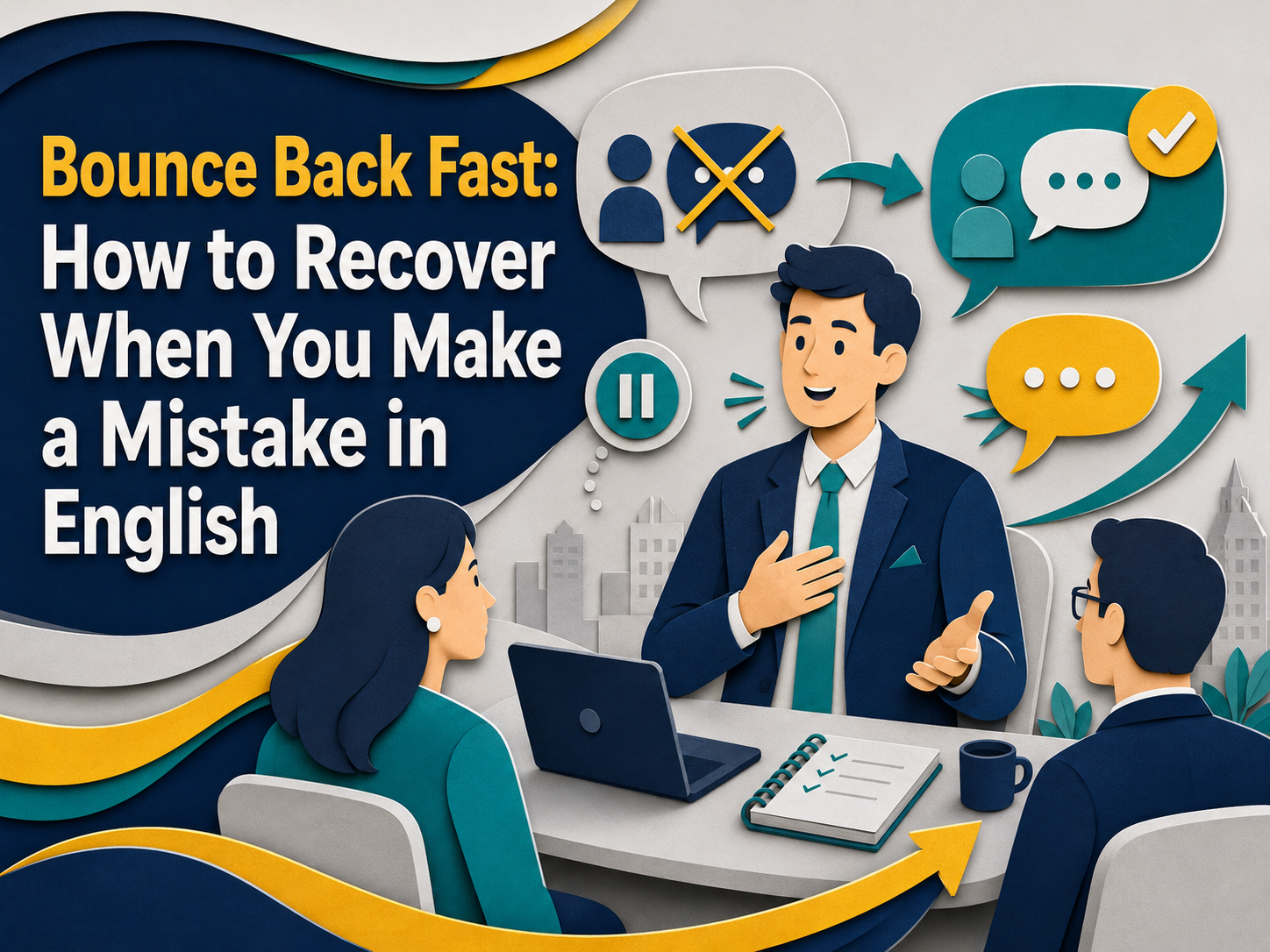
Bounce Back Fast: How to Recover When You Make a Mistake in English 🎯
Intermediate Level | June 28, 2026
Read the article aloud on your own or repeat each paragraph after your tutor.
Everyone makes mistakes when speaking English. You might use the wrong word, forget a sentence, or pronounce something in a strange way. It can feel embarrassing in the moment, especially at work. But here is the truth: one mistake does not ruin the conversation. The real skill is learning how to recover from English mistakes quickly, calmly, and naturally.
Many English learners think mistakes make them look unprofessional. That fear often causes a bigger problem: silence. You stop talking, avoid eye contact, or become so nervous that your next sentence becomes even harder. But most people are not judging you as much as you think. In fact, if you handle a mistake with confidence, you may sound even more professional.
Why Mistakes Feel Bigger Than They Are
When you make a mistake in English, your brain may treat it like a small disaster. You might think, “Oh no, everyone noticed!” or “They must think my English is terrible.” But usually, the listener is focused on your message, not your grammar. They want to understand your idea, not grade your English like a scary school exam from the underworld.
The goal is not perfect English. The goal is clear communication. If your meaning is understandable, the conversation can continue. That is why learning how to recover from English mistakes is more important than trying to avoid every mistake forever. Perfect English is nice, but calm recovery is powerful.
Step 1: Pause and Breathe
The first thing to do after a mistake is simple: pause. Take a short breath. This gives your brain a moment to reset. You do not need to rush into the next sentence like you are escaping a burning building. A small pause makes you look calm and thoughtful.
For example, if you say, “Yesterday I go to the client meeting,” you can pause and correct yourself: “Sorry—yesterday I went to the client meeting.” That small correction is enough. You do not need to apologize five times or explain your entire English-learning history. Just fix it and move on.
Step 2: Use a Recovery Phrase
Recovery phrases are short expressions that help you repair a mistake naturally. Native speakers use them all the time. Try phrases like, “Sorry, I mean…”, “Let me say that again,” or “What I meant was…” These phrases give you control of the conversation.
Imagine you are in a meeting and say, “The customer was angry because the delivery was too early.” Then you realize you meant “too late.” You can say, “Sorry, I mean the delivery was too late.” That is it. Simple. Professional. No drama. The grammar police can go back to their coffee.
Step 3: Keep Your Face and Voice Calm
Your face and voice matter. If you panic, the listener may feel uncomfortable too. But if you smile slightly, speak calmly, and continue, the moment passes quickly. People usually follow your emotional signal. If you act like the mistake is small, they will probably treat it as small too.
This is especially important in business situations. Confidence does not mean you never make mistakes. Confidence means you can stay present when something goes wrong. A calm voice says, “I can handle this.” That is a strong professional message.
Step 4: Repeat the Correct Version
One of the best ways to train your English is to repeat the corrected sentence. This helps your brain remember the better version. It also gives the listener a clear final message. Instead of only thinking about the mistake, you finish with the correct idea.
For example: “We discuss it yesterday—sorry, we discussed it yesterday, and we agreed to update the schedule.” Notice how the correction is quick and natural. You do not stop the whole conversation. You simply repair the sentence and continue forward.
Step 5: Learn One Small Lesson Afterward
After the conversation, take ten seconds to write down the mistake. Do not punish yourself. Just notice it. Maybe you used the wrong tense. Maybe you forgot a word. Maybe your sentence was too long and got messy. That small note becomes practice material for later.
This is how mistakes become useful. Every mistake gives you data. It shows you what to practice next. If you review your common mistakes and practice short corrections, you will start to recover faster. Over time, your confidence grows because you know you can handle imperfect moments.
How to Recover from English Mistakes and Stay in the Conversation
The best English speakers are not perfect. They are flexible. They know how to adjust, explain, correct, and continue. That is what real communication looks like. If you can recover from English mistakes, you will speak with more freedom and less fear.
So the next time you make a mistake, do not freeze. Pause. Breathe. Use a recovery phrase. Correct yourself if needed. Then keep going. Your mistake is not the end of the conversation. It is just a tiny bump in the road—and you, my friend, are still driving.
Vocabulary List
- Recover (verb) — To return to a normal or good condition after a problem.
Example: She recovered quickly after making a small mistake in the meeting. - Embarrassing (adjective) — Making you feel shy, ashamed, or uncomfortable.
Example: Forgetting his words during the presentation felt embarrassing. - Professional (adjective) — Showing skill, respect, and good behavior at work.
Example: She gave a professional answer even after making a mistake. - Pause (verb/noun) — To stop briefly before continuing.
Example: Take a short pause before correcting yourself. - Reset (verb) — To start again with a clearer mind or better focus.
Example: A deep breath can help you reset during a conversation. - Correction (noun) — A change that fixes a mistake.
Example: His correction was quick and natural. - Phrase (noun) — A short group of words with meaning.
Example: “What I meant was…” is a useful recovery phrase. - Panic (verb/noun) — To suddenly feel strong fear or stress.
Example: Don’t panic if you use the wrong word. - Flexible (adjective) — Able to change or adjust easily.
Example: Flexible speakers can explain their ideas in different ways. - Confidence (noun) — The feeling that you can do something well.
Example: Recovering from mistakes builds speaking confidence.
5 Questions About the Article
- Why do English mistakes often feel bigger than they really are?
- What should you do first after making a mistake?
- Name two useful recovery phrases from the article.
- Why is it important to keep your face and voice calm?
- How can writing down mistakes help you improve?
5 Open-Ended Discussion Questions
- What kind of English mistake makes you feel the most nervous?
- How do you usually react when you make a mistake while speaking?
- Which recovery phrase would feel most natural for you to use?
- How can mistakes actually help you become a better speaker?
- What is one mistake you want to practice correcting this week?
📢 Want more tips like this? 👉 Sign up for the All About English Mastery Newsletter! Click here to join us!
Want to finally Master English but don’t have the time? Mastering English for Busy Professionals is the course for you! Check it out now!
Follow our YouTube Channel @All_About_English for more great insights and tips.

 English
  한국어
한국어