

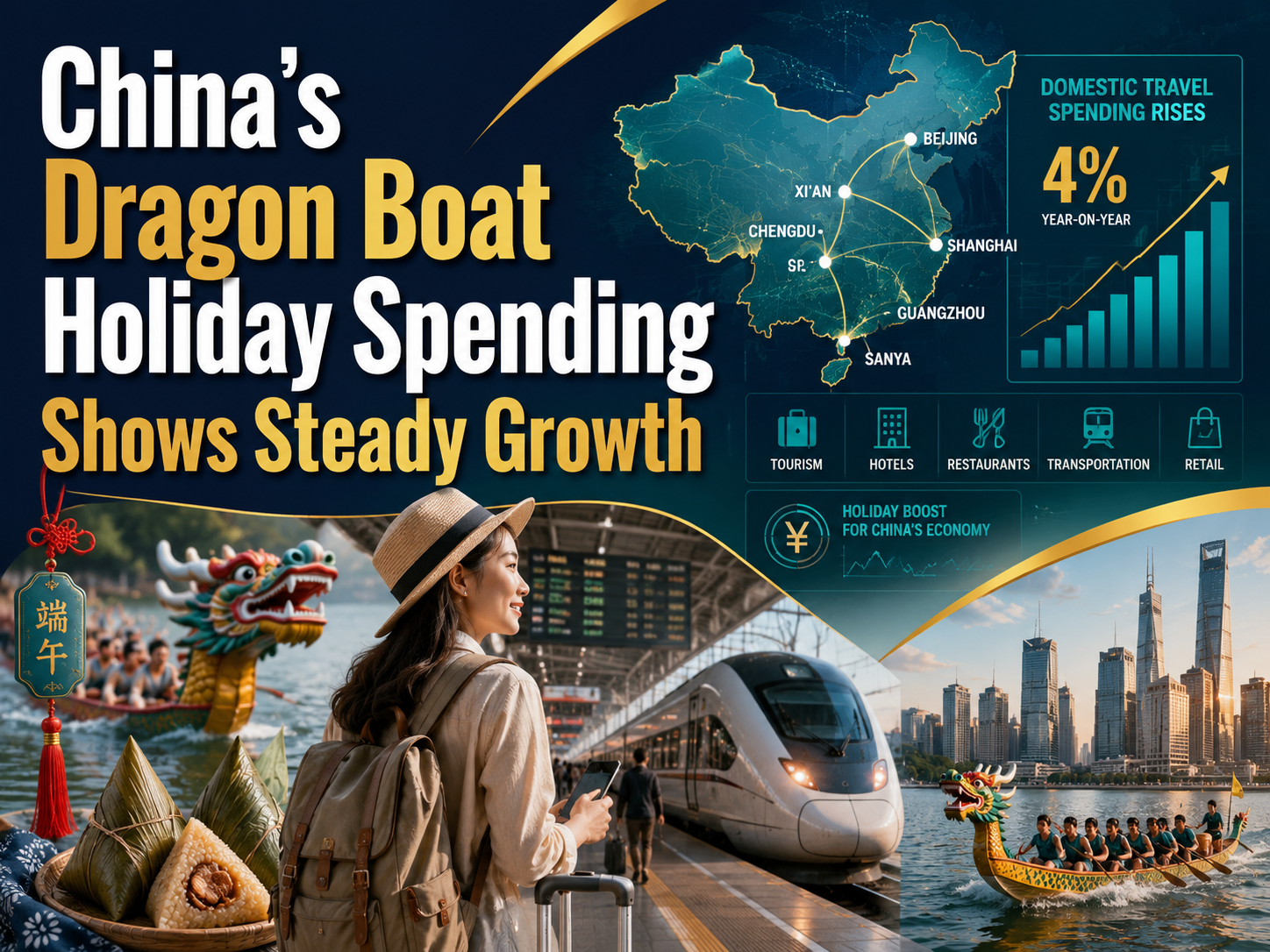
China’s Dragon Boat Holiday Spending Shows Steady Growth
Intermediate | June 28, 2026
✨ Read the article aloud on your own or repeat each paragraph after your tutor.
China Dragon Boat Holiday Spending Rises During Summer Travel Season
China’s Dragon Boat Festival holiday gave the country’s tourism industry a small but important boost. According to Reuters, domestic tourism spending during the three-day holiday reached 44.5 billion yuan, or about $6.57 billion. That was a 4% increase compared with the same holiday last year. The holiday ran from June 19 to June 21, 2026, giving many people a short break to travel, visit family, and enjoy local events. (Reuters)
More Trips, More Spending, But Still Careful Consumers
China’s Ministry of Culture and Tourism said people made 124 million domestic trips during the holiday. That was up 4.4% year on year. In plain English, more people were traveling, and total spending also went up. For China’s economy, that is a good sign. Tourism is one way to measure whether people feel confident enough to spend money. Still, the increase was not huge. It suggests that consumers are moving around again, but many are still watching their budgets carefully. That is the real “fine print” behind the good news.
Why This Matters for China’s Economy
The China Dragon Boat holiday spending numbers matter because China has been trying to support domestic demand. When people travel, they spend money on hotels, restaurants, train tickets, souvenirs, and local attractions. That helps small businesses and local governments. But when spending grows only a little, it can also show that families are still cautious. In business terms, the holiday was a positive signal, but not exactly a fireworks show.
Cross-Border Travel Also Increased
The holiday also brought more international movement. A separate Reuters report said China recorded 6.7 million entries and exits by Chinese and foreign travelers during the festival period. That was 12.9% higher than a year earlier. China also saw a 16% increase in inbound and outbound ships, trains, and vehicles, reaching 305,000 movements during the holiday. These numbers suggest that travel connections between China and the outside world are becoming more active again. (Reuters)
A Traditional Festival with Modern Economic Meaning
The Dragon Boat Festival is not just about money. It is a traditional Chinese holiday with more than 2,000 years of history. It is often connected to the ancient poet Qu Yuan. People celebrate with dragon boat races, family gatherings, and zongzi, a sticky rice dumpling wrapped in leaves. In modern China, however, holidays like this also become important economic signals. They show how much people are willing to travel and spend. (AP News)
What English Learners Can Take Away
This story is useful for English learners because it combines business, travel, culture, and economics. You can use phrases like “spending rose,” “domestic trips increased,” “consumer confidence,” and “year-on-year growth” in business conversations. The China Dragon Boat holiday spending story also gives you a natural way to talk about how holidays affect the economy. It is a good reminder that culture and business often move together — sometimes in the same boat, literally.
Vocabulary
- Domestic (adjective) – happening inside one country.
Example: “China reported 124 million domestic trips during the holiday.” - Tourism spending (noun) – money spent by travelers on hotels, food, transport, and activities.
Example: “Tourism spending reached 44.5 billion yuan.” - Year on year (adverb phrase) – compared with the same time last year.
Example: “Domestic trips rose 4.4% year on year.” - Boost (noun) – an increase or improvement.
Example: “The holiday gave tourism a small boost.” - Consumer confidence (noun) – how willing people are to spend money.
Example: “Travel spending can show consumer confidence.” - Cross-border (adjective) – involving movement between countries or regions.
Example: “Cross-border travel increased during the festival.” - Entry and exit (noun phrase) – a record of people entering or leaving a country.
Example: “China processed 6.7 million entries and exits.” - Cautious (adjective) – careful, especially with money or decisions.
Example: “Many consumers are still cautious about spending.” - Festival (noun) – a special public celebration or holiday.
Example: “The Dragon Boat Festival is an important traditional holiday.” - Economic signal (noun phrase) – information that shows how the economy may be doing.
Example: “Holiday travel can be an economic signal.”
Discussion Questions About the Article
- How much did China’s domestic tourism spending reach during the Dragon Boat Festival holiday?
- How many domestic trips were made during the three-day holiday?
- Why are holiday travel numbers important for understanding China’s economy?
- What happened to cross-border travel during the holiday?
- What traditional activities are connected to the Dragon Boat Festival?
Discussion Questions About the Topic
- Do holidays usually make people spend more money in your country?
- What kind of travel do people prefer during short holidays?
- Why might people travel more but still spend carefully?
- How can traditional festivals help local businesses?
- What holiday in your country has a big effect on travel or shopping?
Related Idiom
“A shot in the arm” – something that gives help, energy, or support.
Example: “The rise in Dragon Boat holiday travel was a shot in the arm for China’s tourism industry.”
📢 Want more practical English through real news stories? Sign up for the All About English Mastery Newsletter here: allaboutenglishmastery.com/newsletter
Want to build stronger English in less time? Check out Mastering English for Busy Professionals.
Follow our YouTube channel @All_About_English for more English tips and practice.
This article was inspired by: Reuters, Reuters, AP News, and China Government/Xinhua


 English
  한국어
한국어