

South Korea and China Look for Closer Cooperation
Intermediate | June 28, 2026
✨ Read the article aloud on your own or repeat each paragraph after your tutor.
South Korea-China Cooperation Gets a New Push in Dalian
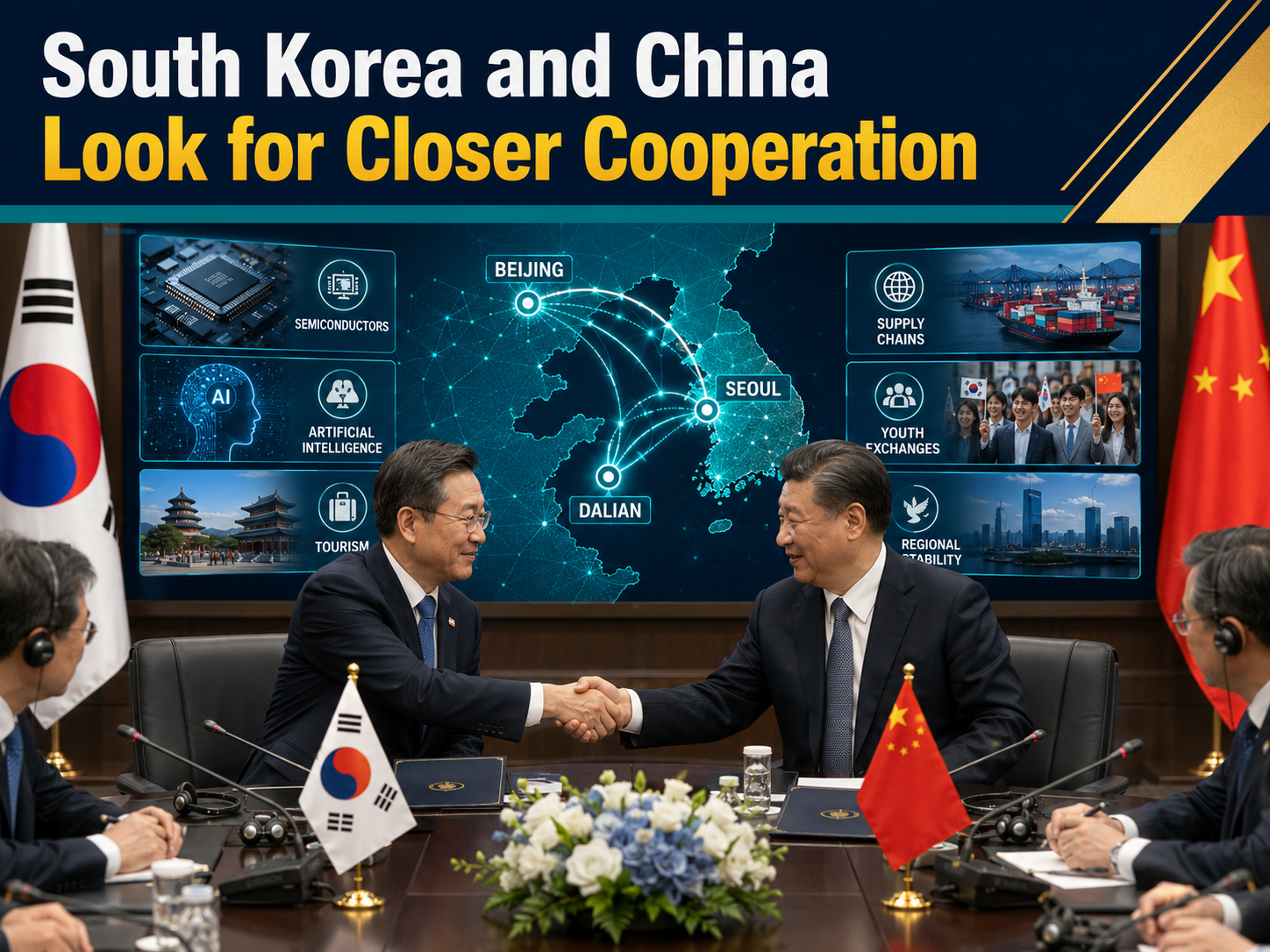
South Korean Prime Minister Kim Min-seok met Chinese Premier Li Qiang in Dalian, China, on June 23, 2026, during the World Economic Forum’s Summer Davos meeting. According to The Korea Herald and Yonhap, the two leaders agreed to work toward improving relations and expanding cooperation between South Korea and China. The meeting focused on politics, the economy, culture, youth exchanges, technology, and regional stability. (The Korea Herald, Yonhap)
First Prime Minister-Level Talks Since 2019
This meeting was important because it was the first prime minister-level meeting between the two countries since 2019. That may sound like a boring diplomatic detail, but in international relations, face-to-face meetings matter. They help leaders rebuild trust, clear up misunderstandings, and keep communication channels open. Kim said the two countries should take their exchanges “to the next level” in politics, the economy, culture, and youth cooperation. In business terms, they were trying to get the relationship back on track. (Yonhap)
Why South Korea-China Cooperation Matters
The South Korea-China cooperation story matters because both countries are deeply connected economically. China is a major trading partner for South Korea, and South Korean companies depend on stable supply chains, strong exports, and steady regional relations. At the same time, Seoul must balance its relationship with Beijing while also keeping close ties with the United States and other partners. That is not exactly a walk in the park — more like juggling coffee cups on a moving train.
Technology, Trade, and Supply Chains
Premier Li said China and South Korea have “huge untapped potential” in trade cooperation. China’s official account of the meeting said the two sides discussed expanding cooperation in semiconductors, artificial intelligence, new energy, and biomedicine. These are not small side topics. They are key industries for the future economy. South Korea is strong in chips, batteries, shipbuilding, and advanced manufacturing. China is a huge market with major industrial power. If both sides can cooperate without too much political friction, businesses in both countries could benefit. (China’s Diplomacy/Xinhua)
Saemangeum, Tourism, and People-to-People Exchanges
The talks also included practical economic ideas. Yonhap reported that Kim asked for an early visit by a Chinese delegation to explore possible investment in South Korea’s Saemangeum project, a large development area in the southwest of the country. The project aims to become a hub for artificial intelligence, robotics, and hydrogen industries. Kim also said South Korea would extend its temporary visa waiver program for Chinese short-term travelers until December 2026, instead of ending it in late June. That move could help tourism and make travel easier between the two countries. (Yonhap)
Regional Stability and Future Dialogue
Kim also asked China to play a constructive role in creating conditions for dialogue involving North Korea and the wider region. KBS World reported that Kim wanted stronger exchanges not only in politics and business, but also among young people and in advanced technology. Li said China was open to building more trust with South Korea and expanding cooperation under the guidance of both countries’ leaders. Both sides used careful diplomatic language, of course — because diplomats never say, “Let’s just stop making this weird.” But the message was clear: both countries want a more stable relationship. (KBS World)
What English Learners Can Take Away
This story is useful for English learners because it gives you strong business and diplomacy vocabulary. You can use phrases like “bilateral relations,” “strategic partnership,” “supply chains,” “high-level talks,” and “economic cooperation” in professional conversations. The South Korea-China cooperation story is also a good example of how countries try to balance business interests, security concerns, and regional relationships at the same time. In real life, cooperation is rarely simple — but it is often necessary.
Vocabulary
- Bilateral (adjective) – involving two countries or groups.
Example: “The leaders discussed bilateral cooperation.” - Cooperation (noun) – working together toward a shared goal.
Example: “South Korea and China discussed closer cooperation.” - Strategic partnership (noun phrase) – an important long-term relationship between countries or organizations.
Example: “The two sides talked about strengthening their strategic partnership.” - Exchange (noun) – the sharing of people, ideas, goods, or culture.
Example: “Kim called for more youth exchanges between the two countries.” - Supply chain (noun) – the system that moves products, parts, and materials from producers to customers.
Example: “Stable supply chains are important for technology companies.” - Delegation (noun) – a group sent to represent a country, company, or organization.
Example: “Kim asked for a Chinese delegation to visit Saemangeum.” - Investment (noun) – money put into a project or business to help it grow.
Example: “The Saemangeum project could attract foreign investment.” - Regional stability (noun phrase) – peace and predictability in a specific area of the world.
Example: “Both countries said they wanted regional stability.” - Visa waiver (noun phrase) – permission to enter a country without a visa for a short time.
Example: “South Korea extended its visa waiver program for Chinese travelers.” - Constructive (adjective) – helpful and focused on solving problems.
Example: “Kim asked China to play a constructive role in regional dialogue.”
Discussion Questions About the Article
- Where did Prime Minister Kim Min-seok and Premier Li Qiang meet?
- Why was this meeting important for South Korea-China relations?
- What areas of cooperation did the two leaders discuss?
- Why is the Saemangeum project important in this story?
- How could the visa waiver extension affect travel between South Korea and China?
Discussion Questions About the Topic
- Why do countries need regular high-level meetings?
- How can business cooperation improve political relationships?
- What challenges can happen when two countries are economic partners but also strategic competitors?
- Why are supply chains important for countries like South Korea and China?
- Do you think youth exchanges can improve long-term relations between countries? Why or why not?
Related Idiom
“Get back on track” – to return to the right direction after a delay, problem, or difficult period.
Example: “The meeting in Dalian may help South Korea and China get their relationship back on track.”
📢 Want more practical English through real news stories? Sign up for the All About English Mastery Newsletter here: allaboutenglishmastery.com/newsletter
Want to build stronger English in less time? Check out Mastering English for Busy Professionals.
Follow our YouTube channel @All_About_English for more English tips and practice.
This article was inspired by: The Korea Herald, Yonhap, Yonhap, KBS World, China’s Diplomacy/Xinhua, and World Economic Forum


 English
  한국어
한국어