

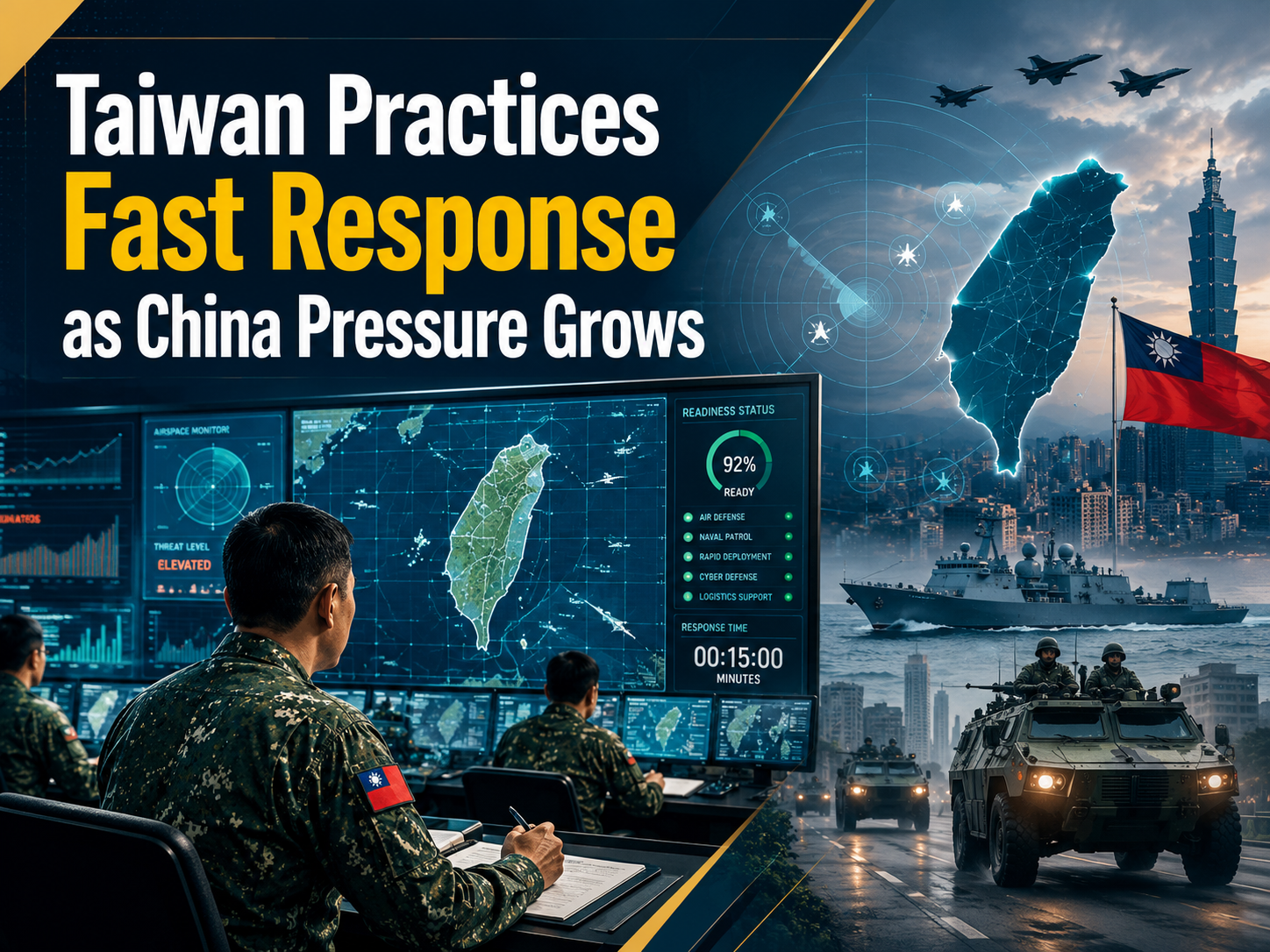
Taiwan Practices Fast Response as China Pressure Grows
Advanced | June 29, 2026
✨ Read the article aloud on your own or repeat each paragraph after your tutor.
Taiwan Combat Readiness Drills Focus on Realistic Defense
Taiwan’s military began a five-day combat readiness exercise in late June to test how quickly its armed forces could respond to a sudden threat. According to Reuters, Taiwan’s defense ministry said the “Immediate Combat Readiness Exercise” would run from Monday to Friday and would focus on more realistic war training instead of carefully planned public demonstrations.
Why the Taiwan Combat Readiness Drills Matter
The Taiwan combat readiness drills come at a tense time. China claims Taiwan as its own territory, while Taiwan’s government rejects Beijing’s claim. Taiwan says Chinese aircraft and ships regularly operate around the island to pressure Taipei. On the same day Taiwan announced the drills, its defense ministry said China had sent 21 military aircraft near Taiwan, including J-16 fighter jets, KJ-500 early warning aircraft, and Y-20 aerial refueling aircraft. Nineteen of those aircraft reportedly flew southwest of Taiwan and into the Western Pacific for long-distance training. That is not exactly a peaceful Sunday stroll.
Training for a Sudden Shift from Peace to War
One important part of the exercise is the idea that China could suddenly turn a routine military drill into a real attack. Taiwan’s military said the goal was to train units “at all levels” to understand combat practices and the battlefield environment during the readiness deployment phase. The drills used actual troops, actual terrain, real-time action, and actual equipment, which means Taiwan wanted the training to feel closer to reality and less like a scripted performance.
Tanks on the Streets and a Clear Message
The Associated Press reported that tanks and armored vehicles were seen on streets and highways in Taoyuan, a city that is home to Taiwan’s largest international airport. The Army’s 269th Infantry Brigade conducted combat readiness patrols there. This kind of training sends a clear message: Taiwan wants its military units to move quickly, coordinate clearly, and respond before a crisis gets out of hand.
Grey-Zone Pressure and Faster Decisions
AP also noted that the drills were designed to prepare for possible escalation from Chinese grey-zone tactics. Grey-zone tactics are aggressive actions that stop short of open war, such as navy patrols, drone flights, coast guard pressure, or repeated military movements near Taiwan. These tactics can create confusion because they are serious, but they are not always direct combat. In business terms, Taiwan is trying to improve its crisis workflow before the “project” turns into a full-blown disaster. Not every problem gives you a polite calendar invite.
Taiwan Says Warning Time Is Getting Shorter
A few days after the drills began, Taiwan Defense Minister Wellington Koo told reporters that Taiwan needed to test whether it could respond immediately because the warning time for a possible Chinese attack is becoming shorter. Reuters reported that Koo said the drills were meant to build the speed needed to move from peacetime to wartime status. Taiwan also recently used its U.S.-made HIMARS rocket system in military exercises, and its larger annual Han Kuang war games are expected later in the year.
The Bigger Picture for the Region
China criticized the drills, saying Taiwan’s ruling party was trying to seek independence by force. Beijing also repeated that it would not rule out the use of force. Taiwan, meanwhile, says it is strengthening its defenses to protect its democratic system and prepare for real threats. For English learners, this story is useful because it includes important international relations vocabulary: readiness, escalation, deterrence, sovereignty, and modernization. It also shows how countries use drills not only to practice, but also to send messages.
Vocabulary
- Combat readiness (noun) – the ability to fight or respond quickly in a military situation.
Example: “Taiwan tested its combat readiness during the five-day drill.” - Exercise (noun) – a planned practice activity, especially for the military.
Example: “The military exercise ran from Monday to Friday.” - Deployment (noun) – the movement of troops or equipment into position.
Example: “The drill tested rapid deployment across Taiwan.” - Escalation (noun) – when a situation becomes more serious or dangerous.
Example: “Taiwan prepared for a sudden escalation near the island.” - Grey-zone tactics (noun) – aggressive actions below the level of open war.
Example: “Drone flights and coast guard patrols can be grey-zone tactics.” - Sovereignty (noun) – the authority of a government over its own territory.
Example: “China says Taiwan is part of its sovereignty claim.” - Modernization (noun) – the process of updating systems, equipment, or methods.
Example: “Taiwan’s military modernization includes more realistic training.” - Joint operations (noun) – military actions involving different branches working together.
Example: “The drills focused on improving joint operations.” - Logistical sustainment (noun) – the ability to supply troops with food, fuel, weapons, and support.
Example: “Logistical sustainment is important during long military operations.” - Deterrence (noun) – preventing an attack by showing strength or readiness.
Example: “Taiwan hopes stronger defense will improve deterrence.”
Discussion Questions (About the Article)
- What was the main purpose of Taiwan’s five-day combat readiness exercise?
- Why is Taiwan focusing on more realistic military training?
- What did China do near Taiwan around the time the drills were announced?
- Why are grey-zone tactics difficult to respond to?
- What did Taiwan Defense Minister Wellington Koo say about warning time?
Discussion Questions (About the Topic)
- Should small countries or territories invest heavily in defense if they face a larger neighbor?
- How can military drills help prevent war instead of causing it?
- What is the difference between preparing for conflict and provoking conflict?
- How should businesses prepare for sudden crises in a similar way?
- What role should allies play when a region faces rising military tension?
Related Idiom
“Better safe than sorry” – it is wiser to prepare early than regret being unprepared later.
Example: “Taiwan’s combat readiness drills show a ‘better safe than sorry’ approach to national defense.”
📢 Want more practical English through real news stories? Sign up for the All About English Mastery Newsletter here: allaboutenglishmastery.com/newsletter
Want to build stronger English in less time? Check out Mastering English for Busy Professionals.
Follow our YouTube channel @All_About_English for more English tips and practice.
This article was inspired by: Reuters, Reuters, AP News, and Taiwan News


 English
  한국어
한국어